Click to Call
Best Public Space Brand Activations That Move
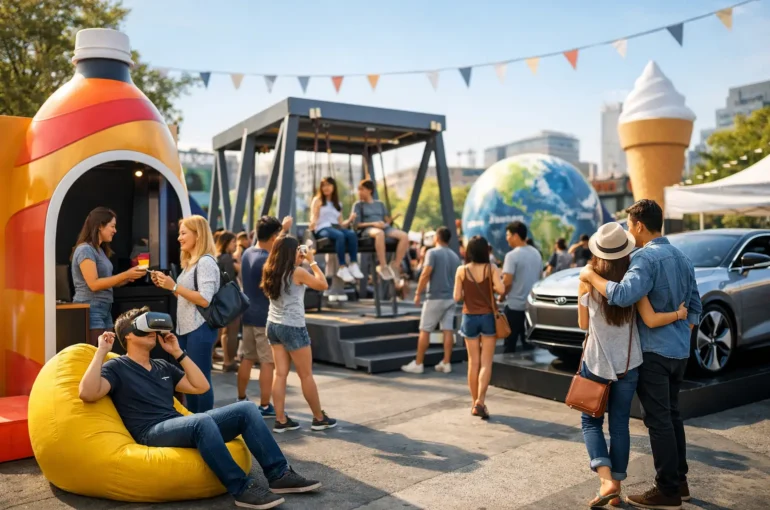
A crowded precinct gives brands only a few seconds to earn attention. People are crossing roads, lining up for coffee, heading into a stadium or moving between shops. The best public space brand activations do not wait quietly for that attention. They place a clear, memorable message directly in the path of high-value audiences, then repeat it where and when it matters.
For Australian brands, the opportunity is bigger than putting a logo in a busy place. Public space activation works when the format, location, timing and message operate as one campaign. Get those elements right and a street, forecourt, retail strip or event perimeter becomes a live media channel that people see, photograph and remember.
What makes a public space activation work?
A strong activation creates useful interruption. It is visible enough to stop the eye, simple enough to understand at a glance and relevant to the environment around it. A digital mobile billboard outside a concert venue can build anticipation before doors open. An Event Screen can turn a community event into a branded gathering point. Bike boards can put an offer directly through dense pedestrian zones where larger vehicles are not the right fit.
The key is not novelty for novelty’s sake. A giant prop or elaborate build may attract a crowd, but it can also consume budget, create operational complexity and deliver little repeated exposure beyond a single moment. Mobile formats offer a different advantage: they can move between audience hotspots, build frequency across the day and respond to real conditions on the ground.
That flexibility matters when foot traffic shifts, weather changes or an event programme runs late. A fixed placement stays where it is. Mobile outdoor media lets a campaign follow the audience.
Start with the audience moment, not the format
The most effective campaigns begin by identifying the moment you want to own. Is your audience commuting into the CBD? Meeting friends at a dining precinct? Driving past retail centres on a Saturday? Arriving at a sporting event? Each moment calls for a different approach.
A property developer promoting a new release may need consistent visibility around growth corridors and key local retail areas. A hospitality venue may want high-frequency exposure near offices on Thursday and Friday afternoons. A national product launch may require coordinated activity across Sydney, Melbourne, Brisbane and regional centres, with local route planning that still delivers one consistent brand message.
Before choosing a screen, trailer or vehicle, answer three practical questions: who needs to see it, where are they naturally concentrated, and what should they do next? That final question shapes the creative. If the goal is awareness, lead with a distinctive visual and a short brand line. If the goal is immediate action, use a single offer, clear location cue or easy-to-read QR code. Trying to communicate five messages in a passing glance is a reliable way to communicate none.
Choose a format that matches the environment
Digital mobile billboards for reach and repetition
Digital mobile billboards are built for campaigns that need scale, movement and flexible scheduling. They work particularly well around traffic corridors, CBD routes, retail precincts, entertainment districts and event approaches. Dynamic creative also gives campaign managers room to rotate messages by daypart, promote a countdown or keep a multi-location launch feeling current.
The trade-off is creative discipline. Movement and bright screens already command attention, so the artwork should not fight the format. Use strong contrast, large type and one central idea. A detailed poster that works on a laptop screen will not necessarily work from a car, footpath or bus stop.
Event screens for dwell time
When people are staying in one place, Event Screen 8 and Event Screen 16 units can do more than deliver an ad impression. They can provide event information, sponsor visibility, entertainment and a focal point for a crowd. This makes them suited to sports days, festivals, outdoor cinemas, community gatherings, university activations and branded experiences.
Here, the campaign needs to earn its place in the event. A screen that helps audiences find a schedule, watch live content or follow a result becomes part of the experience. The sponsor message then benefits from attention that is invited rather than forced.
Solar ad trailers for location ownership
Solar ad trailers suit campaigns that need a visible, self-contained presence at a site for an extended period. Think sales suites, display villages, event entrances, regional promotions or areas where conventional billboard inventory is limited. They create a strong visual marker without requiring a permanent structure.
They are not the answer to every brief. If the audience moves through several locations in a day, a trailer may be less efficient than a mobile route. But where the objective is to own one strategic location, the format delivers a clear physical footprint.
Bike boards and walking boards for close-range impact
Some of the best activation opportunities sit in places where vehicles cannot operate effectively: busy shopping strips, markets, waterfronts, campuses and pedestrian event zones. Digital bike boards, bike boards and walking boards put branded messages at human scale and close to decision points.
These formats are especially useful for sampling support, retail openings, app downloads and hospitality promotions. They allow campaign teams to build presence through tightly packed areas while keeping the message visible to people already on foot. The creative should be bold and brief, because engagement happens at close range and often in motion.
Build repetition into the route plan
One sighting can create awareness. Repeated sightings create familiarity, and familiarity gives a campaign more chance of being recalled when a customer is ready to act. That is why route planning is a core part of public space activation, not a back-office detail.
Map the locations where your audience gathers across a full day. Morning commuter routes may differ from lunchtime retail traffic, which may differ again from the evening entertainment crowd. A campaign can use those shifts to maintain visibility rather than spending its full budget in one area at one time.
Frequency should be purposeful, not random. Revisit priority precincts, circle event approaches and place the message near relevant retail or venue locations. For a multi-city campaign, use the same core creative and campaign objective while adapting routes to each market. What works around Melbourne’s inner-city commuter flow may need a different deployment pattern in Perth, Adelaide or the Gold Coast.
Mobile Outdoor Media supports national execution with local knowledge, helping brands coordinate campaigns across Australian states without turning each city into a separate media-buying exercise.
Design for a three-second decision
Outdoor creative has to work fast. A person should understand the brand and the message before the vehicle has passed or the crowd has moved on. Start with the strongest visual asset, then add a short headline and one action. If a logo is small, an offer is buried or the phone number is impossible to read, the campaign is making the audience work too hard.
Digital formats can rotate several frames, but that does not mean every frame should carry a new idea. Repetition is useful. A simple sequence can build recognition: brand, product benefit, offer, then brand again. Keep key information consistent across every frame so viewers who see only one still receive the message.
Campaign managers should also consider the physical context. Bright colours can perform differently in full sun than they do after dark. Fine lines and low-contrast imagery disappear at distance. Production specifications exist for a reason: use them early, before artwork reaches final approval and print or screen deadlines get tight.
Make event activation useful, not intrusive
Public spaces are shared spaces. The campaigns people respond to best tend to add energy, information or a genuine point of interest without blocking access or overwhelming the setting. This is where operational planning earns its value.
Check site requirements, council conditions, event organiser rules, safe access and timing well before launch. Some locations welcome high-impact visual activity; others have restrictions around vehicle access, operating hours, sound or placement. A smart campaign works within those parameters rather than discovering them on the day.
Staffing also affects the outcome. If a walking board team is supporting a promotion, they need a clear route, consistent presentation and a simple answer to the most likely customer question. If a screen is part of an event, someone should know who controls the content schedule and what happens if programming changes. The public sees the finished experience, but dependable activation is built behind the scenes.
Measure what the campaign was built to achieve
Not every public space activation should be judged by the same metric. A brand launch may be measured through reach, location coverage and repeated exposure. A retail push may track redemption, QR scans, web traffic or changes in footfall. An event sponsor may look at attendance, screen time, social content and lead capture.
Set the measurement approach before the campaign goes live. Use unique offer codes or dedicated landing pages where direct response matters. Record routes, operating times and key locations so activity can be reviewed against the plan. For live events, capture quality photos and video that show both the format and the audience context. Those assets are useful for reporting, internal buy-in and future campaign planning.
The strongest public space activation is rarely the one with the most moving parts. It is the one that puts a sharp message in front of the right people, often enough to stick, and gives them a reason to take the next step. Take your message to the streets with a format and route plan built for the audience you want to win.
Related reading: Event Screen Hire Australia: The 2026 Guide
Planning an activation and not sure which format fits the space? Talk to our team.