Click to Call
Mobile Display Advertising Australia: The 2026 Reference Guide
Did you know that digital formats now command over 76% of all outdoor advertising revenue across Australia? You’ve likely felt the sting of rising social media CPMs and the rigid, eye-watering costs of fixed roadside billboards that simply don’t move with your audience. It’s frustrating to watch your budget disappear into digital noise while high-traffic pedestrian zones remain out of reach for traditional media. A robust mobile out of home advertising strategy is no longer a luxury for big brands; it’s a tactical necessity for any business that wants to be seen where it actually matters in 2026.
We understand that you need more than just a presence; you need to dominate the street level with precision and speed. This comprehensive guide will show you how to master the Australian mobile outdoor media landscape using high-impact, flexible assets that go exactly where your customers are. You’ll gain a clear framework for choosing the right mobile equipment and learn how to plan routes that guarantee maximum exposure.
We’ll also provide the hard data and growth projections you need to justify your OOH spend in a competitive 2026 marketing budget. From solar-powered trailers to digital bike boards, it’s time to stop waiting for customers to find you and start taking your message directly to them. We’ve built this reference guide to ensure your brand doesn’t just join the conversation, but leads it on every corner.
Key Takeaways
- Discover why shifting from fixed roadside sites to HD LED mobile assets is the most cost-effective way to dominate high-traffic zones in 2026.
- Learn how to build a high-impact mobile out of home advertising strategy that combines the reach of Digital Mobile Billboards with the 24/7 visibility of Solar Ad Trailers.
- Identify the best street-level assets, such as Digital Bike Boards and Walking Boards, to bypass vehicle congestion and engage pedestrians in busy CBDs.
- Understand the psychological power of motion in outdoor media and how it effectively combats digital ad fatigue and “banner blindness.”
- Get a practical framework for selecting the right asset mix to intercept your competitor’s audience with geographic precision.
Defining the Mobile Display Advertising Landscape in 2026
Mobile display advertising isn’t just a sign on a truck; it’s a high-impact, non-fixed media asset designed to hunt for your audience. In 2026, the industry has moved well beyond static vinyl wraps. High-definition LED screens are now the national standard, offering a level of brightness and clarity that fixed signage struggles to match. A successful mobile out of home advertising strategy relies on this ability to move where the people are, bypassing the “dead zones” that plague traditional roadside billboards. You’re targeting the right eyes at the right time, rather than hoping they drive past a specific pole.
This mobility makes it the ultimate solution for a modern Australian marketing mix. While fixed sites are stuck in one spot, mobile units are constantly travelling to high-traffic zones, ensuring your brand stays relevant throughout the day. It’s a proactive approach that fits perfectly into an omnichannel strategy, providing a physical touchpoint that complements digital campaigns. By integrating with broader media buys, mobile outdoor assets provide the frequency and reach necessary to break through the clutter of 2026’s crowded advertising environment.
The Shift from Static to Dynamic OOH
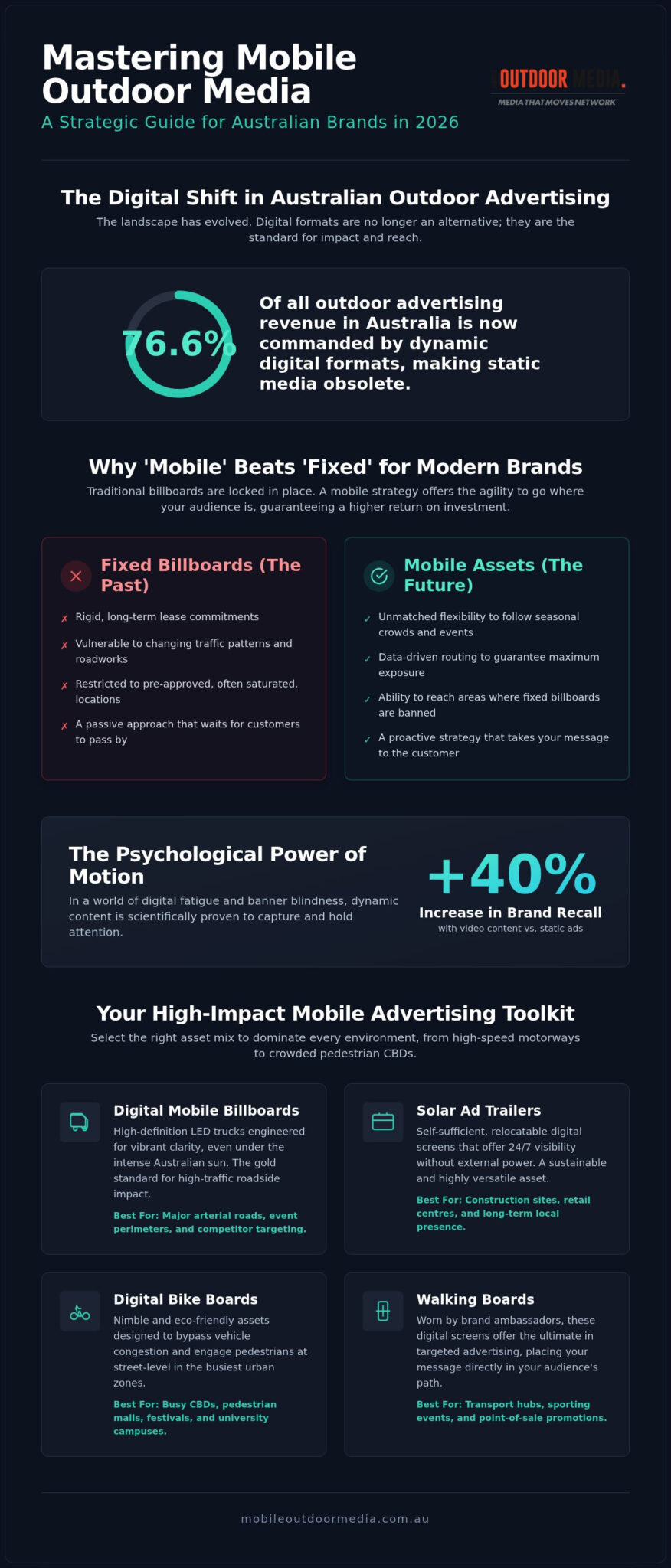
Digital Out-of-Home (DOOH) revenue hit a massive 76.6% share of the Australian market in 2025. This growth is driven by the transition to dynamic content. You’re no longer restricted to a single, unchangeable message for the duration of a campaign. 2026 technology allows for real-time creative updates based on live triggers like weather changes or event results. Digital Mobile Billboards now use data-driven route planning to ensure maximum impact. This precision allows brands to integrate campaigns with mobile device retargeting, catching an eye at the street level and following up on a smartphone seconds later.
Why ‘Mobile’ Beats ‘Fixed’ for Modern Australian Brands
Fixed billboards often come with rigid, long-term lease commitments that don’t always pay off. If the traffic patterns change or roadworks divert your audience, your investment stays stuck. Mobile assets eliminate this risk. You have the power to follow seasonal crowds to national events or beachfronts without being locked into an underperforming location. This flexibility is vital for maintaining a high ROI.
Mobility also allows you to reach areas where fixed billboards are restricted or simply non-existent. You can deploy Relocatable Billboards to intercept your competitor’s audience directly or dominate transit hubs during peak periods. Unlike traditional Out-of-home advertising, which waits for the customer to find it, mobile media takes the message directly to the street. It’s a more aggressive, results-oriented way to manage your 2026 marketing budget and ensure your mobile out of home advertising strategy delivers actual results.
Core Formats: From Digital Billboard Trucks to Solar Trailers
Selecting the right hardware is the most critical phase of a mobile out of home advertising strategy. You can’t rely on a one-size-fits-all approach when the Australian market is so diverse. From high-speed transit corridors to regional construction sites, the format you choose dictates your campaign’s effectiveness. In 2026, brands are moving away from the limitations of fixed infrastructure and embracing a fleet-based approach that offers both scale and agility. It’s about matching the asset to the environment to ensure your message isn’t just seen, but remembered.
Digital Mobile Billboards: High-Definition Impact
These assets are the gold standard for high-traffic roadside impact. Our digital mobile billboards use high-resolution LED technology specifically engineered to remain vibrant under the intense Australian sun. It isn’t just about brightness; the real power lies in motion. Video content and moving graphics on these screens can increase brand recall by up to 40%, a figure that makes them indispensable for fast-moving roadside audiences. It’s a level of engagement that static signs simply can’t compete with in a crowded media environment where every second of attention counts.
Sustainable Solar Powered Advertising Trailers
Sustainability has transitioned from a buzzword to a mandatory requirement for 2026 brands. Solar Ad Trailers are the preferred choice for eco-conscious organisations because they offer 24/7 visibility while operating entirely independently of the power grid. They’re perfect for long-term site branding, remote community events, or maintaining 24-hour awareness in suburban zones. Because they run on clean energy, they align perfectly with the corporate social responsibility goals often seen in major Australian Government advertising campaigns. For a deeper dive into these assets, refer to our Solar Powered Advertising Trailers Guide to see how they fit into a green media plan.
Beyond the roadside, we deploy specialised equipment like Event Screen 8 and Event Screen 16 for large-scale public gatherings. These screens transform open spaces into immersive brand experiences, providing the visual gravity needed for festivals or product launches. For construction sites or brands entering a new territory, Relocatable Billboards provide a semi-permanent presence without the burden of a long-term lease. This diverse mix of assets ensures your message is never static and always positioned for success. If you’re looking to dominate your next target zone, you should check our current equipment availability to secure your dates.
Street-Level Engagement: Bike Boards and Walking Boards
Large-scale digital trucks are unbeatable for arterial roads, but a truly effective mobile out of home advertising strategy must penetrate the heart of the city. You can’t park a semi-trailer in a crowded pedestrian mall or a narrow beachfront alley. This is where street-level assets become your most effective tactical weapon. By bypassing vehicle traffic, you intercept pedestrians in busy CBDs, transit hubs, and beachfronts where fixed signage is often restricted or non-existent. These agile units create a “guerrilla” presence that generates immediate buzz in high-density areas that trucks simply cannot access. It’s about being present where the foot traffic is heaviest and the engagement is highest.
The Power of Digital Bike Boards
Digital Bike Boards represent the ultimate blend of agility and high-definition technology. They target narrow lanes, event queues, and pedestrian malls with surgical precision. Unlike a static roadside poster, the movement of a digital display at eye level triggers an immediate “stop and stare” reaction from passers-by. According to the IAB Australia 2026 Report, agency investment in programmatic digital-out-of-home continues to surge because brands demand this level of flexibility and measurable street-level engagement. You can discover how digital bike board advertising can activate urban audiences by placing your creative directly in the visual path of your target demographic. For budget-conscious campaigns, standard Bike Boards still offer incredible reach in coastal areas and suburban centres.
Walking Boards for Brand Activation
Walking Boards take the concept of high-visibility signage and add a critical human element. This isn’t just about a display; it’s about personal brand activation and direct engagement. These assets are perfect for grand openings, product sampling, or time-sensitive campaigns requiring a direct call-to-action. When you organise walking board teams for maximum street-level saturation, you’re not just showing an ad; you’re creating a tangible brand presence. This human-centric approach allows for a level of interaction and trust that a digital screen alone cannot replicate. It’s the most direct way to drive foot traffic into a store or sign-ups at a local event.
By integrating these street-level assets into your national campaign, you ensure that no part of the Australian landscape is off-limits. Whether it’s a high-energy music festival or a busy metropolitan train station, these formats allow your brand to move with the crowd. They provide the final, personal touchpoint that bridges the gap between large-scale awareness and local action.
Fixed billboards often become part of the scenery. Commuters who drive the same route daily develop “banner blindness;” they effectively tune out static messages after the third or fourth pass. A dynamic mobile out of home advertising strategy shatters this habit by introducing unexpected movement into the visual environment. Humans are hardwired to notice motion; it’s a primal psychological response. When a high-definition Digital Mobile Billboard enters an audience’s field of vision, it resets their attention and forces engagement.
This format also offers geographic precision that fixed sites simply can’t match. You can intercept your competitor’s audience right at their doorstep or dominate a specific shopping precinct during peak trading hours. In 2026, the ROI for mobile display is becoming increasingly difficult to ignore. With premium digital OOH CPMs typically ranging from A$25 to A$45, it remains significantly more cost-effective than the rising costs of traditional TV or radio spots. Those traditional channels often struggle with audience fragmentation and high entry costs that don’t guarantee the same level of physical presence.
Audience Interception and Route Planning
Effective campaigns aren’t left to chance. We use data-driven mapping to plan routes based on high-traffic times and specific demographic clusters. This allows for “hyper-local” targeting on a national scale. By positioning assets near major event centres or busy transport hubs, you ensure your message is delivered when the audience is most receptive. Flexibility is the key here; if a particular route isn’t delivering the expected eye-balls, we can adjust the path in hours. To understand the full framework behind this approach, our guide to mobile billboard route planning for high-impact exposure covers exactly how to match your vehicle’s movement to the daily rhythm of your target audience. This speed is vital for brands that need to react to sudden market shifts or short-term promotional opportunities.
Creative Versatility in 2026
Modern hardware allows you to move far beyond static images. You can now deploy full-motion video, animation, and even real-time social feeds to keep your content fresh. The secret to success lies in designing for a 3-second “glance time.” You don’t have long to make an impression, so your creative must be punchy, high-contrast, and feature a bold Australian call-to-action. Implementing a mobile out of home advertising strategy gives you the creative canvas to experiment with different messages across different locations. Whether you’re using Solar Ad Trailers for 24/7 visibility or agile bike boards, the goal is immediate message retention and a clear path to conversion.
Implementing a High-Impact National Strategy
A successful mobile out of home advertising strategy begins with a clear objective. You need to decide if you’re chasing broad brand awareness, driving direct response for a retail offer, or providing tactical event support. In 2026, the most effective national campaigns don’t just pick one asset; they build a layered ecosystem. This might mean using Digital Mobile Billboards for high-reach arterial roads while deploying Digital Bike Boards to saturate pedestrian zones during a product launch. By aligning your asset mix with specific geographic goals, you ensure your budget works harder across every Australian territory.
Execution at this scale requires navigating a complex regulatory landscape. Each state and local council has specific rules regarding mobile signage and transit times. You don’t want your campaign stalled by compliance issues or safety oversights. A professional national rollout handles these logistics behind the scenes, ensuring your message stays on the road and out of legal trouble. It’s about combining aggressive market entry with the operational precision required for long-term success.
Measuring results has also evolved. In 2026, we look beyond simple impressions to track social media “lift” and physical foot traffic increases. By monitoring how a street-level activation correlates with digital search volume or store visits, you gain a transparent view of your ROI. This data is essential for justifying OOH spend in a marketing environment that demands accountability. With the Australian outdoor market projected to grow at an annual rate of 10.1% through to 2033, the brands that master these measurement frameworks now will be the ones that dominate the next decade.
The Mobile Outdoor Media Advantage
We provide a “straight-talking” Australian approach to national media. You get access to a massive national inventory of digital and solar assets, backed by professional drivers and well-maintained equipment. We don’t just provide the hardware; we provide the expertise to ensure it’s positioned for maximum impact. Whether it’s your first campaign or your fiftieth, you need a partner who understands the pacy, campaign-based nature of the Australian market and can deliver results without the fluff.
Next Steps for Your 2026 Campaign
Timing is everything. To execute a high-impact rollout, you should brief your provider at least six to eight weeks in advance, especially when targeting peak seasonal traffic or major national events. Start by identifying your “must-win” zones and let the data dictate your mobile billboard route planning decisions. When you’re ready to move beyond the limitations of fixed billboards and digital ad fatigue, it’s time to put your brand in motion.
Dominate the Australian Streets in 2026
The Australian media landscape has shifted. Relying on fixed billboards is no longer enough to cut through the noise of 2026. You’ve seen how dynamic movement, solar-powered sustainability, and street-level agility can transform a standard campaign into a high-performance mobile out of home advertising strategy. By combining durable, high-resolution LED technology with expert strategic route planning, you ensure your message doesn’t just sit there; it hunts for your audience.
We provide a massive national inventory of digital and solar assets designed to withstand the harsh sun while delivering crystal-clear visuals. Whether you’re activating a CBD with bike boards or dominating a highway with relocatable billboards, the goal remains the same: maximum impact without the rigid constraints of traditional media. It’s time to stop letting your budget fade into the background and start taking your brand directly to the people who matter.
Your next national success story starts with a single move. We’re ready to help you lead the market and stay ahead of the competition with results that speak for themselves.
Frequently Asked Questions
How much does mobile display advertising cost in Australia?
Costs vary based on the format, duration, and the national scope of your campaign. Unlike fixed billboards that require long-term lease commitments, mobile assets offer better flexibility with daily or weekly rates. Factors influencing the total investment include the type of equipment used, such as high-definition LED trucks or solar trailers, and specific route requirements. Committing to longer campaign durations often leads to significant cost savings compared to short, one-off activations.
Is digital mobile billboard advertising effective for small businesses?
Digital mobile billboards are highly effective for small businesses because they allow for hyper-local targeting without the massive overhead of national TV spots. You can deploy a single unit to dominate a local precinct or a grand opening, ensuring your budget is spent exactly where your customers live and work. This agility makes it easier to compete with larger brands by intercepting their audience at the street level with high-impact, professional visuals.
Can mobile billboards operate in any weather condition?
Our national fleet is engineered to withstand the harsh Australian climate, from intense summer heat to heavy rain. High-resolution LED screens are designed with high-brightness capabilities to ensure your creative remains visible even in direct midday sun. Weatherproofing is a standard feature of professional mobile outdoor assets, allowing your campaign to continue running reliably regardless of the conditions. This durability ensures your mobile out of home advertising strategy stays on track year-round.
How do you measure the ROI of a mobile billboard campaign?
ROI is measured through a combination of impression data, GPS tracking, and digital lift. We track exactly where the asset travelled and correlate that data with increases in website traffic, social media engagement, or physical store visits. In 2026, many brands use unique QR codes or specific landing pages on their creative to capture direct response data. This transparency allows you to see the tangible impact of your outdoor spend on your bottom line.
Do I need special permits for mobile advertising in Australia?
Navigating permits and local council regulations is a core part of a professional national rollout. While specific requirements vary between states and local government areas, we handle the compliance and operational logistics to ensure your campaign runs without interruption. It’s vital to work with a provider who understands the Australian regulatory landscape to avoid fines or forced shutdowns. We ensure all assets meet safety standards and transit regulations for every planned route.
What is the best route for a mobile billboard to take?
The best route depends entirely on your target demographic’s daily habits and high-traffic times. We use strategic route planning to map paths that pass through busy shopping hubs, transit corridors, and major event precincts during peak periods. Instead of staying on one road, your asset moves with the crowd to ensure maximum frequency and reach. This data-driven approach ensures your message is delivered when and where your audience is most receptive and ready to act.
How long does it take to get a mobile advertising campaign live?
Most campaigns can be live within two to three weeks once the creative assets are finalised and the route is approved. This speed is a major advantage over traditional media, which often requires months of lead time and rigid booking cycles. For national rollouts or major events, we recommend briefing your provider six to eight weeks in advance to secure specific equipment and ensure all operational logistics are perfectly aligned for your start date.
Can I update the creative on a digital billboard during a campaign?
Yes, one of the biggest benefits of digital technology is the ability to update your creative in real-time. You can change your message based on the time of day, weather triggers, or specific campaign milestones without any additional printing costs. This flexibility is a cornerstone of a modern mobile out of home advertising strategy, allowing you to keep your content fresh and react instantly to market changes or competitor moves across the country.