Click to Call
Outdoor Screen Rental for Festivals: The Ultimate 2026 Planning Checklist
What is the point of investing in a massive visual display if your audience can’t see a single frame through the midday Australian sun? When you’re managing a major event, a technical glitch isn’t just an inconvenience. It’s a direct hit to your sponsor ROI and the crowd’s energy. Securing the right outdoor screen rental for festivals means more than just booking a display. It’s about ensuring visibility, safety, and reliability in a high-pressure environment.
Organising a festival is a logistical minefield where wind safety, generator noise, and power reliability can make or break your reputation. You’ve got one shot to get the visuals right. This guide ensures you master the logistics of festival screen hire with a focus on high-impact, trailer-mounted technology. We’ve built a comprehensive 2026 planning checklist designed for event organisers who demand seamless technical execution and zero excuses. You’ll learn how to eliminate glare, secure your site against the elements, and use live feeds to drive maximum audience engagement across the entire festival grounds.
Key Takeaways
- Understand why LED technology is the only viable choice for daylight visibility and how it outperforms projection in high-ambient light environments.
- Master the “sweet spot” calculation for viewing distances to ensure every punter has a clear view, regardless of where they stand in the field.
- Simplify your site logistics by identifying the exact power requirements and safety protocols needed for a secure outdoor screen rental for festivals.
- Boost your event’s ROI by using digital ad loops and live feeds to increase sponsor visibility and keep the crowd engaged from the front row to the back fence.
- Learn the importance of choosing a national partner with the infrastructure to provide on-site technical support and rapid deployment across any Australian location.
Understanding the Festival Environment: LED vs. Projection Screens
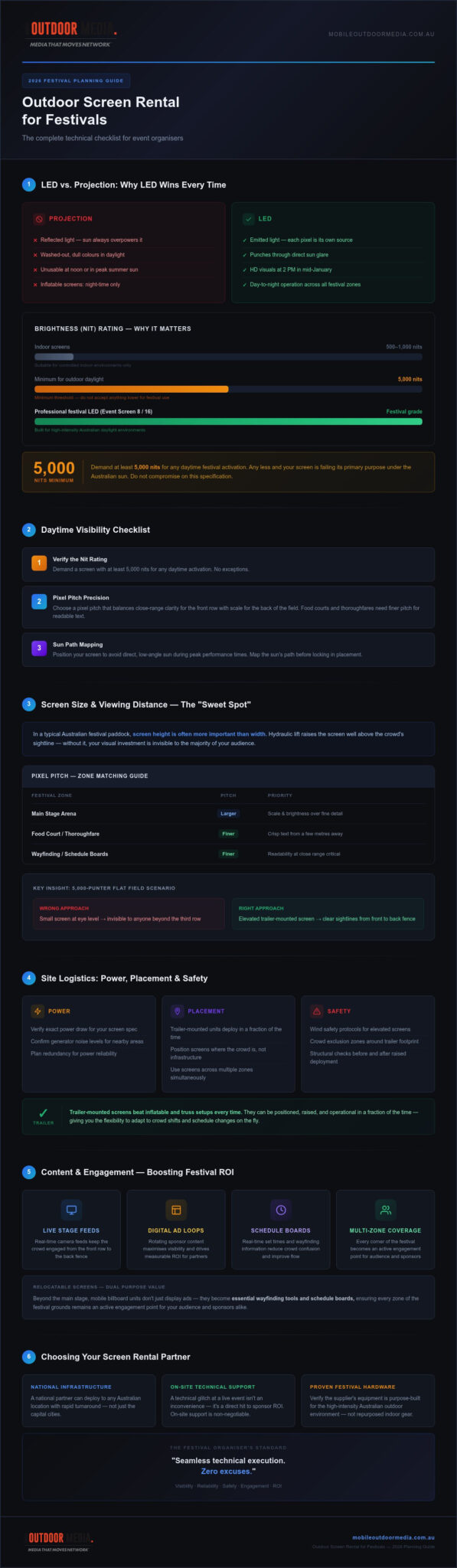
Ambient light is the absolute enemy of a successful event. If you’ve ever tried to watch a projector in a sun-drenched backyard, you’ve seen the problem first-hand. The image looks washed out, the colours are dull, and the message is lost. For any outdoor screen rental for festivals, clarity isn’t a luxury. It’s a requirement. If your crowd can’t see the stage feed or the sponsor’s logo, the equipment is failing its primary purpose.
The technical gap between projection and LED comes down to how light reaches the eye. Projection is reflected light. A bulb hits a surface, and that light bounces back to the viewer. The Australian sun is far more powerful than any festival-grade projector; the sun always wins. LED screens use emitted light. Each individual pixel is its own light source, allowing the screen to punch through direct glare with aggressive brightness. This is the only way to maintain high-definition visuals during a 2 PM set in mid-January.
To ensure your content stays visible, you must check the “nit” rating. A nit is a measurement of luminance. For indoor use, 500 to 1000 nits is plenty. For a festival screen to survive the Australian daylight, you need a minimum of 5000 nits. Professional hardware like our Event Screen 8 or Event Screen 16 is built specifically for this high-intensity environment. While inflatable projection screens might work for a night-time cinema, they’re useless for a multi-day music festival that starts at noon.
The Daytime Visibility Checklist
- Verify the Nit Rating: Demand a screen with at least 5000 nits for any daytime activation.
- Pixel Pitch Precision: Choose a pixel pitch that balances clarity for the front row with scale for the back of the field.
- Sun Path Mapping: Position your screen to avoid direct, low-angle sun during peak performance times.
Mobility and Placement Flexibility
Festivals are dynamic environments. A static, fixed screen limits your ability to adapt to crowd shifts or schedule changes. When comparing setup times, a trailer-mounted outdoor screen rental for festivals beats an inflatable setup every time. These units can be positioned, raised, and operational in a fraction of the time it takes to rig a truss or inflate a frame. You need to be where the people are, not just where the infrastructure allows you to be.
Beyond the main stage, relocatable billboard advertising serves as a functional hub for your site. These units don’t just display ads; they become essential wayfinding tools and schedule boards. By using high-impact, mobile screens across different zones, you ensure that every corner of the festival grounds remains an active engagement point for your audience and sponsors alike. For a comprehensive look at how mobile signage for events can follow foot traffic and command attention across your entire site, our 2026 guide covers the latest digital billboard and solar-powered solutions available across Australia.
The Essential Screen Size and Viewing Distance Checklist
Choosing the right screen size isn’t just about guest count. It’s a calculation of geometry. Many organisers make the mistake of picking a screen based solely on their expected attendance. If you have 5,000 punters in a flat field, a small screen at eye level is useless to anyone behind the third row. When securing an outdoor screen rental for festivals, you must prioritise screen height and pixel pitch to ensure every ticket holder gets a clear view of the action.
The “Sweet Spot” for viewing depends heavily on pixel pitch, which is the distance between the centres of two pixels. A smaller pitch means higher resolution at close range. For a massive festival arena, you don’t necessarily need the ultra-fine pitch used in corporate boardrooms. You need scale. However, if the screen is placed in a high-traffic thoroughfare or food court, a finer pitch ensures that text, such as menus or set times, remains crisp from only a few metres away. It’s about matching the technical specs to the specific crowd dynamics of each zone.
In a typical Australian festival paddock, screen height is often more important than width. Our trailer-mounted screens can be raised significantly above ground level. This elevation is what allows the content to clear the heads of the crowd, reaching people at the very back of the site. Without this hydraulic lift, your visual investment is effectively invisible to the majority of your audience. High-impact visibility requires getting the bottom of the screen well above the sightline of the standing crowd. For a detailed breakdown of how portable display models compare on these exact specifications, our guide to LED trailer screen hire for 2026 events walks through each option side by side.
Comparing Event Screen 8 and Event Screen 16
Your choice of hardware should depend on the specific zone of your event. The Event Screen 8 is our versatile workhorse, perfect for entry gates, boutique stages, or as a dedicated schedule board in high-traffic areas. It provides high impact without overwhelming smaller spaces. For the main arena or live stage broadcasts, the Digital Screen 16 is the industry standard. This 16sqm display is designed specifically for massive crowds, offering the scale required to make every punter feel like they’re in the front row.
Resolution and Aspect Ratio Requirements
Content creators must design for a standard 16:9 aspect ratio to avoid awkward cropping or stretching on the day. When your outdoor screen rental for festivals is used for safety announcements or emergency schedules, text legibility becomes the absolute priority. Use high-contrast colours and avoid thin, decorative fonts that disappear in the harsh Australian daylight. All video files should be delivered in high-definition formats to maintain professional standards across the entire site. If you’re currently mapping out your 2026 site plan, talk to our technical team to ensure your screen placement is optimised for maximum impact.
Site Logistics: Managing Power, Placement, and Safety
Logistics can’t be an afterthought. When you’re coordinating an outdoor screen rental for festivals, the physical placement and power requirements dictate your entire technical success. Unlike fixed infrastructure, trailer-mounted units offer incredible mobility, but they still require precise site preparation. You need to account for turning circles, ground stability, and clear access routes before the first bumper hits the grass. A 16sqm screen on a heavy-duty trailer isn’t something you can simply “manhandle” into position at the last minute.
Site access is the first hurdle. Our mobile units are designed for rapid deployment, but they require firm, level ground to operate safely. If your festival site is prone to mud or has soft, sandy patches, you’ll need to plan for track mats or specific entry points. Always verify the dimensions of your chosen screen trailer against the narrowest gate or tightest turn on your site map. Pre-empting these movement constraints prevents costly delays during the high-pressure bump-in period.
Power is the heartbeat of your visual display. While smaller signage might run on standard 10A or 15A circuits, high-impact event screens typically demand 3-phase power. If you’re relying on site generators, ensure they’re positioned far enough away to manage noise without causing significant voltage drop over long cable runs. For remote zones where running hundreds of metres of heavy-gauge cable is impractical, Digital Solar Outdoor Signage provides a “set and forget” solution that eliminates the need for external power altogether.
The Festival Power Checklist
- Source Proximity: Identify the nearest 3-phase outlet and measure the exact cable run required.
- Cable Protection: Use heavy-duty cable ramps for any lines crossing pedestrian thoroughfares or vehicle tracks.
- Generator Redundancy: Ensure your power plan includes a backup or “hot swap” capability for mission-critical broadcasts.
Safety and Wind Load Planning
Australian weather is notoriously unpredictable. A large LED display acts like a giant sail; without proper planning, high winds can turn a professional asset into a major liability. Every outdoor screen rental for festivals must come with a certified wind rating. Our screens are engineered to withstand significant gusts, but safety protocols are non-negotiable. You must have a clearly defined “wind-action plan” that dictates exactly when a screen should be lowered or de-rigged based on real-time weather monitoring.
Structural stability goes beyond wind. Your provider should ensure all trailer-mounted units are properly levelled with outriggers and earthed to protect against electrical surges or lightning strikes. Safety isn’t just about the hardware staying upright; it’s about protecting the thousands of punters walking past it. By sticking to rigorous Australian safety standards, you protect your audience, your sponsors, and your reputation as a professional event organiser.
Content and Engagement: Boosting Festival ROI with Digital Media
A screen is a digital asset, not just a decoration. When you’re managing an outdoor screen rental for festivals, your goal is to turn that visual real estate into a high-yield revenue stream. Static vinyl banners are a thing of the past. Digital ad loops allow you to rotate multiple sponsors through a single location, multiplying your potential income without cluttering the site. It’s about delivering professional, high-definition visibility that sponsors are actually willing to pay for.
Beyond the money, screens solve the “back of the field” problem. In a massive arena, punters at the rear often feel disconnected from the stage. High-quality live feeds bridge this gap. By broadcasting the performance in real-time, you maintain the energy levels across the entire site. This keeps people on-site longer, which directly impacts food and beverage sales. You’re not just showing a video; you’re maintaining the atmosphere of the event.
Safety and communication are the final pillars of engagement. Festivals are fluid. Schedules change, and weather happens. Digital screens allow you to push real-time updates instantly. Whether it’s a set time change or a crowd control announcement, you have the power to reach every corner of the grounds in seconds. This level of responsiveness is impossible with traditional signage.
Sponsor Integration Checklist
- Standardise Ad Slots: Keep ad durations to 15 or 30 seconds to maintain a fast-paced, engaging loop that holds attention.
- Headline Takeovers: Sell “Takeover” moments where a single sponsor dominates all screens during major set transitions or headliner arrivals.
- Playback Verification: Provide sponsors with digital logs after the event to prove exactly how many times their content was displayed to the crowd.
Audience Interaction Strategies
Engagement should be a two-way street. Use QR codes displayed between sets to drive traffic to digital programmes, food ordering apps, or official merchandise stores. This reduces physical queues and improves the overall punter experience. You can even integrate social media walls that display live photos from the festival hashtag, encouraging guests to share their experience online. If things go pear-shaped, your outdoor screen rental for festivals must have the capability for immediate emergency overrides to provide clear instructions to the crowd.
Choosing Your Screen Rental Partner: Why National Expertise Matters
Choosing a partner for your outdoor screen rental for festivals is a decision that impacts every department of your event. If the screen fails, your sponsors lose visibility and your safety communications vanish. You need a partner who doesn’t just deliver gear but understands the pressure of a national touring schedule. Local providers might cover a single city; they often lack the infrastructure to support a multi-state festival circuit with consistent hardware and technical expertise. National reach ensures that whether your event is in a capital city or a remote regional paddock, the quality of the display remains identical.
Technical support shouldn’t be a phone call to a remote office. You need boots on the ground. A professional partner provides on-site technicians who can troubleshoot in real-time, ensuring that a minor signal glitch doesn’t become a headline-ruining blackout. Reliability is also a factor of fleet age. Outdated LED panels are prone to dead pixels and power issues. Always assess the quality of the fleet before signing. You want a partner who invests in modern, high-impact hardware designed specifically for the rigours of the Australian outdoor environment.
Booking timelines are the final piece of the puzzle. The peak Australian festival season sees massive demand for high-quality LED trailers. If you’re planning for 2026, you should be securing your visual assets at least six to nine months in advance. Waiting until the last minute often means settling for inferior gear or paying massive premiums for interstate transport. A proactive booking ensures your site plan is locked in and your technical requirements are fully mapped out well before the bump-in begins.
The Partner Evaluation Checklist
- National Deployment: Does the provider have the logistics network to service festivals across all Australian states?
- Mobility: Are the screens trailer-mounted for rapid relocation if the site layout needs to change?
- Technical Redundancy: What is the specific backup plan for hardware failure or signal loss during a live performance?
Finalising Your 2026 Festival Plan
Before the first truck arrives, verify that all insurance and public liability coverage is current and specific to festival environments. Review the bump-in and bump-out schedule with your provider to ensure it aligns with other site contractors. Precision at this stage prevents the chaos that often plagues large-scale events. If you’re ready to master your logistics and ensure a seamless technical execution for your next event, Contact Mobile Outdoor Media for a National Festival Quote and let’s get your 2026 planning underway.
Lock In Your 2026 Visual Strategy
Success in the 2026 festival season depends on your ability to command attention in a crowded market. You’ve seen why projection fails in the daylight and why screen height is the secret to reaching the back of the arena. High-impact visuals require hardware that can punch through the glare while remaining safe in unpredictable weather. Every decision you make during the planning phase should focus on reliability and audience engagement.
Securing a professional outdoor screen rental for festivals is an investment in your event’s reputation and bottom line. By utilising relocatable trailer-mounted assets and daylight-visible LED technology, you provide sponsors with the premium placement they demand. Don’t leave your technical execution to chance or local providers with limited gear. Our national Australian coverage means we bring the same level of expertise and reliability to every site, from metro hubs to regional paddocks.
Take control of your site’s visual impact today. Delivering a world-class experience starts with a technical partner who understands the scale of your ambition and has the infrastructure to back it up.
Frequently Asked Questions
Do outdoor LED screens work in direct sunlight?
Yes, professional LED screens are engineered to stay visible even in the harshest Australian sun. Unlike projection systems that wash out in daylight, our high-nit LED panels emit their own light at a brightness level of 5000 nits or more. This ensures your content remains crisp and legible during the peak of a summer festival. High-luminance technology is the only reliable way to maintain sponsor visibility and audience engagement during daytime hours.
What size screen do I need for a festival with 5,000 people?
A crowd of 5,000 punters typically requires a large-format display like our Event Screen 16. While guest count is a vital starting point, the layout of your site and the viewing distance are equally important factors. Elevating a 16sqm screen ensures the visuals clear the heads of a standing crowd, making the action accessible to everyone in the main arena. Proper height is often more critical than width in a flat festival field.
Can I run a festival screen off a standard 10A power point?
Most professional event screens require 3-phase power to operate safely and reliably. A standard 10A or 15A domestic power point simply cannot provide the current needed for high-intensity LED panels. When planning your outdoor screen rental for festivals, always ensure you have a dedicated 3-phase source or a high-capacity site generator. This prevents voltage drops and equipment failure that can occur when power systems are pushed beyond their limits.
How much wind can an outdoor event screen handle safely?
Our trailer-mounted screens are engineered to handle significant wind gusts, but safety protocols are always site-specific. Every screen comes with a certified wind rating that dictates the exact conditions under which the display must be lowered. A professional “wind-action plan” is a mandatory part of our logistics. This protocol ensures the safety of your audience and staff remains the priority if the Australian weather takes an unpredictable turn during the event.
Is it possible to use solar power for large festival screens?
Solar power is a highly effective solution for relocatable signage and ad trailers, though massive main-stage screens still generally require external power sources. Our solar-powered ad trailers are perfect for sustainable festivals looking to manage wayfinding and schedules in remote zones without running cables. For the largest 16sqm displays, we recommend using high-efficiency generators or 3-phase grid power to maintain the high brightness levels required for daylight visibility.
What content formats are best for outdoor LED displays?
Stick to a standard 16:9 aspect ratio and high-definition file formats like MP4 or MOV for the best results. Content should be designed with high contrast and bold text to maintain legibility in direct sunlight. Avoid thin fonts or cluttered designs that might become difficult to read from the back of a large crowd. Providing high-resolution files ensures that your sponsor logos and live feeds look professional across the entire festival site.
How long does it take to set up a trailer-mounted event screen?
One of the major benefits of a professional outdoor screen rental for festivals is the rapid deployment time. Most units are operational in under 60 minutes once positioned on site. This speed is a massive advantage for festivals with tight bump-in schedules where every minute counts. Unlike fixed truss structures that require hours of rigging, our hydraulic systems allow for a fast and secure setup. This efficiency reduces labour costs and ensures your site is ready for the first punters.
Do I need a technician on-site for the duration of the festival?
While our hardware is designed for “set and forget” reliability, having an on-site technician is recommended for complex events with live feeds. A dedicated technician manages signal switching, monitors power stability, and handles any immediate troubleshooting. This ensures your technical execution remains seamless from the opening gates until the final headliner finishes. For simpler ad loops or signage, our team provides a full induction to ensure your staff are comfortable with the basic operations.