Click to Call
2026 Guide: High-Impact Trade Show Screen Placement
Your premium booth space in the exhibition centre is a sunk cost if visitors treat your signage like background noise. In a crowded hall, static banners are effectively invisible. You’re fighting for eyes against hundreds of other brands, yet most exhibitors still rely on outdated displays that fail to stop traffic. Strategic placement of trade show advertising screens is the only way to break through that clutter and actually own the room. It isn’t just about having a screen; it’s about where it sits to command attention from the moment a lead enters the floor.
We know the frustration of paying for prime real estate only to be ignored. You need a way to turn that floor space into a lead-generating powerhouse without the logistical nightmares of a national tour. This 2026 guide shows you how to outshine competitors and capture every lead using strategic placement for trade show advertising screens. We’ll walk through identifying high-impact visual corridors, leveraging relocatable digital assets like Event Screen 16, and ensuring your setup is ready to go anywhere in Australia with zero fuss.
Key Takeaways
- Master the use of high-brightness LED displays to cut through the harsh ambient lighting of major Australian convention centres.
- Learn how to deploy strategic placement for trade show advertising screens to capture visitor attention within the first 10 metres of the hall.
- Maximise your ROI by leveraging content flexibility, allowing you to update offers in real-time without the cost of reprinting static signage.
- Match your screen dimensions to your booth footprint and discover the power of external placement to engage attendees before they step inside.
- Streamline your national event tour by partnering with specialists who manage transport, setup, and logistics across every major city in Australia.
The Evolution of Trade Show Advertising Screens in 2026
Trade show marketing has shifted. Relying on a printed backdrop and a bowl of mints won’t cut it anymore. In 2026, high-brightness LED displays have become the baseline for any brand serious about its presence. These trade show advertising screens are engineered specifically to slice through the flat, often dim ambient lighting found in major Australian exhibition halls. They provide a level of vibrancy that traditional print simply cannot match. If your booth doesn’t glow, it’s effectively invisible.
The move toward a digital-first event presence is driven by the need for speed and impact. Marketing teams no longer want to be locked into a single message for a three-day event. Digital assets allow for real-time pivots, letting you change your call-to-action based on the specific crowd or time of day. This agility is what separates the market leaders from the exhibitors who are just filling space.
Why Static Banners are Losing the Battle for Eyeballs
The phenomenon of banner blindness is a real threat to your event ROI. Attendees are bombarded with hundreds of static images as they navigate the aisles. Their brains have learned to filter out the noise, meaning your expensive pull-up banners often go completely unnoticed. Digital motion changes the equation. Industry professionals report that movement triggers a primal response in the human eye, forcing visitors to look toward the screen even if they didn’t intend to.
When you compare recall rates, the gap is massive. Digital displays offer a dynamic way to tell your brand story in seconds. Unlike static media walls, Digital Mobile Billboards and high-impact event screens allow you to rotate multiple messages or run full-motion video. This keeps your booth fresh throughout the day, ensuring your message resonates even with repeat foot traffic. It’s about being memorable in a sea of forgettable cardboard stands.
The Impact of High-Luminance LED Technology
Modern LED technology has solved the biggest headache for exhibitors: glare and wash-out. High-quality trade show advertising screens feature high-luminance output that maintains clarity even under the harshest overhead convention centre lights. This isn’t just about being bright; it’s about being sharp. It ensures your branding remains legible from the other side of the hall.
Pixel pitch is the secret to a professional presentation. In a booth environment, your audience is often standing just a couple of metres away. Fine pixel pitch ensures that your graphics look crisp and high-definition from close range, rather than looking like a blocky mess. Beyond clarity, the shift toward relocatable digital assets offers a level of flexibility that fixed displays lack. Being able to adapt your screen position based on real-time traffic flow means you can respond to the floorplan as the event evolves. This unwavering confidence in your visual setup ensures your brand remains the focal point of the hall from start to finish.
Choosing the Right Screen Size for Your Australian Campaign
Choosing the right scale for your trade show advertising screens is a tactical decision. It isn’t just about what looks impressive; it’s about what works within your allocated square metres. If you place a massive display in a small booth, you risk overwhelming the visitor. Content becomes unreadable from a close viewing distance. Conversely, a tiny screen in a major keynote area will be swallowed by the room. You need to map your screen size to the specific viewing corridors of the exhibition hall.
For most exhibitors at major centres like the ICC Sydney or MCEC, the choice comes down to the booth footprint. You want to dominate the visual corridor without encroaching on the space needed for lead capture. This is where relocatable assets provide a massive advantage. You aren’t stuck with a fixed install. You can move the display to hit the peak traffic flow as it changes throughout the day. It’s about being where the eyes are, not just where the power outlet is.
Event Screen 8 vs. Event Screen 16: Which Fits Your Space?
The Event Screen 8 is the workhorse for standard exhibition booths across Australia. It offers high-definition clarity that remains crisp even when prospects are standing just two metres away. It’s compact enough to fit into most floorplans while still providing the high-brightness LED power needed to stand out in a bright hall.
When you need to command a larger area, scaling up to an Event Screen 16 is the right move. This is the go-to choice for outdoor activation zones or massive keynote stages where your message needs to reach hundreds of people simultaneously. It turns your presence from a simple booth into a landmark within the event. These larger units are designed for high-impact visibility that anchors an entire section of the exhibition.
Mobile Billboards for External Entrance Activation
Your campaign shouldn’t start at the booth. It should start the moment your target audience arrives at the venue. Using digital mobile billboards allows you to own the commuter path leading into the trade show. By positioning these relocatable assets near venue entrances or along main access roads, you prime the audience before they even see a competitor. It builds anticipation and directs foot traffic straight to your stand.
Strategic parking is the key. Placing a mobile unit near the registration queue or the main car park exit ensures your brand is the first and last thing attendees see. This external activation creates a seamless journey from the street to your stand. To see how these mobile units drive results, you can read about how mobile LED billboard trucks increase brand recall. If you want to ensure your brand is the most visible name on the floor, you can check our current availability for your next event date.
Digital Screens vs. Static Stands: The ROI Analysis
Calculating the return on investment for your exhibition presence requires looking beyond the initial hire invoice. Static stands and pull-up banners might seem like the budget-friendly choice at first glance, but they’re often a false economy. Once a fabric wall is printed, its message is locked in. If you realise halfway through the first day that your headline isn’t resonating, you’re stuck with it. Investing in trade show advertising screens flips this script by providing a platform that works as hard as your sales team does.
The true value lies in content flexibility. In a multi-city Australian tour, the costs of reprinting, shipping, and disposing of static media walls add up quickly. Digital assets remove the need for physical storage and the inevitable landfill waste associated with one-off event signage. For a deeper dive into how these formats stack up across different environments, you can compare static vs digital mobile billboards to see which delivers the best results for your specific campaign goals.
Real-Time Content Management and A/B Testing
Agility is the defining feature of 2026 event marketing. With digital trade show advertising screens, you can pivot your messaging in seconds. Morning crowds at a trade show often have different priorities than the afternoon rush. You can run educational, high-level brand content when the hall opens and switch to aggressive, limited-time offers as the day closes. This level of A/B testing ensures you’re always showing the most effective message for the current audience.
Integrating live data and social media feeds further increases engagement. Showing real-time testimonials or a live countdown to a product demonstration creates a sense of urgency that static print can’t replicate. From a logistics perspective, choosing digital also removes the headache of coordinating heavy crates. When you work with a national partner, the screens are delivered, set up, and ready to go, allowing your team to focus on lead generation rather than wrestling with media wall frames.
Durability and Professionalism in 2026
Your booth is a physical representation of your brand’s authority. High-end LED screens signal market leadership and a commitment to innovation. Static stands are prone to visible wear; wrinkled fabric, peeling decals, and scuffed edges immediately cheapen your presentation. Digital displays maintain a clean, high-definition look from the first hour of the show to the final pack-down. This consistent quality ensures your brand remains the most professional presence in the aisle.
The “clean look” of digital isn’t just about the screen itself. It’s about the entire infrastructure. Modern relocatable billboard advertising and event screens feature integrated housing that hides cables and power units, creating a sleek, minimalist footprint. You aren’t just buying a display; you’re securing a high-performance asset that commands respect from every lead who walks past your stand.
How-To: 5 High-Impact Mobile Billboard Placement Strategies
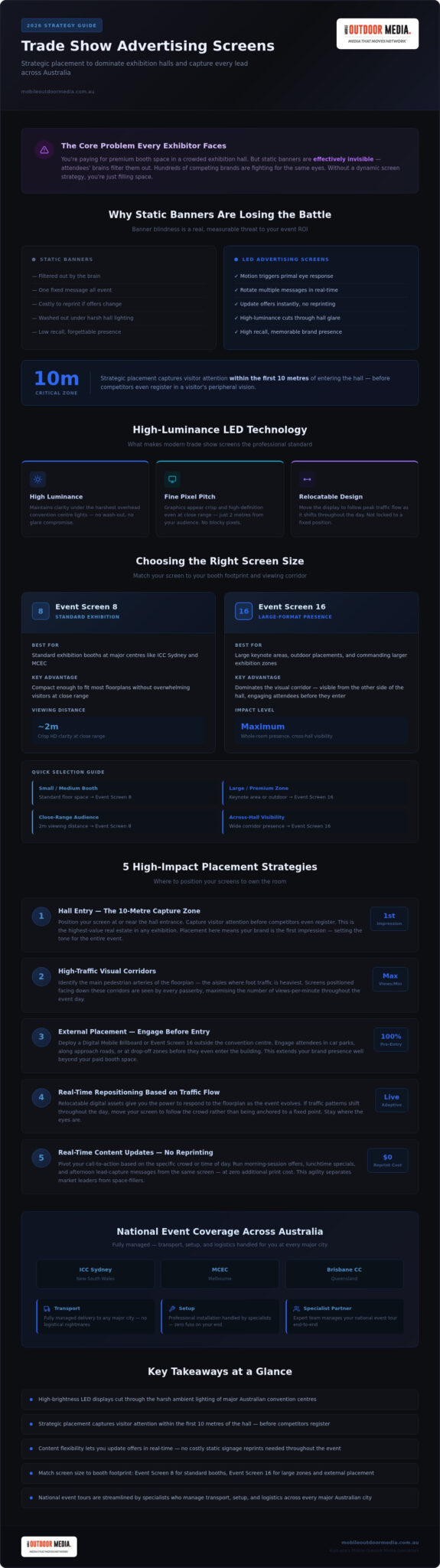
Strategic positioning is the difference between a high-performing lead magnet and expensive wallpaper. Even the most advanced trade show advertising screens fail if they’re tucked away in a visual blind spot. You need to map your assets to the natural movement of the crowd. This isn’t about hope; it’s about engineering visibility through five proven tactics.
- 1. The Threshold Strategy: Attendees make subconscious decisions about which aisles to explore within the first 10 metres of entering a hall. Place your screen at the entry point of your sector to claim early mindshare.
- 2. The Eye-Level Anchor: Most booths create a flat, horizontal line across the aisle. Break this pattern by positioning your screen vertically or using a raised relocatable structure that forces the eye to adjust.
- 3. The External Perimeter: Don’t wait for them to walk inside. Use mobile billboards to dominate the venue car park and arrival paths. It ensures your brand is the first thing they see before the “hall fatigue” sets in.
- 4. The “Social Magnet” Placement: Turn your screen into a high-definition backdrop for photos. Large-scale LED walls positioned at the back of a booth create a natural stage for social media content.
- 5. The Solar Trailer Advantage: High-dwell areas like outdoor catering and smoking zones are often overlooked. These spots are perfect for solar-powered assets that don’t require venue power.
Mastering the Internal Hall Layout
Success on the floor requires identifying high-flow corridors and avoiding dead zones where traffic stalls. Corner booths often suffer from shadowing where a larger neighbour blocks the view. You can counter this by angling your screen to catch traffic from both directions of the aisle. Use height to your advantage. A relocatable billboard structure that sits above the standard 2.4-metre booth height ensures you’re visible from three aisles away. It’s about owning the vertical space as much as the floor space.
External Activation: Owning the Arrival
Capturing leads starts at the venue boundary. Outdoor activation zones often lack the infrastructure for traditional power, making Digital Solar Outdoor Signage a critical asset. These units operate independently, allowing you to place high-brightness trade show advertising screens in car parks or near shuttle bus drop-off points. For even tighter urban spaces, digital bike boards provide last-mile advertising that follows the crowd right to the registration desk. This multi-layered approach ensures your message is inescapable.
Partnering for National Success Across Australia
Executing a trade show strategy in one city is a challenge. Coordinating that same impact across a national tour requires a different level of logistical precision. When you move your campaign from the ICC Sydney to the Brisbane Convention and Exhibition Centre, you can’t afford to worry about whether your hardware will arrive on time or if the setup meets local safety standards. Partnering with a national expert means you outsource the transport, setup, and pack-down of your trade show advertising screens to a team that understands the specific requirements of every major Australian venue.
Being Australian-owned and operated isn’t just a badge of pride; it’s a functional advantage. Local teams are across Australian safety compliance and venue-specific site inductions. This ensures your deployment is seamless and risk-free. You get a single point of contact for your entire national circuit, allowing your marketing team to focus on lead conversion rather than freight tracking. It’s about reliability at scale, ensuring your brand looks just as sharp in Perth as it did in Melbourne.
Coordinating Multi-City Exhibition Tours
Consistency is the backbone of brand authority. By centrally managing your digital content, you ensure that your messaging remains identical across every city on the tour. You can sync deployment schedules so your screens are active the moment the doors open in every state. This removes the risk of “version drift” where old creative is shown in one city while new offers run in another. For a comprehensive look at managing these large-scale deployments, you can read Digital Mobile Billboard Hire: The 2026 Guide. It covers the essential steps for scaling your impact beyond a single event.
Street-Level Synergy: Bike Boards and Walking Boards
The most successful campaigns in 2026 use a tiered approach to visibility. While large-scale event screens dominate the hall, street-level assets like Digital Bike Board Advertising capture the audience in high-traffic pedestrian zones outside the venue. These mobile units navigate busy footpaths where trailers can’t go, providing a constant brand presence near hotels and transport hubs. They act as the “scouts” that lead prospects toward your main booth.
Complementing your digital presence with Walking Board Advertising allows for direct, face-to-face engagement. These ambassadors carry your message into the heart of the crowd, bridging the gap between your high-impact trade show advertising screens and the individual prospect. By mixing massive LED power with agile street-level activation, you create a 360-degree brand environment. This integrated fleet ensures that your brand isn’t just a booth in a hall, but the dominant narrative of the entire event week.
Own the Visual Corridor at Your Next Event
Trade show success in 2026 requires more than just showing up. It’s about deploying high-brightness LED technology that commands attention from the moment visitors enter the convention centre. By mastering strategic placement and leveraging the flexibility of digital assets over static print, you transform your booth from a passive display into an active lead-generating powerhouse. You’ve seen how the right scale and the right angle can break through the noise of a crowded hall.
Don’t let the logistics of a national tour hold your brand back. Whether you’re coordinating a multi-city exhibition or a single high-impact activation, having a partner who manages the full-service setup and transport is critical. Our national Australian coverage ensures that your trade show advertising screens are delivered, positioned, and operational with zero stress for your team. We handle the heavy lifting so you can focus on closing deals.
It’s time to outshine the competition and secure your spot as the most visible brand in the hall. We’re ready to help you dominate your next event with unwavering confidence and precision.
Frequently Asked Questions
What is the best screen size for a standard trade show booth?
The Event Screen 8 is the ideal choice for standard 3m x 3m or 6m x 3m exhibition booths. It provides high-definition clarity for close-range viewing without overwhelming your floorplan. If you’re anchoring a larger keynote area or an outdoor activation zone, scaling up to an Event Screen 16 is necessary to maintain visual dominance across the hall.
Do digital advertising screens require a special power supply at the venue?
Most indoor units run on standard 10-amp or 15-amp power circuits provided by the exhibition centre. If you’re operating in an outdoor zone where infrastructure is limited, solar ad trailers are the superior choice. They operate independently of the venue grid, removing the cost and logistical hassle of arranging temporary power drops.
Can I update the content on my digital screen during the event?
You can update your content in real-time throughout the entire event duration. This flexibility allows you to pivot your messaging based on morning or afternoon traffic flows. It’s a massive advantage for brands running limited-time offers or integrating live social media feeds into their trade show advertising screens to drive higher engagement.
Are mobile billboards allowed to park outside major Australian convention centres?
Mobile billboards can be strategically positioned on public roads surrounding convention centres or in pre-arranged venue car parks. Rules vary between major hubs like Sydney’s ICC and Melbourne’s MCEC. We manage these local logistics to ensure your relocatable assets are parked legally and positioned for maximum visibility to arriving attendees.
How far in advance should I book my event screen hire for a national tour?
Secure your booking at least three to six months in advance for national tours across Australia. Major exhibition seasons see high demand for digital assets. Early booking ensures we can synchronise your fleet across multiple cities and lock in the specific units required for your campaign before the peak event calendar begins.
What is the difference between an Event Screen 8 and an Event Screen 16?
The primary difference is the physical dimensions and the intended viewing distance. The Event Screen 8 is compact and sharp for booth-level engagement where visitors are standing close. The Event Screen 16 offers double the visual area, making it the preferred choice for outdoor perimeters or massive hall anchors where you need to reach a larger crowd.
Can solar ad trailers work effectively inside an exhibition hall?
Solar ad trailers are designed for outdoor use and require direct sunlight to maintain their battery charge effectively. For indoor exhibition halls, you should rely on the Event Screen 8 or 16 models. These units are specifically built to handle the ambient lighting of convention centres while running on standard venue power supplies.
Do you provide technical support during the trade show?
We provide full-service setup, logistics management, and technical support for every deployment. Our team handles the transport and precision positioning of your trade show advertising screens across Australia. You don’t need to worry about the hardware; we ensure it’s running perfectly from the first hour of the show to the final pack-down.