Click to Call
Static vs Digital Mobile Billboards: Which Wins for Your Australian Campaign in 2026?
Did you know that digital formats now command over 76% of Australia’s total outdoor advertising revenue? While the shift toward screens is undeniable, many Australian brands still find themselves stuck between the high costs of fixed roadside sites and the fear of choosing an outdated medium. You want maximum brand recall without being locked into a single, expensive location for months on end. We understand that tracking ROI in outdoor media can feel like guesswork, especially when your budget is on the line.
Deciding between static vs digital mobile billboards is the most critical choice you’ll make for your 2026 strategy. This article promises to clarify which format suits your specific budget and campaign goals, ensuring you get the flexibility to move your ads where the crowds actually are. We will compare the “always-on” repetition of static units against the surgical precision of digital displays, giving you a clear roadmap to dominate the Australian market and maximise every dollar spent.
Key Takeaways
- Master the choice between “always-on” repetition and high-impact LED agility to dominate high-traffic Australian zones.
- Compare the ROI and CPM of static vs digital mobile billboards to stop wasting budget on fixed roadside sites that underperform.
- Learn why digital assets offer instant creative deployment while static mobile billboards provide unmatched long-term brand recall.
- Use our 5-point checklist to select the right format based on your specific campaign duration and local council regulations.
- Leverage GPS tracking and nationwide coverage to ensure your message hits the right audience at the right time.
The Evolution of Mobile Outdoor Advertising in Australia
The Australian advertising market is changing fast. Fixed roadside billboards, once the kings of the highway, are increasingly being tuned out by daily commuters. To capture real attention in 2026, brands are turning to mobile outdoor media as a high-impact alternative. This isn’t just about putting a poster on a truck; it’s about strategic movement and surgical targeting. Whether it’s a massive LED screen at a Sydney festival or a fleet of bike boards in Melbourne’s CBD, mobile assets offer a level of agility that fixed steel frames simply can’t match. We don’t just put your brand on the road; we put it exactly where your customers are standing.
A Mobile billboard provides a versatile solution for businesses that are tired of being stuck in one spot. By taking the message directly to high-traffic zones, brands can bypass the limitations of geography and local council zoning that often restrict new fixed sites. In an era where consumer attention is the primary currency, being where the people are is no longer optional; it’s a necessity for survival. The battle for eyes has moved from the static roadside to the dynamic streets, and understanding the choice between static vs digital mobile billboards is the first step toward winning that war.
Why “Mobile” Beats “Fixed” in 2026
The era of rigid, long-term contracts for a single roadside spot is over. Australian brands now demand flexibility. Fixed billboards suffer from “ad blindness” because they quickly become part of the permanent scenery. Mobile assets break this pattern. They move with the crowd, appearing at major sporting events, shopping centres, or transit hubs exactly when the audience is largest. You aren’t waiting for customers to drive past your sign; you’re driving your sign to your customers. This proactive approach ensures your message remains fresh and impossible to ignore. It’s about dominating the space, not just occupying it.
The Core Difference: Static vs Digital
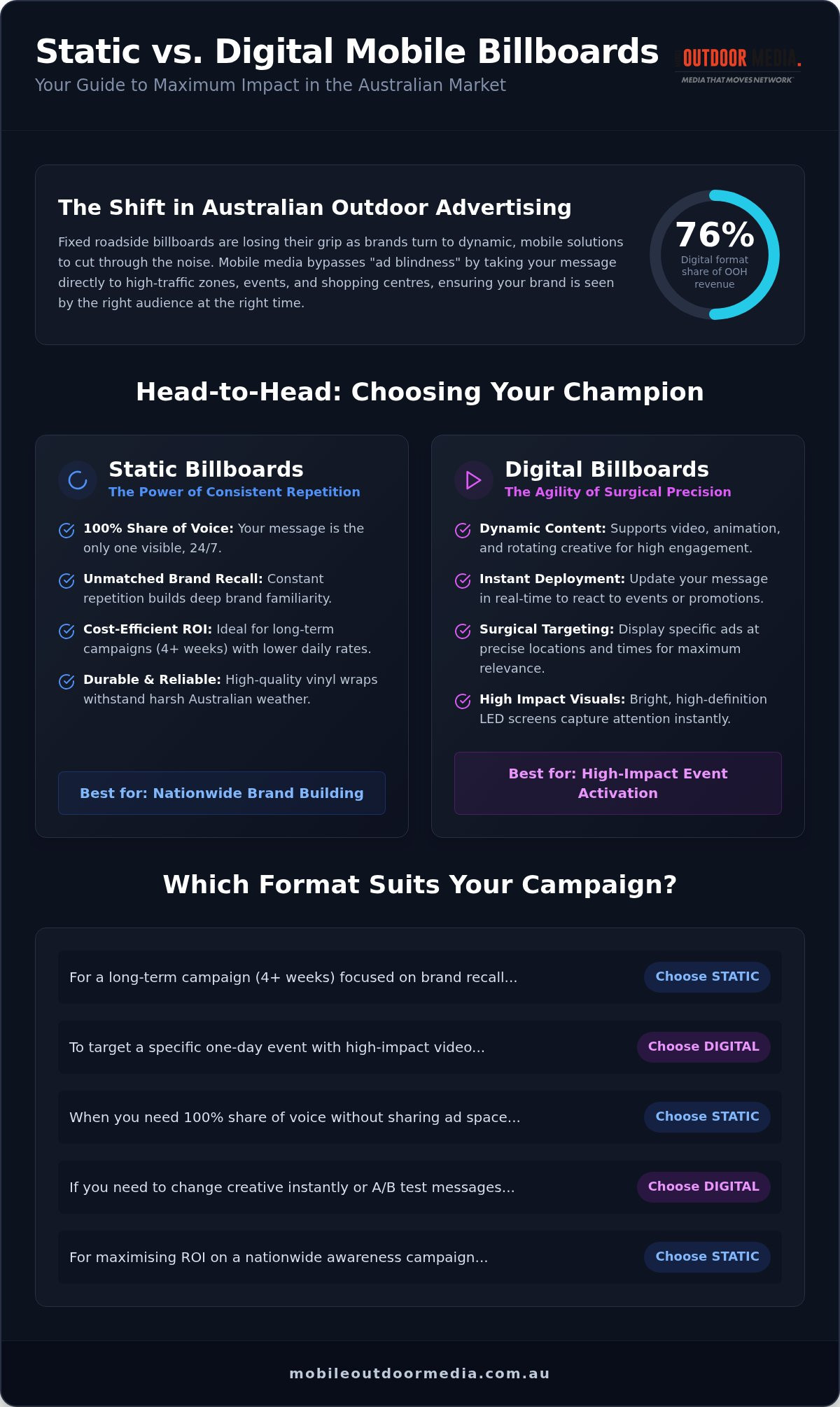
Understanding the nuances of static vs digital mobile billboards is essential for any campaign manager. Static units rely on high-quality, weather-resistant vinyl wraps that cover the entire surface of a truck or trailer. These are perfect for bold, singular messages that require constant visibility without the cost of screen time. Digital units utilise high-definition LED screens that support video, animation, and rotating creative. In the context of relocatable assets, static mobile billboards use high-impact printed vinyl wraps for consistent messaging, while digital units employ high-definition LED screens for dynamic, multi-creative campaigns. Both formats have their place in a modern strategy, but their effectiveness depends on your specific goals.
Static Mobile Billboards: The Power of Consistent Repetition
Static mobile billboards are the undisputed workhorses of the outdoor advertising world. While digital screens often grab the headlines, the printed format offers something unique: 100% share of voice. Every single second that the vehicle is on the road, your message is the only one visible. There’s no screen rotation, no waiting for a 10-second slot, and no risk of a technical glitch. When analysing static vs digital mobile billboards for a nationwide rollout, the static option wins on sheer persistence. It provides a massive, 24/7 presence that builds deep brand familiarity through relentless repetition. We don’t just put your brand on a truck; we make it part of the urban landscape.
Cost-Efficiency for Long-Term Campaigns
For campaigns running four weeks or longer, static is the gold standard for ROI. Digital billboards usually operate on a loop, which means your ad might only appear for 10 seconds every minute. With a static mobile billboard, you own the entire space for the duration of the booking. You aren’t sharing the spotlight with seven other advertisers. While there’s an initial production cost for printing high-quality vinyl, this is quickly offset by lower daily hire rates compared to high-spec LED trucks. It’s a “set and forget” strategy that delivers consistent results without the need for constant content management. Even when considering the Outdoor Media Association’s Digital Signage Policy, which sets strict rules for how digital content must transition, static remains the most straightforward way to ensure your creative is never interrupted or skipped.
High-Impact Visuals and Durability
Modern static billboards use high-tension vinyl wraps that provide a professional, sleek finish. These aren’t just posters; they’re durable, vibrant skins designed to handle the brutal Australian sun and sudden tropical downpours. This reliability makes them the perfect choice for grand openings or long-term retail awareness where you need a consistent look across a national fleet. If you want a reliable partner to handle your next big launch, our mobile billboards offer the scale and durability you need to dominate the streets. We ensure your brand looks sharp from day one to day thirty, providing a high-impact visual that demands respect from every passerby.
Digital Mobile Billboards: Agility, Engagement, and Data
Digital mobile billboards are the true disruptors of the Australian outdoor advertising space. While static units provide relentless repetition, digital assets offer a level of agility that traditional print simply can’t touch. These high-brightness LED screens are designed to command attention, cutting through the intense midday glare in cities like Brisbane or Perth. When weighing up static vs digital mobile billboards, the digital format wins on its ability to stop traffic with motion, video, and real-time updates. It’s not just an advertisement; it’s a high-definition experience that demands a second look from every passerby.
The real power of digital lies in its integration with 2026 data-driven marketing. Brands no longer have to settle for a single message for a month-long campaign. A 2024 survey found that 76% of consumers took action after seeing a digital out-of-home (DOOH) advertisement, such as searching online or making a purchase. This high conversion rate is driven by the format’s ability to stay relevant. Digital units allow for instant creative swaps, meaning your campaign can evolve as quickly as the news cycle or the weather. It’s about being reactive, relevant, and impossible to ignore.
Unmatched Creative Flexibility
Day-parting is a massive advantage for Australian retailers and hospitality brands. You can promote a hearty breakfast deal during the morning commute in Sydney and switch to a cocktail special by the time the sun sets over the harbour. This surgical precision ensures you aren’t wasting impressions on the wrong audience. Digital screens also excel at creating urgency. Whether it’s a live countdown timer for a grand opening or a social media feed showing real-time customer engagement, the “wow factor” of motion keeps your brand at the forefront of the public’s mind. You can launch a campaign in hours, not days, bypassing the printing and installation lead times required for vinyl. This makes digital the ideal choice when using mobile billboards for product launches where speed-to-market and high-definition impact are non-negotiable. The same principles that make motion and brightness essential on the street apply equally when deploying trade show advertising screens to capture leads in a crowded exhibition hall.
The Rise of Solar-Powered Digital Trailers
Modern Australian brands are increasingly prioritising sustainability, making our Solar Ad Trailers a top-tier choice for 2026. These units provide sustainable 24/7 digital visibility without the need for noisy generators. This “silent” operation is a significant benefit in noise-sensitive residential areas or high-end shopping precincts where traditional trucks might be restricted. Positioning your brand on a solar-powered asset doesn’t just look good; it aligns your business with the eco-friendly values of the modern Australian consumer. It’s the perfect blend of high-tech visibility and environmental responsibility, ensuring your message is seen and respected around the clock.
Head-to-Head: ROI, Flexibility, and Audience Impact
Choosing between static vs digital mobile billboards isn’t just about the tech; it’s about the math of your campaign. When we look at the cost per thousand impressions (CPM), static units often lead for long-term saturation. Because the daily hire rate is lower and you own 100% of the screen time, the cost per eye settles significantly over a month-long run. Digital, however, offers a different kind of value. While the daily investment is higher, the novelty and brightness of LED screens often lead to higher quality engagement. People don’t just see a digital ad; they notice it. This “stopping power” is what drives the 497% average ROI seen across the Australian billboard industry.
Speed is the next major battleground. Digital wins this round comfortably. We can have your creative live across a national fleet in a matter of hours. There are no printing lead times or installation windows to navigate. Static requires a bit more foresight. You need to account for the three to five days required for high-tension vinyl printing and physical application. If your campaign is reactive or tied to a sudden market shift, digital is your only choice. If you have a planned, steady rollout, the reliability of static is unmatched.
Sustainability is also a growing concern for Australian marketing directors in 2026. Static billboards involve physical vinyl that eventually requires disposal or recycling. Digital units, while paper-free, consume significant power. This is where our solar-powered assets change the game, providing a carbon-neutral way to maintain high-definition visibility. When you book your mobile campaign with us, we help you balance these environmental factors against your specific reach requirements.
When Static Wins
- 24/7 Dominance: You need your message visible every single second without being part of a rotation.
- Budget Efficiency: You have a tight budget but need maximum road time over a four-week period or longer.
- Brand Foundations: Your message is evergreen and doesn’t require frequent updates or time-sensitive offers.
When Digital Wins
- Event Bursts: You’re targeting a three-day festival or a weekend grand opening where immediate impact is everything.
- Message Variety: You want to cycle through multiple products or use countdown timers to build hype.
- High-Traffic Activations: You’re moving through premium CBD zones where motion and brightness are required to cut through the noise.
Choosing Your Champion: How to Book the Right Mobile Media
Success in the 2026 Australian advertising market requires more than just a big sign. It requires the right format for the right location. The decision between static vs digital mobile billboards often comes down to your campaign’s “heartbeat.” Is it a fast-paced sprint for a weekend sale, or a steady marathon for brand authority? We don’t just provide the assets; we provide the strategy to ensure your message hits the right eyes at the right time. Every vehicle in our fleet comes standard with GPS tracking, giving you total transparency over exactly where your brand is seen across Australia.
For those with semi-permanent needs, such as construction sites or long-term infrastructure projects, our Relocatable Billboards offer a unique middle ground. These units provide the massive impact of a traditional billboard with the flexibility to move as your site evolves. It’s about having a “fixed” presence that isn’t actually fixed. This adaptability is what separates a standard campaign from one that truly dominates a local area. When you combine this with precise route planning, you ensure your ad isn’t just driving; it’s working.
The 5-Point Selection Framework
- Campaign Duration: Static is the king of the marathon (4+ weeks). Digital is the master of the sprint (1-7 days).
- Creative Complexity: Does your message require the “wow factor” of high-definition video, or the simple, bold power of a high-tension vinyl image?
- Budget Allocation: Static requires upfront production for vinyl printing. Digital has higher daily hire rates but zero printing costs.
- Location Sensitivity: Are you targeting a quiet residential zone? Our solar-powered trailers offer silent, eco-friendly digital visibility.
- Update Frequency: If you need to change your offer mid-campaign, digital is your only choice for instant deployment.
Maximising Exposure with Mobile Outdoor Media
A hybrid approach is often the ultimate power move for large-scale national campaigns. You might use digital trucks to dominate the Sydney CBD during peak hour while deploying static trailers to maintain a constant presence in regional centres. To get even closer to the crowd, we integrate street-level assets like Digital Bike Boards and Walking Boards. These units navigate footpaths and pedestrian malls where larger vehicles can’t go, ensuring your brand is literally walking alongside your customers. It’s a multi-layered strategy that leaves no stone unturned.
We’ve spent years perfecting the logistics of national rollouts. From Darwin to Hobart, our infrastructure is built to handle high-pressure campaigns with surgical precision. Don’t leave your outdoor ROI to chance by choosing the wrong format. Organise your next mobile billboard campaign with the experts at Mobile Outdoor Media today and secure your spot on the streets for 2026.
Take Control of the Australian Streets in 2026
The choice between static vs digital mobile billboards isn’t about finding a universal winner; it’s about matching the medium to your specific mission. Static assets provide the “always-on” repetition required for deep brand recall and consistent visibility. Digital units offer the high-definition agility needed to disrupt high-traffic CBD zones with time-sensitive, reactive content. We’ve built a robust infrastructure that spans the entire continent, ensuring your message reaches every corner of Australia with surgical precision.
Whether you need the sustainable 24/7 impact of our specialised solar-powered trailers or the premium finish of high-tension vinyl, our fleet is ready to deliver. We handle the complex logistics and nationwide deployment so you can focus on your ROI. Don’t let your competitors own the conversation in the coming year. The most successful campaigns will be those that move with the audience and refuse to be ignored.
Ready to dominate your market? Contact Mobile Outdoor Media for a Nationwide Quote and start building your most effective outdoor campaign yet. The road to your next big success starts here.
Frequently Asked Questions
What is the main difference between static and digital mobile billboards?
The primary difference lies in the display technology and the share of voice you receive. Static units use high-tension printed vinyl that remains visible 24/7, providing a constant, uninterrupted presence for your brand. Digital units utilize high-definition LED screens that support motion, video, and rotating ads. When comparing static vs digital mobile billboards, static offers a permanent “always-on” message, while digital provides the flexibility of multiple creatives and reactive updates.
How much does it cost to hire a mobile billboard in Australia?
Costs depend on the asset type, campaign duration, and the specific geographical zones you want to target. Generally, digital units command a higher daily rate due to the technology and power requirements. Static units involve an initial production fee for the vinyl wrap, but this is often offset by a lower daily hire rate over longer periods. Factors like the city and the size of the asset, such as a truck versus a bike board, will also influence the final investment.
Can I change my ad creative during a digital mobile billboard campaign?
Yes, you can update your digital creative almost instantly without any additional printing or installation costs. This allows brands to run time-sensitive offers, such as breakfast specials in the morning and dinner deals in the evening. It’s a significant advantage for 2026 strategies that require reactive marketing. Static formats, by contrast, require a full re-print and physical application if you want to change the message mid-campaign.
How do you track the location and performance of a mobile billboard?
Every vehicle in our nationwide fleet is equipped with GPS tracking as standard to provide total transparency. This allows you to monitor the exact route of your campaign in real-time and verify that your message is hitting high-traffic areas as planned. Performance is typically measured through audience reach data and MOVE metrics, which are the industry standard for outdoor visibility and exposure in Australia.
Are mobile billboards legal on Australian roads?
Mobile billboards are legal across Australia, but they must adhere to specific regulations that vary by state and local council. In New South Wales, for instance, there are strict rules regarding the display of video content on moving vehicles to ensure road safety. We handle all compliance and regulatory requirements to ensure your campaign stays within the legal guidelines of each territory, avoiding potential fines or disruptions.
Which format is better for a grand opening event?
Digital mobile billboards are usually the superior choice for high-impact, short-term events like grand openings. The brightness of the LED screens and the ability to use motion graphics or live countdowns create a sense of urgency that static images can’t match. It’s designed to cut through the noise in crowded spaces and drive immediate foot traffic to your new site when it matters most.
How long does it take to get a static mobile billboard on the road?
It typically takes between three to five business days to get a static unit ready for deployment. This timeframe accounts for the high-quality printing of the vinyl wraps and the physical application to the vehicle. If you’re weighing up static vs digital mobile billboards for a last-minute launch, digital is the faster option, as it only requires an electronic file upload to go live. This speed advantage is particularly critical when planning mobile billboards for product launches where timing can make or break your campaign’s momentum.
Do digital mobile billboards work in bright Australian sunlight?
Our digital units use high-brightness, outdoor-rated LED screens specifically engineered to cut through the intense Australian glare. Whether it’s the midday sun in Brisbane or a bright afternoon in Perth, the screens maintain high contrast and vibrant colours. This ensures your message remains clear and legible from a distance, even in the harshest lighting conditions, providing maximum impact around the clock.