Click to Call
Static vs Digital Mobile Billboards: The 2026 Guide to Australian OOH
Your 2026 marketing budget is too valuable to waste on a fixed roadside billboard that commuters eventually stop noticing. You’ve likely felt the frustration of rigid contracts and high production costs for a sign that stays stuck in one spot, regardless of where your target audience actually moves. When weighing up static vs digital mobile billboards, the right choice depends on whether you need the relentless, 24/7 presence of a printed skin or the rapid-fire agility of a high-spec LED screen. We don’t deal in fluff; we deliver results that move with the market.
We know you’re looking for high brand recall without the headaches of slow turnaround times or wasted spend on low-visibility locations. It’s about getting your message in front of the right eyes at the exact right time. This guide explores how to optimise your outdoor strategy for the unique Australian landscape. We’ll compare the “unmissable” saturation of traditional mobile displays with the tactical, data-driven flexibility of digital assets. By the end, you’ll have a clear roadmap to drive a superior ROI and manage your next national campaign blitz with absolute confidence.
Key Takeaways
- Discover why leading Australian brands are shifting from fixed roadside positions to the geographic flexibility of relocatable and mobile assets.
- Learn how static mobile billboards provide 24/7 brand saturation through high-impact, professional vinyl displays designed for long-term campaigns.
- Understand the tactical advantages of digital mobile billboards, including real-time creative updates and the ability to deploy dynamic video content.
- Evaluate the critical trade-offs in static vs digital mobile billboards regarding production lead times, audience retention, and overall campaign agility.
- Apply a strategic framework to select the most effective asset based on your specific campaign duration and the complexity of your creative goals.
The Evolution of Mobile Out-of-Home (OOH) in Australia
The Australian outdoor advertising market reached $1.3 billion in 2025. While the spend is high, the way brands reach their audience has fundamentally shifted. Traditional fixed billboards are no longer the default choice for high-growth companies. Instead, the industry is witnessing a massive pivot toward relocatable and mobile assets. A mobile billboard offers a versatile alternative, allowing brands to break free from the constraints of a single postcode. Whether you are weighing up static vs digital mobile billboards, the goal remains the same: meeting the audience where they live, work, and play in 2026.
Why Fixed Roadside Billboards are Losing Favour
Fixed roadside billboards suffer from one major flaw: they are stuck. Long-term leases often lock businesses into a single location for months or years. If traffic patterns shift due to new infrastructure or roadworks, your ROI vanishes instantly. Beyond the logistics, “billboard blindness” has become a genuine hurdle in urban centres. Commuters see the same sign in the same spot every morning. Eventually, their brains simply stop processing the message. This lack of flexibility makes it nearly impossible to pivot your strategy if a campaign isn’t performing. Brands now demand the ability to move their message to where the crowd actually is.
The Rise of the “Always-On” Mobile Strategy
Modern national campaigns require a mix of stability and agility. Mobile assets provide hyper-targeted geographic saturation that fixed signs can’t match. By using mobile billboard advertising, you can follow your audience from morning commutes to weekend events. There is a significant psychological impact when a brand appears at eye-level on the street rather than towering 10 metres above the road. It feels more immediate and personal. This “always-on” approach ensures your brand remains part of the local conversation. In the battle of static vs digital mobile billboards, both formats offer distinct advantages for capturing this street-level attention.
Choosing the right format depends on your specific goals for 2026. Static options provide a constant, unmissable presence that never turns off. Digital versions allow for high-speed creative changes and video content. Both are part of a broader move toward a more responsive, results-driven OOH landscape in Australia. We don’t just put your brand on a truck; we put it in the right place at the right time.
Static Mobile Billboards: The Classic Powerhouse
The 6m x 3m printed format remains a titan in the Australian advertising industry. It’s not just about the massive scale; it’s about the physical presence that a high-quality vinyl skin provides. Professional mounting on a static mobile billboard ensures your creative is sharp, vibrant, and impossible to ignore. This format is the bedrock of many national blitzes because it offers the “sole occupancy” advantage. Your brand doesn’t share a rotation with five other advertisers. You own the space 100% of the time, providing a level of saturation that digital rotations simply can’t match. It’s a no-nonsense approach for brands that want to dominate a specific geographic area without interruption.
Visibility doesn’t end when the sun goes down. By using solar-lit trailers, your message stays active 24/7 without the need for noisy generators or external power sources. This is a critical factor when considering static vs digital mobile billboards, as the constant glow of a solar-powered static board provides a reliable, eco-friendly beacon for your brand. Recent Australian OOH market data suggests that while digital formats are rising, physical assets still hold a massive share of the market due to their durability and consistent reach in high-traffic corridors.
Cost-Effectiveness for Long-Term Campaigns
For campaigns spanning several weeks or months, static is often the superior budget choice. While digital assets carry higher daily hire rates due to the sophisticated hardware involved, static boards involve a one-off production cost for the vinyl skin. Once printed, the daily rate for the asset is significantly lower. This makes it the ideal choice for retail grand openings or long-term brand awareness projects where you need a presence for 30 days or more. If you’re planning a sustained market entry and want to maximise your reach, you can check our availability to lock in your campaign dates early.
The Visual Impact of Physical Print
High-resolution vinyl offers a level of clarity that holds up even under the harsh Australian sun. LED screens are impressive, but they can occasionally suffer from glare or pixelation when viewed from certain angles. Certain creative designs, particularly those with fine text or intricate gradients, often pop better on physical media. The matte or gloss finish of a premium skin eliminates the “flicker” associated with some digital displays. This ensures a premium, stable look for your brand at every hour of the day, ensuring your message is delivered exactly as the designers intended.
Digital Mobile Billboards: The Tech-Forward Challenger
Digital mobile billboards represent the cutting edge of modern outdoor advertising. These high-brightness LED screens are designed specifically to cut through the visual clutter of congested Australian roads. Unlike their static counterparts, digital mobile billboards offer the power of video, animation, and high-frequency creative rotations. This ensures your brand isn’t just another sign on the road; it’s a dynamic experience that captures the eyes of every passing driver. When you weigh up static vs digital mobile billboards, the digital format is the clear winner for brands that need to command attention in high-traffic urban environments where a static image might blend into the background.
Tactical Agility and Dayparting
Agility is the defining trait of the digital fleet. These assets allow for sophisticated “dayparting,” where your creative changes automatically based on the time of day. A quick-service restaurant can promote coffee during the morning peak and switch to family meal deals by the afternoon school run. You aren’t locked into one message for the duration of the campaign. Deployment is nearly instantaneous. While printing and mounting vinyl takes days, a digital file can be uploaded and go live across a national fleet in just a few hours. This speed allows you to react to live events or competitor promotions with surgical precision.
Engagement and Data Integration
The technology goes far beyond simple images. Modern digital assets can integrate live social media feeds, weather-triggered content, or real-time countdowns to create a sense of immediate urgency. This level of interactivity is a driving force behind current OOH advertising market trends; industry forecasts suggest digital formats will represent 40% of all global OOH spending by 2026. Every truck in our fleet is equipped with GPS tracking. This provides verified proof of play and absolute route accountability. You receive a clear, data-backed report showing exactly where your message travelled and when it was displayed. It’s a professional, transparent approach that eliminates the “wasted spend” fears often associated with traditional media buys.
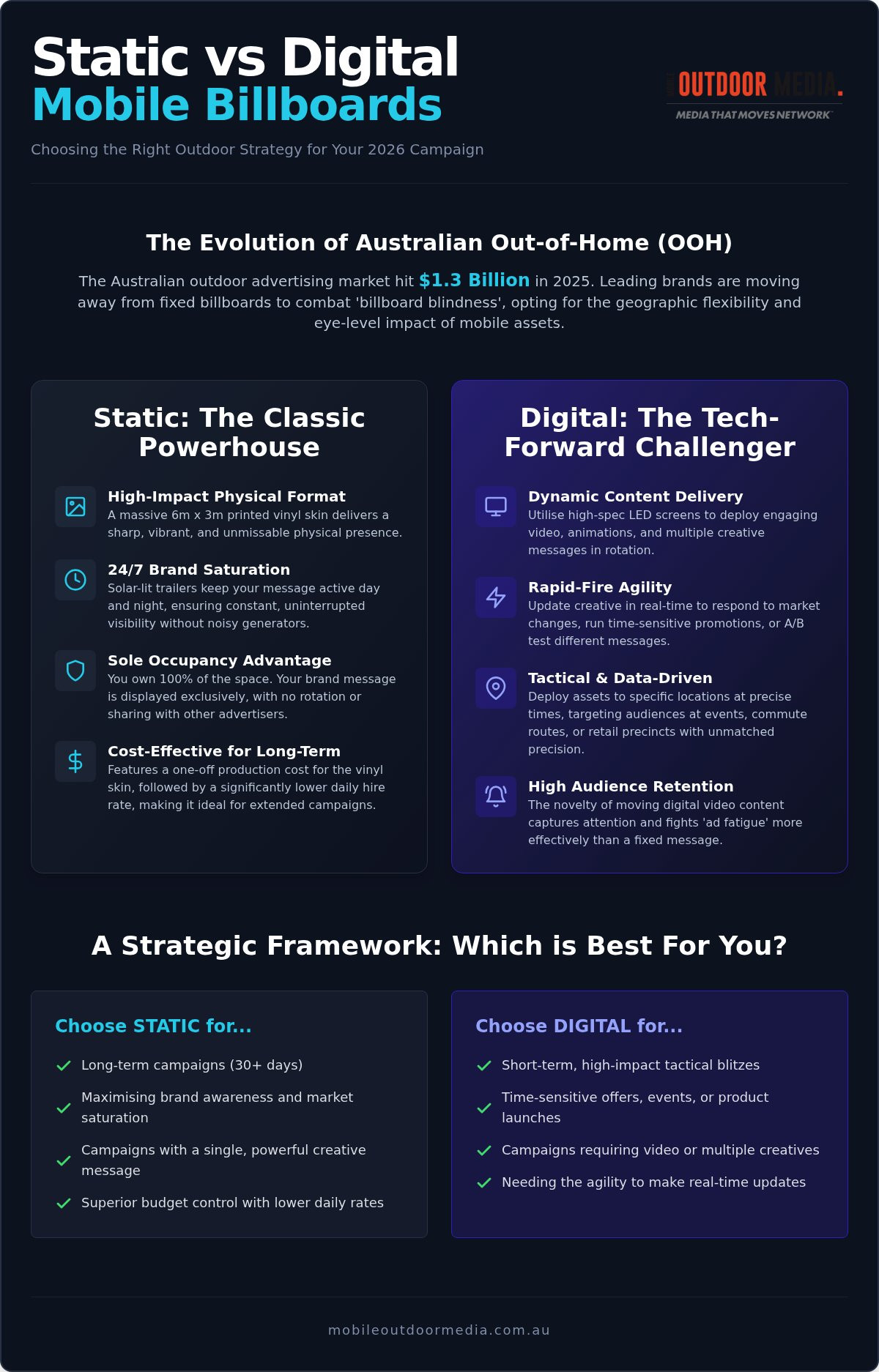
Head-to-Head: Static vs Digital Comparison
Choosing between static vs digital mobile billboards comes down to a trade-off between constant presence and tactical speed. Production lead times are the first major differentiator. A static campaign requires a few days for high-resolution vinyl printing and professional mounting. Digital campaigns bypass this physical step entirely; your creative can be live across a national fleet within hours of a final export. While digital offers speed, static provides 100% share of voice. Your brand never rotates with another advertiser on the same side of the asset. This constant visibility is a massive advantage for high-frequency routes where commuters see your message every single day.
Geographic flexibility is a hallmark of both formats. Our trucks and trailers move where the crowds gather, but they serve different strategic roles. Static assets are the heavy lifters for brand saturation. They stay in the field, providing a reliable landmark for your campaign. Digital assets are the sprinters, capable of shifting creative mid-route to match changing demographics. Whether you need a slow-burn awareness drive or a high-intensity weekend blitz, the choice depends on how quickly you need to pivot your message.
The ROI Factor: Which Format Wins?
Return on investment is calculated differently for each format. For long-term runs of four weeks or more, static often provides a lower cost-per-thousand (CPM). The initial production cost is amortised over the length of the campaign, resulting in a lower daily rate. Digital justifies its higher daily investment through increased engagement and “cut-through.” High-brightness LED screens are proven to hold attention longer in low-light conditions or busy urban centres. If your message is complex or requires video to be effective, the engagement boost from digital will likely drive a better return than a printed board.
Sustainability in 2026: The Solar Edge
Environmental impact is no longer a secondary concern for Australian media buyers. Carbon-conscious planning is now a standard requirement. Static billboards use recyclable vinyl skins that can be repurposed after a campaign. On the tech side, solar ad trailers have revolutionised the industry by providing emission-free, 24/7 visibility. These units use high-efficiency solar panels to power the display and lighting, bridging the gap between traditional impact and modern eco-friendly technology. Comparing the lifecycle of a vinyl skin to an LED panel shows that both can be part of a sustainable strategy when managed by a professional partner committed to waste reduction.
Choosing Your Champion: A Strategic Framework
Deciding on static vs digital mobile billboards isn’t about following a trend; it’s about strategic alignment with your 2026 marketing goals. To ensure your budget drives the highest possible ROI, you need a logical decision-making process. Start by defining your campaign duration. A six-week brand saturation drive has different requirements than a 48-hour event blitz. Next, evaluate your creative complexity. If your message relies on dynamic video or real-time data, digital is your only path. You must also assess your total budget, balancing one-off production costs against daily hire rates. Finally, determine the level of interaction required. Once these factors are clear, the final step is selecting a national partner capable of seamless execution.
When to Go Static
Static formats are the undisputed kings of “always-on” brand saturation. They’re the best choice for political campaigns, long-term retail branding, and simple, high-impact call-to-action messages. When weighing up static vs digital mobile billboards for a national blitz, the choice often comes down to the required share of voice. Because the board never rotates to another advertiser, you’re guaranteed 100% visibility. Every person who passes that asset sees your brand, not a rotation of five others. For businesses needing a semi-permanent presence at a specific site without the rigid contracts of fixed roadside signs, relocatable billboards offer a heavy-duty, professional solution that can be moved as local traffic patterns evolve.
When to Go Digital
Digital is the go-to for product launches, time-sensitive events, and campaigns that require multiple message variations. If you need to test different headlines or react to live market conditions, the digital fleet provides the agility you need. For massive crowd engagement at festivals, sports matches, or community events, stadium-grade event screens deliver a visual experience that captures attention from hundreds of metres away. When your strategy requires street-level activation in busy CBD precincts, digital bike boards allow you to take high-tech, glowing creative directly into pedestrian zones where trucks cannot go.
The final step in this framework is choosing a partner with the national infrastructure to back up your strategy. Mobile Outdoor Media provides a professional, no-nonsense service that handles the logistics of large-scale deployments across Australia. We don’t just provide the assets; we provide the expertise to ensure your campaign runs without a hitch. Whether you choose the constant presence of static or the tactical speed of digital, we ensure your brand dominates the landscape and delivers the results your business demands.
Dominate the Australian Landscape in 2026
Success in the modern outdoor market requires a clear choice between the relentless 24/7 saturation of print and the tactical agility of LED. Static displays offer an unmissable share of voice for long-term brand building, while digital screens provide the dynamic edge needed for rapid launches and high-engagement events. Getting the balance right in the static vs digital mobile billboards debate is the only way to ensure your 2026 media spend delivers a real-world return. We provide the infrastructure to make that happen without the fluff.
Mobile Outdoor Media operates Australia’s most versatile mobile media fleet. We handle full national deployment and logistics support for every campaign, regardless of scale. Our options range from pedestrian-level walking boards to massive 20m² LED trucks, giving you the tools to saturate any market with absolute precision. You don’t need to settle for low-visibility locations or rigid contracts anymore. It’s time to put your brand exactly where your audience is moving.
We are ready to help you outpace the competition and own the streets. Let’s get your next campaign on the road.
Frequently Asked Questions
What is the main difference between static and digital mobile billboards?
The primary difference lies in the display medium and share of voice. Static billboards use high-quality printed vinyl skins that provide 100% occupancy for your brand. Digital versions utilise high-definition LED screens capable of showing video and animation. When comparing static vs digital mobile billboards, static offers a constant, unmissable physical presence. Digital provides tactical agility, allowing you to rotate multiple creatives or update your message remotely to react to live market conditions.
How much does it cost to hire a mobile billboard in Australia?
Pricing for mobile billboard hire across Australia depends on several factors, including the type of asset selected and the total campaign duration. Digital LED trucks typically carry a higher daily rate than static trailers due to the sophisticated hardware involved. However, static assets require an initial production fee for the vinyl skin. We provide tailored quotes based on your national deployment needs, ensuring you receive a cost-effective solution that maximises brand recall and ROI.
Can I change my creative message during a digital mobile billboard campaign?
Absolute flexibility is a major advantage of the digital fleet. You can update your creative message remotely at any time during the campaign. This allows for dayparting, where you might show a breakfast offer in the morning and a different promotion for the evening commute. Because there are no printing or installation delays, your new message can be live across the national fleet in just a few hours. This speed helps you stay ahead of competitors.
How long does it take to print and install a static mobile billboard skin?
Production lead times for a static campaign generally involve a few business days. This timeframe covers the high-resolution printing of the heavy-duty vinyl skin and the professional mounting onto the asset. While this is slower than a digital upload, the result is a durable, high-impact display that never flickers or turns off. Planning your campaign at least a week in advance ensures your static billboard is ready for a seamless national launch on your chosen date.
Are digital mobile billboards visible during bright Australian daylight?
Modern LED billboard trucks are equipped with high-brightness, stadium-grade screens specifically engineered for the harsh Australian sun. These displays feature advanced light sensors that automatically adjust brightness levels to maintain maximum clarity and “cut-through” even in direct midday glare. You don’t have to worry about washed-out colours or poor visibility. Your video content or static digital creative will remain vibrant and sharp, ensuring your brand captures attention in any outdoor environment or weather condition.
What are the best locations to deploy a mobile billboard truck?
Strategic deployment is about following the crowd. The best locations include high-traffic arterial roads, busy retail precincts, and the fringes of major CBD zones where foot traffic is highest. Mobile assets are also highly effective when positioned near major sporting venues or community festivals during peak entry and exit times. By moving with the audience, you avoid the “billboard blindness” associated with fixed signs. We help you map out the most effective routes for national saturation.
Do mobile billboards require special permits for national campaigns?
Compliance is a critical part of any national campaign. Regulations governing mobile advertising vary between different Australian states and local councils. These rules often focus on road safety, driver distraction, and parking durations. Working with an experienced national partner ensures your campaign adheres to all relevant legislation. We manage the logistics and route planning to ensure your message is seen in high-impact areas while staying fully compliant with local government requirements and safety standards.
How is the success of a mobile billboard campaign measured?
We use several metrics to track campaign performance. Every asset in our fleet is equipped with GPS tracking, providing verified proof of play and route accountability. For direct engagement, brands often use campaign-specific QR codes, unique URLs, or dedicated promo codes to track conversions from the street to the website. When you evaluate static vs digital mobile billboards, the data-backed reports we provide give you a clear picture of exactly where and when your message reached your audience.