Click to Call
Organising Relocatable Construction Signage: 2026 Guide
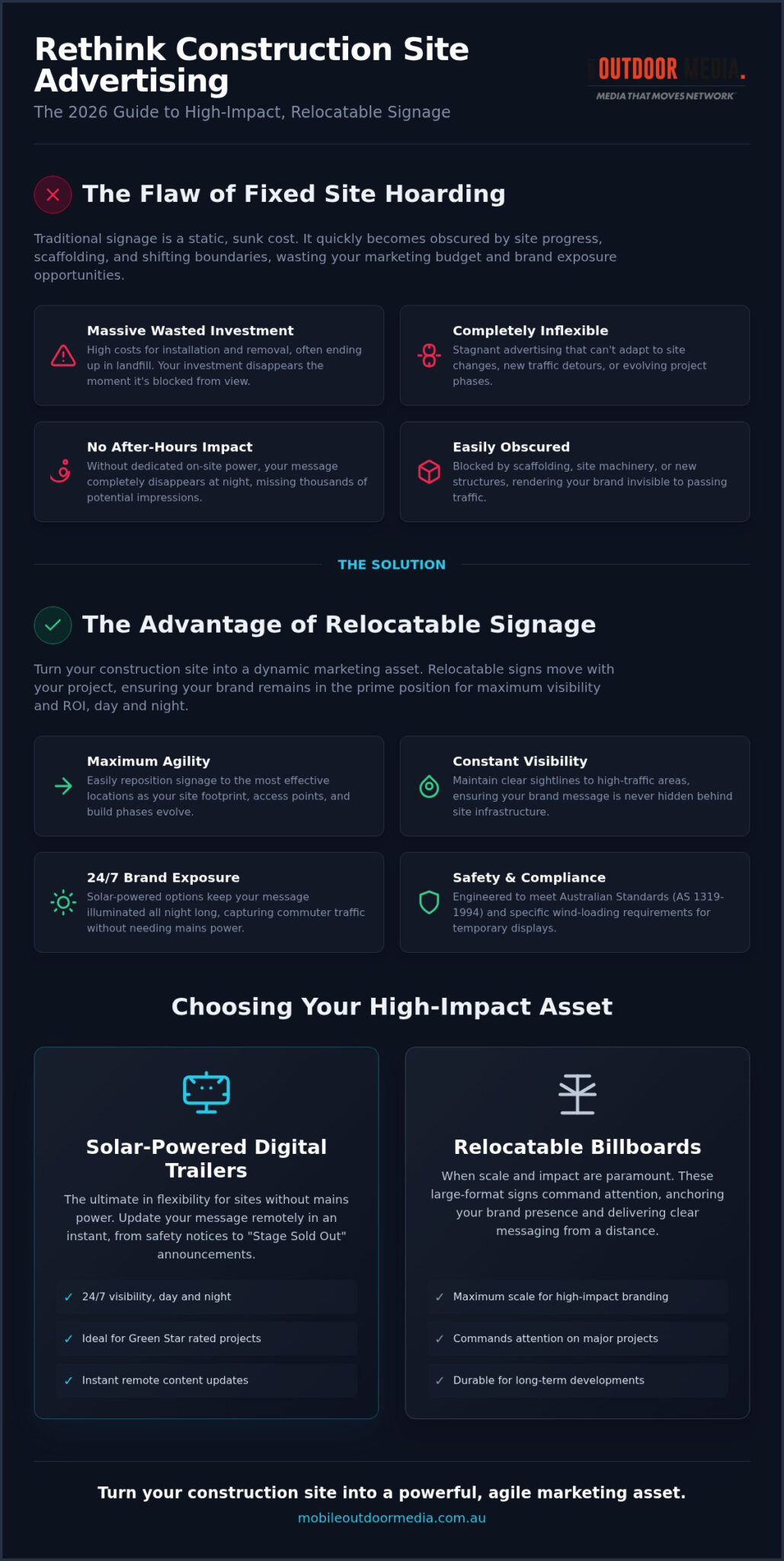
Why are you paying thousands for fixed site hoarding that becomes invisible the moment your build progresses past the first floor? It’s a massive waste of marketing budget. Most developers accept that signage gets obscured by scaffolding or shifting boundaries as a cost of doing business, but that’s a mistake that costs you leads and brand recognition. You wouldn’t tolerate a stagnant project timeline, so you shouldn’t tolerate stagnant advertising.
We understand the headache. Fixed hoarding is expensive to install and even harder to move when the site layout changes. If you don’t have power on-site, your message disappears the moment the sun goes down. This 2026 guide teaches you how to implement high-impact relocatable signage for construction that adapts to your evolving site while maximising brand exposure across Australia. You don’t have to settle for static, hidden boards that fail to deliver a return on investment.
We will break down how to build a flexible signage strategy that moves with your project, ensures compliance with Australian safety standards, and uses solar technology to keep your brand glowing without a mains connection. It’s time to turn your construction site into a dynamic, mobile marketing asset that actually works for your bottom line.
Key Takeaways
- Swap static site hoarding for flexible assets that move as your project boundaries and access points evolve.
- Identify the most durable relocatable signage for construction to ensure your brand remains visible in harsh Australian conditions.
- Learn how to eliminate “dead zones” by conducting a traffic flow analysis and positioning signage away from site machinery.
- Stay compliant with mandatory Australian Standards (AS 1319-1994) and specific wind-loading requirements for temporary displays.
- Discover the benefits of a managed service that handles the deployment and relocation of your signage assets across the country.
What is Relocatable Signage for Construction and Why Use It?
Static hoarding is a relic of the past. In the fast-paced world of Australian development, relocatable signage for construction refers to high-impact, non-fixed media assets such as heavy-duty trailers and portable billboards. These aren’t just safety notices; they’re professional-grade communication tools designed to move as your project grows. While traditional Temporary traffic control signs focus on managing vehicle flow, relocatable assets provide a dual-purpose solution that combines site safety compliance with high-value brand marketing.
Construction sites are living organisms. Boundaries shift, access points move, and scaffolding rises. A sign that worked on day one might be completely obscured by day sixty. Using flexible assets ensures your message remains visible to the thousands of motorists passing your site daily, regardless of the build phase. You need a solution that works as hard as your crew does.
The Limitations of Fixed Site Hoarding
Traditional timber or metal hoarding is a massive sunk cost. You pay for the materials, the intensive labour to install it, and eventually, the cost to tear it down and send it to landfill. It’s an environmental nightmare and a financial drain. Beyond the cost, fixed hoarding lacks agility. If a new crane or site shed is delivered and blocks your main branding, that investment is effectively dead. Fixed boards can’t pivot to face a new high-traffic detour or adjust to a change in site entry. This leaves your brand hidden behind the very infrastructure you’re building, wasting precious exposure time. For a detailed breakdown of how mobile assets outperform static displays across every key metric, the relocatable outdoor media vs. fixed billboards 2026 comparison guide is essential reading for any developer weighing their options.
Benefits of Portability as Site Footprints Evolve
Agility is your greatest asset on a busy site. Relocatable billboards allow you to reposition your branding to the most effective corners of your lot as the footprint evolves. If the local council changes traffic flow or a neighbouring development starts, you can simply move your sign to maintain clear sightlines. This “plug-and-play” nature means you don’t need a team of carpenters every time you want to update your presence. For developers looking to dominate the local area, relocatable billboard advertising offers rapid deployment that keeps your brand front and centre without the permanent commitment of fixed structures. It’s about staying visible where the eyes are, not where the fence used to be.
Choosing the Best Type of Relocatable Signage for Your Site
Selecting the right relocatable signage for construction requires more than just picking a size. You’ve got to consider the duration of your build and the specific traffic demographics passing your site. In Australia, the environment is a major factor. Signs need to withstand extreme UV levels and high wind loads without fading or becoming a safety hazard. While some competitors suggest small A-frames or mesh banners, these often fail to capture attention on large-scale projects. You need assets that command respect and deliver clear messaging from a distance.
Matching your sign type to your project goals is essential. For high-traffic areas where traffic flow is constant, digital options provide the most flexibility. If you’re running a longer-term development where the branding stays consistent, static relocatable billboards offer a massive, unmissable presence that anchors your project in the local mind. Understanding the strategic and financial advantages of relocatable outdoor media compared to fixed billboard formats can help you make a more informed investment decision for your specific project type. To ensure your site meets all local requirements, always refer to the latest Compliance and Safety Standards for Relocatable Site Signage.
Solar-Powered Digital Trailers for 24/7 Visibility
Solar ad trailers are a game-changer for sites without reliable mains power. These units use high-efficiency panels to keep your message illuminated through the night, ensuring you aren’t losing impressions after dark. Because they’re digital, you can update your content remotely. Whether it’s a new ‘Stage 1 Sold Out’ message or a safety update, the change is instant. This technology is particularly valuable for projects aiming for Green Star certification, as it avoids the environmental cost of diesel generators or temporary electrical trenching.
Relocatable Billboards for High-Impact Branding
When scale is the priority, relocatable billboards provide the canvas you need for high-resolution project renders and leasing information. These assets are built for rapid deployment and can be positioned on any flat ground without the need for footings or permanent fixtures. They offer the same visual weight as a traditional billboard but with the flexibility to move as your site boundaries shift. This makes them ideal for ‘coming soon’ campaigns where you need to dominate the local skyline immediately. If you aren’t sure which asset fits your footprint, you can speak with our team for a site assessment to find the perfect fit for your project.
How to Strategically Position Construction Signage for Maximum Impact
Positioning your relocatable signage for construction isn’t a “set and forget” task. You need a tactical approach that prioritises visibility over convenience. Start with a traffic flow analysis. Look at the surrounding road network. Which intersections have the longest dwell times? Where do motorists naturally slow down? Once you’ve mapped the traffic, identify the “dead zones” on your site. These are areas where fixed mesh or hoarding is obscured by excavators, site sheds, or parked deliveries. Align your assets with site entry and exit points. This serves a dual purpose: it guides subcontractors safely and ensures your branding is the last thing visitors see. To keep the message fresh, rotate your signage every 4-8 weeks. Commuters develop “sign blindness” quickly. A simple relocation of 20 metres or a change in digital content can re-engage their attention instantly.
Identifying High-Traffic Exposure Points
Don’t guess where people are looking. Use local traffic data to pinpoint the busiest exposure points. Place your solar ad trailers where they can be seen from a distance, particularly on high-speed arterial roads. Clear sightlines are non-negotiable. If a motorist only has three seconds to read your render, the sign must be unobstructed and angled for maximum impact. While vehicle impressions are the primary goal, don’t ignore pedestrian traffic. Position assets near site gates to capture the attention of locals without creating a sidewalk hazard. Balancing these perspectives ensures you aren’t just seen, but noticed by every demographic passing your site.
Adapting Signage to Construction Phases
Your signage strategy must evolve with the build. During Phase 1 (Excavation), focus on community awareness and site management. This is the time to establish your presence while the site is relatively flat. As you move into Phase 2 (Structure), the site becomes cluttered. Move your assets to avoid being hidden by cranes, concrete pumps, or delivery bays. By Phase 3 (Fit-out and Leasing), your goals shift toward the finish line. Reposition your mobile billboards to target potential tenants or buyers. High-impact renders should face the most prestigious approach to the site. This phase is about the “sell,” and your signage should reflect that shift in priority by moving to the most prominent street frontage as hoarding is removed.
Compliance and Safety Standards for Relocatable Site Signage
Safety compliance on a job site isn’t just a box to tick. It’s about protecting your crew and the public while maintaining your professional reputation. For relocatable signage for construction, this means strictly adhering to Australian Standards (AS 1319-1994). This standard dictates the layout and design of safety signs to ensure they’re instantly recognisable. But for large-scale assets, compliance goes deeper than just the graphic design. You must account for wind-loading requirements. A relocatable billboard in an open, high-wind site acts like a massive sail. Without proper engineering and secure anchoring, it’s a liability. We ensure every asset uses non-slip bases and heavy-duty outriggers to stay exactly where you put it. Legibility is the other half of the safety equation. Roadside visibility requires high-contrast colours and bold, sans-serif typography that motorists can process at speed.
Weather Resistance and Durability
The Australian sun is brutal on outdoor media. We use UV-stable inks to prevent your renders from fading into a washed-out mess within three months. Structural integrity is just as vital. Your signage needs to withstand the sudden summer storms and high winds common across the country. For solar ad trailers, durability also means internal reliability. We run strict maintenance schedules for our digital screens to guarantee 100% uptime. If a screen goes dark, you aren’t just losing impressions; you’re losing the professional image you’ve worked hard to build. Our gear is built to handle the dust and vibration of a working site without skipping a beat.
Managing Site Safety and Directional Signage
You can leverage your branding assets to improve site logistics. Don’t just put up a generic PPE sign. Integrate your branding with essential safety messages like site speed limits and mandatory hard hat zones. This creates a cohesive, professional look that tells the public your site is well-managed. Use relocatable signs to mark temporary delivery zones and visitor parking clearly. This reduces confusion for subcontractors and keeps the site entrance clear of bottlenecks. Just remember that placement must never obstruct the view of traffic signals or pedestrian crossings. Safety always comes first, even when you’re chasing maximum brand exposure. When you use relocatable billboard advertising, you get the benefit of a professional install that respects these exclusion zones while still dominating the streetscape.
Request a compliance-ready signage plan
Why Mobile Outdoor Media is the Leader in Relocatable Signage
Static wraps and mesh banners have their place, but they don’t offer the strategic flexibility required for large-scale development. Mobile Outdoor Media’s national fleet and rapid deployment capabilities set us apart as the premier choice for relocatable signage for construction. We don’t just drop off a trailer and leave you to it. Our managed service means we take full responsibility for moving your assets as your site evolves. This frees your site managers to focus on the build while we ensure your branding is always positioned for maximum ROI. For a detailed breakdown of costs and specific equipment options, check out our Relocatable Billboard Hire: 2026 Australian Buying Guide.
We solve the problems that static sign companies ignore. While others focus on permanent fixtures, we specialise in high-impact mobility. This approach ensures your project stays visible from day one until the final handover. We move it. You build. It’s a partnership designed for the speed of modern Australian development.
Seamless Deployment Across Australia
We handle the entire lifecycle of your site media. From initial design and print to national site delivery, our process is streamlined for speed. Construction timelines are rarely fixed, so we offer flexible hire terms that match your project’s reality. Whether you’re running a six-month fit-out or a three-year multi-stage development, our inventory of relocatable signage for construction scales with you. Having a single point of contact for national projects simplifies your logistics. You get the same Red Dot-calibre designs and professional service whether your site is in the heart of a capital centre or a remote regional hub.
Innovation in Construction Marketing
We go beyond basic branding to offer genuine communication solutions. Digital Mobile Billboards are powerful tools for community announcements or urgent recruitment drives. If you need to hire fifty tradespeople by Monday, a digital message in a high-traffic commuter corridor is the fastest way to get results. For major milestones like “Topping Out” ceremonies or official site launches, our Event Screens provide the scale and clarity needed to impress stakeholders. These aren’t just signs; they’re event-grade media assets. Our solar-powered technology also helps you meet sustainability targets by minimising the site’s carbon footprint. It’s professional, it’s effective, and it’s built for the future of Australian construction.
Build a Smarter Site Presence in 2026
Your construction site is a dynamic, evolving environment, so your branding shouldn’t be stuck in the mud. Transitioning to relocatable signage for construction ensures your message remains visible as your project boundaries shift and scaffolding rises. You now have the blueprint for strategic placement and compliance with Australian Standards, allowing you to turn every fence line into a high-value marketing asset that actually delivers a return on investment.
Mobile Outdoor Media provides the national Australian coverage and expert site placement strategy you need to dominate the local skyline. With solar-powered 24/7 visibility, your brand never goes dark, even on sites without reliable mains power. It’s time to stop wasting budget on fixed hoarding that gets hidden by machinery and start using assets that work as hard as your crew does. We’re ready to deploy when you are.
Take control of your site’s exposure and let’s get your brand moving across Australia.
Frequently Asked Questions
Do I need a permit for relocatable signage on my construction site?
Permit requirements depend on where the asset sits. If your relocatable signage for construction is positioned entirely within your private site boundaries, you often won’t need a specific council permit. However, if the sign overhangs a public footpath or is placed on a nature strip, local council approval is mandatory. Every jurisdiction has different bylaws; we recommend a quick check with your local planning department before deployment to ensure full compliance.
How long does it take to deploy a relocatable billboard in Australia?
We pride ourselves on rapid deployment across the country. Once your artwork is approved and the site plan is finalised, we can typically have your assets on-site within a few business days. Our national fleet allows us to move quickly, ensuring your branding is live before the first shovel hits the ground. This speed is a massive advantage over fixed hoarding, which requires weeks of structural planning and physical construction.
Are solar ad trailers bright enough to be seen during the day?
Absolutely, our solar ad trailers use high-brightness LED technology specifically engineered for the harsh Australian sun. These screens feature high-nit ratings that ensure your message remains crisp and legible even in direct midday glare. As the sun sets, the sensors automatically adjust the brightness to maintain optimal visibility without blinding motorists. You get 24/7 exposure that static mesh banners simply can’t match during low-light hours or heavy rain.
Can relocatable signage withstand high wind zones on-site?
Yes, all our large-scale units are designed to meet strict Australian Standards for wind-loading. We use heavy-duty outriggers and non-slip ballast systems to ensure the signs remain stable during severe weather events. This is a critical safety feature for open sites or coastal developments where gusty winds are common. Unlike lightweight mesh that can tear or blow away, these engineered structures provide a secure, reliable platform for your branding throughout the build.
How often can I move my relocatable signage as the site changes?
You can move your signage as frequently as your site requirements evolve. Our managed service is designed for this exact flexibility. Whether you need to shift an asset 20 metres to clear a new delivery bay or move it to a different street frontage for a new sales phase, our team handles the logistics. This ensures your relocatable signage for construction is always in the most high-impact position possible without distracting your site managers.
Can I change the content on digital construction signs remotely?
Yes, all our digital assets feature remote content management via secure cellular connections. You don’t need to be on-site to update your messaging. Whether you want to announce a project milestone, change a recruitment notice, or update a leasing contact number, the change is near-instant. This flexibility allows you to keep your marketing relevant and reactive to the daily progress of your build without any additional printing costs or physical labour.
What is the standard size for a relocatable billboard for construction?
Our relocatable billboards typically come in large-format sizes, with the 6m x 3m “Super 8” equivalent being a popular choice for major developments. These sizes are chosen to match the visual impact of traditional roadside billboards while maintaining a footprint that fits within standard site boundaries. We also offer smaller digital trailers and bike boards for sites with limited space or those targeting specific pedestrian corridors in busy urban centres.
Is relocatable signage more cost-effective than fixed site hoarding?
Relocatable options are significantly more cost-effective when you factor in the total lifecycle of the project. Traditional fixed hoarding involves high labour costs for installation and demolition, plus expensive landfill fees at the end. Relocatable assets are reusable, require zero structural waste, and deliver much higher marketing ROI through better visibility. You’re investing in a professional media asset rather than a temporary fence that gets thrown away at the project’s conclusion.