Click to Call
Local Area Marketing Billboards: The 2026 Guide to Dominating Your Catchment
Your local marketing budget is likely leaking cash through wastage every single day. If you’re relying on static signs or broad mass media, you’re paying to reach people who will never step foot in your shop. It’s a frustrating reality when fixed billboards end up in the wrong spot or get drowned out by competitor noise in high-density urban centres. Using mobile billboards for local advertising changes the game by putting your brand on wheels and moving it precisely where the crowd is.
We agree that owning your neighbourhood shouldn’t feel like a gamble. You need a way to ensure your message is unmissable during a grand opening or a major local event. This guide reveals how to bypass traditional advertising limitations and dominate your catchment with surgical precision. We’ll preview the latest 2026 strategies for high-impact brand recall, including how industry studies show mobile assets achieve a staggering 97% recall rate. You’re about to learn how to outmanoeuvre the competition and turn every local street into your personal high-traffic showroom.
Key Takeaways
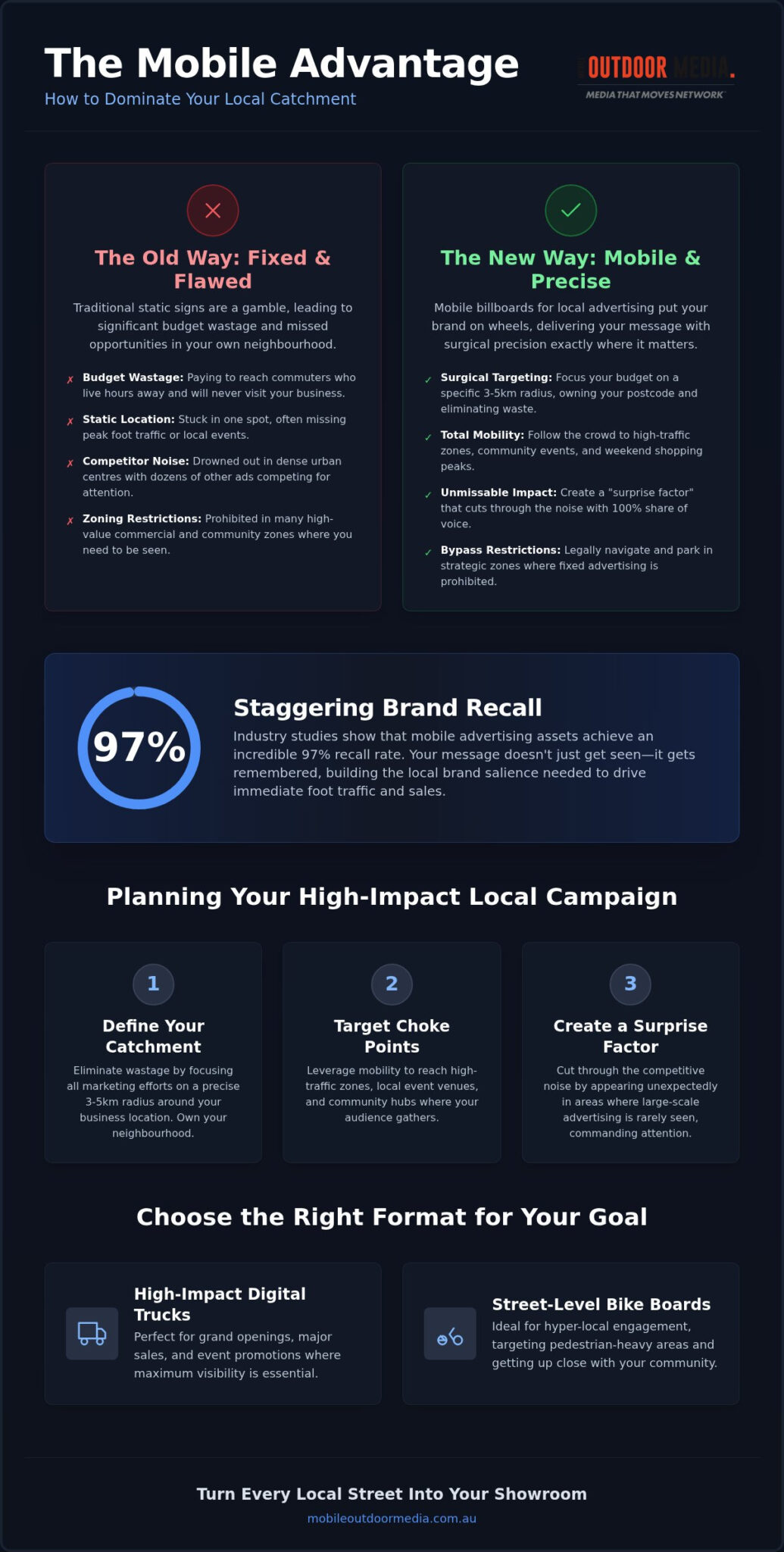
- Define your local catchment with precision to eliminate budget wastage and focus your marketing efforts on a specific 3-5km radius.
- Leverage the mobility of assets to reach high-traffic zones and “choke points” where traditional fixed signage is often prohibited or restricted.
- Utilise mobile billboards for local advertising to create a “surprise factor” that cuts through competitor noise in dense urban centres.
- Select the right format for your specific goal, choosing between high-impact digital trucks for events or street-level bike boards for hyper-local engagement.
- Partner with a national provider to ensure reliable, professional execution that turns your local neighbourhood into a high-recall brand zone.
What are Local Area Marketing (LAM) Billboards?
Local Area Marketing (LAM) is a tactical discipline. It ignores the noise of national campaigns to focus on the people living and working right next to your business. While traditional outdoor media relies on people happening to drive past a fixed point, LAM flips the script. It uses mobile billboards for local advertising to take your message directly into the streets where your customers spend their time. This isn’t just about visibility; it’s about dominance within a specific geographic catchment. It’s surgical, cost-effective, and designed for local impact.
Traditional roadside billboards often result in massive wastage. You pay for thousands of impressions from commuters who live two hours away and will never visit your site. LAM billboards eliminate this inefficiency. By using mobile billboard advertising, you achieve “postcode ownership.” You ensure your brand is the most prominent thing people see in their own neighbourhood. This is how mobile billboards serve as the primary tool for LAM; they bring the message to the audience rather than waiting for the audience to find the message.
The Core Objectives of Local Billboard Campaigns
A well-executed local campaign isn’t just a decoration. It’s a driver of immediate action. Businesses use these assets to solve specific local challenges and drive measurable results:
- Driving immediate foot traffic: For a retail store grand opening, you need people through the doors on day one. A mobile unit circling the local shopping precinct creates that urgency and awareness.
- Increasing brand salience: In high-density urban centres, competition is fierce. Constant physical presence makes your brand the first one locals remember when they need your service.
- Supporting hyper-local events: Whether it’s a weekend warehouse sale or a local festival sponsorship, mobile media provides a high-impact, short-term promotional burst that static signs can’t match.
Why 2026 is the Year of Hyper-Local Precision
The marketing landscape has shifted significantly. In 2026, digital advertising costs have continued to climb while click-through rates suffer from extreme ad-blindness. Consumers are fatigued by screen-based interruptions. This is why physical presence in a neighbourhood is now a premium asset. Being “on the ground” builds a level of community trust that a social media ad simply can’t replicate. It shows your business is an active part of the local fabric.
Effective local marketing now requires a multi-channel approach. Using mobile billboards for local advertising provides the physical anchor for your digital efforts. When a customer sees your truck in their street and then sees your ad on their phone, the brand recall is significantly higher. It’s about being unmissable in the real world to win in the digital one. You aren’t just advertising; you’re staking a claim on your local market.
The Strategic Advantage of Mobility in Local Advertising
Mobility provides a tactical edge that fixed signage simply can’t match. When you use mobile billboards for local advertising, you aren’t tied to a specific street corner or a long-term council lease. You have the freedom to appear exactly where your audience is at any given moment. This creates a “surprise factor.” In residential areas or light commercial zones where static billboards are rare, a large-scale mobile asset commands immediate attention. It breaks the visual routine of the neighbourhood and forces people to look.
One of the biggest advantages is the ability to bypass the strict zoning restrictions that limit fixed roadside billboards. Local councils often prohibit permanent advertising structures in high-traffic retail strips or near community hubs. However, because these assets are vehicle-based, they can navigate these restricted zones and park in strategic spots that are otherwise off-limits to your competitors. You also benefit from 100% share of voice. There are no rotating digital ads or shared panels with three other brands. For the entire duration of your campaign, your brand is the only message being delivered to the catchment.
Overcoming the Limitations of Fixed Signage
The best advertising spots aren’t always where the fixed poles are located. Foot traffic patterns change throughout the week. A street that is packed on a Tuesday morning might be empty by Saturday. Mobile media allows you to follow the crowd. You can target morning commutes during the week and then shift to weekend shopping peaks or local sporting events. This flexibility ensures you’re never paying for “dead air” when the audience has moved elsewhere. It also prevents scenery fatigue. If a sign stays in one spot too long, locals eventually stop seeing it. By moving the asset to different street corners, you keep the message fresh and unmissable. You can discuss your route strategy with our team to find the highest-impact locations for your next campaign burst.
Psychology of Movement and Brand Recall
Human biology is hardwired to notice movement. Our peripheral vision is naturally drawn to moving objects in a static environment. This evolutionary trait makes digital mobile billboards incredibly effective at capturing attention. When a large, bright screen moves through a street, it triggers a higher level of memory encoding than a static poster. This creates “talkability.” Locals notice the truck, mention it to neighbours, and remember the brand long after the vehicle has moved on. It turns a simple advertisement into a community event, ensuring your business stays top-of-mind within the local market.
Choosing the Right Mobile Format for Your Local Campaign
Not every neighbourhood is built the same. A wide arterial road requires a different approach than a narrow, heritage-listed shopping lane. Choosing the right hardware is the difference between an unmissable campaign and a wasted budget. You need to match the physical scale of your asset to the local streetscape to ensure maximum visibility without feeling out of place. This is where the variety of mobile billboards for local advertising becomes your greatest tactical advantage. By selecting the right size and format, you ensure your message fits the environment while still commanding the attention it deserves.
Digital Trucks vs. Solar Ad Trailers
Vehicle-mounted digital trucks are the heavy hitters of local marketing. These assets offer high-brightness LED screens that provide incredible cut-through, even in direct Australian sunlight. They’re perfect for high-impact bursts where you want to dominate a specific route during peak hour. Conversely, solar powered advertising trailers are the masters of persistence. They don’t require a driver to be present at all times and can be parked in a single high-value spot for days or weeks. While a digital truck provides dynamic movement, a solar trailer offers a reliable, 24/7 presence that becomes a landmark in the local area. These trailers are specifically engineered for long-term placement, making them ideal for ongoing brand awareness in a fixed catchment.
Street-Level Activation: Bike and Walking Boards
In dense urban centres or pedestrian-only precincts, large trucks can’t always go where the people are. This is where street-level assets take over. Using digital bike boards allows your brand to penetrate shopping strips and parklands where traditional vehicles are banned. They move at a human pace, making them less intrusive and more engaging for people on foot. If you want direct interaction, walking boards take this a step further. They put your message on the backs of professional brand ambassadors who can answer questions, hand out flyers, and drive immediate store visits. These assets turn your marketing into a conversation rather than just a broadcast.
The real magic happens when you combine these formats. Integrating various mobile billboards for local advertising creates a “surround sound” effect that a single static sign can’t match. Use a large relocatable trailer at a major intersection to build broad awareness, while bike boards weave through the nearby side streets to catch people as they approach your store. This layered approach ensures your brand is the only thing a customer sees from the moment they leave their house until they reach your door. It’s a complete takeover of the local catchment that leaves no room for competitor noise.
How to Plan a High-Impact Local Billboard Campaign
Planning a campaign isn’t about general awareness; it’s about tactical execution. If you don’t have a clear plan, you’re just driving a billboard around without a purpose. Dominating your local market requires a structured approach that focuses on where your customers actually live and breathe. Most local businesses get 80% of their trade from a 3-5km radius. This is your primary catchment. Don’t waste your budget chasing eyes outside this zone. Focus your energy where it actually converts into sales.
Once your catchment is defined, you must identify local “choke points.” These are the busy intersections, supermarket entrances, or train station exits where traffic slows down and eyes wander. Your next step is matching the asset to the specific environment. Use relocatable trailers for long-term visibility in car parks and digital bikes for crowded pedestrian strips. Keep your creative simple with high-contrast colours and a singular, local call to action. Finally, organise your route planning to ensure you’re present during peak morning and afternoon commutes. This variety makes mobile billboards for local advertising the most flexible tool in your kit.
Creative Best Practices for Local Cut-Through
When your billboard is on the move, you only have a few seconds to make an impression. Less is always more. Use large, legible fonts and bold colours that pop against the urban grey. Avoid cluttered designs or long lists of services. A local reference is your secret weapon. Adding a line like “Just around the corner on High St” instantly builds relevance and trust with the community. It makes your business feel like a local fixture rather than a distant corporation. Using mobile billboards for local advertising allows you to tailor these messages to specific streets, increasing the personal connection with the audience.
Timing and Duration: The Local “Burst” Strategy
In 2026, the most successful local campaigns use an intensive “burst” strategy. A 3-5 day high-intensity campaign often delivers better results than a month-long low-intensity run. This creates a sense of ubiquity. When locals see your brand three times in one morning, it sticks. Coordinate these bursts with community events, market days, or school pick-up times to maximise exposure. If you’re launching a new location, link your movement to a specific outdoor advertising grand opening strategy to ensure your first day is a massive success.
Partnering with Mobile Outdoor Media for National Local Coverage
Dominating a single catchment is a strong start. Scaling that success across fifty different postcodes simultaneously is where true market leaders separate themselves from the pack. Partnering with a professional provider ensures you have the national infrastructure required for high-stakes local execution. We don’t just provide a truck; we provide a managed solution that removes the logistical headache from your plate. By using mobile billboards for local advertising, national brands can maintain a consistent brand voice while appearing like a trusted local fixture in every neighbourhood they enter.
Reliability in mobile billboard advertising isn’t just about the hardware; it’s about the “straight-talking” expertise and logistical precision we bring to the table. You need to know your asset is exactly where it’s supposed to be, especially during a coordinated national rollout. We operate as a stable, high-capacity partner that respects your campaign timelines and budget. Our team focuses on results, providing the transparency and accountability you need to own your local markets with absolute confidence.
National Reach, Local Expertise
Dealing directly with an Australian-owned and operated specialist means you’re talking to the people who actually own and manage the fleet. There are no middle-men or layers of agency fluff to slow you down. We manage the complex logistics of national rollouts while keeping a laser focus on local nuances. This allows for total brand consistency across the country, but with the flexibility to include local creative tweaks. You can tailor your message with specific store addresses or neighbourhood-specific offers without losing the professional polish of a national campaign. It’s the best of both worlds: the power of a major brand with the relevance of a local shop.
The Future of Local OOH with Mobile Outdoor Media
As we move through the 2026 landscape, the competition for physical attention is only getting tougher. Our commitment to innovation ensures your brand stays ahead of the curve. From high-impact relocatable billboards that own a site for weeks to advanced digital screens that offer real-time content updates, we provide the tools to win. We don’t promise unreachable goals; we build on a proven infrastructure to deliver rending results. Ready to dominate your patch? Contact our team today to discuss your next high-impact campaign and start owning your local catchment.
Dominate Your Local Market with Precision Mobility
Owning your local catchment in 2026 requires more than just a presence; it requires a tactical advantage. By utilising mobile billboards for local advertising, you can bypass the inherent wastage of fixed signage and engage your audience directly where they live and work. We’ve explored how the right mix of high-impact assets and strategic timing can turn a standard campaign into a local takeover.
Mobile Outdoor Media remains a leader in Australia-wide deployment, offering the most advanced digital and solar options on the market. As specialists in local area marketing since our inception, we understand the straight-talk approach needed to drive foot traffic and build lasting brand recall. Don’t settle for being another face in the crowd when you can be the most unmissable brand in the street.
Your neighbourhood is your most valuable asset. Start protecting your patch and outmanoeuvring the competition with a partner who knows how to deliver results on the ground.
Frequently Asked Questions
What is the best type of mobile billboard for a local retail store?
Digital mobile billboards are generally the most effective choice for local retail stores because they offer high-impact LED screens and dynamic movement. These assets are perfect for driving immediate foot traffic during grand openings or limited-time sales events. If your shop is located in a dense pedestrian zone or a narrow shopping strip, digital bike boards provide a lower-profile alternative that can weave through crowds to capture attention at eye level.
How much does local area marketing billboard hire cost in Australia?
The cost of hiring a mobile billboard in Australia depends on the specific format you choose, the campaign duration, and the geographic reach required. Short-term intensive bursts are priced differently than long-term relocatable billboard placements. Factors such as whether you require a driver-operated vehicle or a stationary solar trailer will also influence the total investment. Most businesses find that the lack of wastage in a targeted local campaign provides a superior return.
Do I need a permit to park a mobile billboard on a local street?
Permit requirements for mobile billboards for local advertising are determined by individual local council ordinances. While stationary trailers often require specific placement approvals or must comply with local parking time limits, vehicle-mounted billboards typically operate under standard commercial vehicle regulations. It’s essential to check the specific bylaws of your target catchment to ensure compliance. Professional providers manage these logistical details to ensure your campaign runs smoothly without legal interruptions or fines.
Can I change the location of my mobile billboard during the campaign?
Yes, total flexibility is the primary advantage of this medium. Unlike a fixed sign, you can move your asset to follow local foot traffic patterns as they shift throughout the day. You might target a busy train station during the morning commute and then relocate to a local shopping centre for the afternoon peak. This ability to pivot ensures your brand remains in front of an active audience, maximising your exposure without the cost of multiple static placements.
What is the difference between a static trailer and a digital mobile billboard?
A static trailer typically uses a high-quality vinyl wrap and is ideal for long-term, 24/7 brand presence in a single high-value location. A digital mobile billboard uses high-definition LED screens to display dynamic content, including video or rotating messages. While static trailers provide a reliable landmark effect, digital units offer superior cut-through in bright daylight and allow you to update your creative messaging instantly to reflect changing local offers or events.
How do I track the results of my local area marketing campaign?
Tracking the success of a local campaign is achieved through a combination of digital and physical metrics. Many brands use unique QR codes or “mention this ad” offers to track direct conversions from the street. Additionally, professional mobile media assets are equipped with GPS tracking, allowing you to verify exactly where and when your message was displayed. Comparing foot traffic data before and during the campaign burst provides a clear picture of the billboard’s impact on store visits.
Are solar ad trailers effective for night-time advertising?
Solar ad trailers are highly effective for night-time advertising because they use integrated battery systems to store energy collected during the day. This stored power ensures the LED screens remain bright and legible long after the sun goes down. In 2026, advanced battery technology allows these trailers to operate continuously through the night, providing 24/7 visibility for your brand in areas where street lighting might be limited or competitor signage is dark.
Can mobile billboards be used in residential areas?
Mobile billboards for local advertising can be used in residential areas, provided they comply with local noise and parking regulations. This is an excellent strategy for service-based businesses like real estate agents or local tradespeople who want to build trust within a specific neighbourhood. A well-planned route through residential streets ensures your brand becomes a familiar sight to locals in their most comfortable environment. It’s a powerful way to establish community presence where traditional large-scale advertising is usually absent.