Click to Call

Bike Boards vs Street Teams for Australian Brands
A packed precinct is not automatically an advertising opportunity. Your campaign still needs to be seen, understood and remembered before the crowd moves on. That is the real decision behind bike boards vs street teams: do you need a moving visual statement, a human conversation, or a coordinated mix of both?
For Australian brands promoting retail openings, events, property, hospitality offers or time-sensitive launches, the answer comes down to the action you want people to take. Bike boards build repeated visual reach across a defined area. Street teams create direct interaction. They can work in the same places, but they do very different jobs.
Bike Boards vs Street Teams: The Core Difference
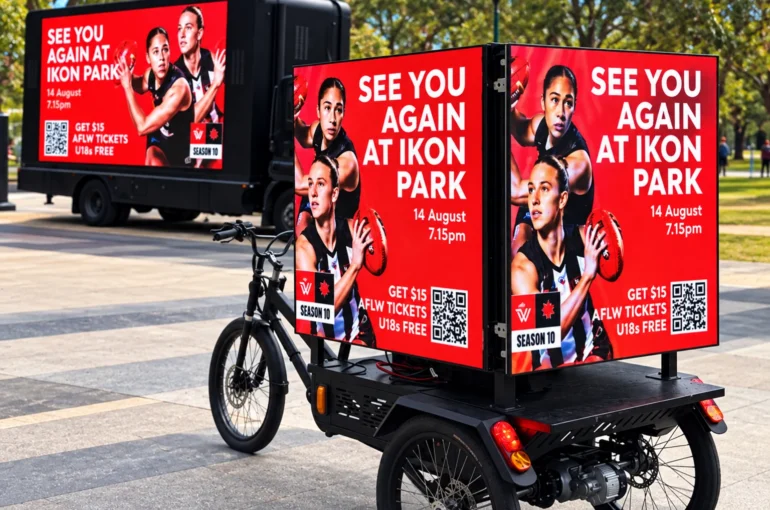
Bike boards turn the journey into the media space. A branded bike board travels through high-footfall streets, retail strips, promenades, transport-adjacent areas and event precincts, putting a large-format message in front of people as it moves. The format is built for visibility at pace. People may only see it for a few seconds, so the creative needs to land fast.
Street teams are people-led activations. Brand ambassadors may hand out samples, distribute promotional material, demonstrate a product, invite sign-ups or direct people to a nearby venue. Their value is not simply being present. It is their ability to start a conversation and respond to questions in the moment.
Choose bike boards when the priority is broad, mobile awareness. Choose street teams when your campaign relies on product trial, data capture, education or a personal handover. If you need both attention and action, pair them rather than forcing one format to do everything.
When Bike Boards Do the Heavy Lifting
Bike boards are designed for campaigns that need to own the street without being tied to one fixed location. They are particularly effective where pedestrian movement is steady but dispersed – around shopping districts, CBD lunch areas, beachside precincts, university zones, entertainment strips and major event surrounds.
The key advantage is repetition. A person might spot the board at the station, see it again near a café and pass it once more while heading towards a venue. That repetition gives a simple message more chance of sticking. A static placement gets one line of sight. A mobile board can build multiple moments of exposure throughout a route.
This makes bike boards a strong choice for a clear offer or announcement: a new store opening, ticket release, sale period, venue launch, streaming release, app promotion or event date. Use a short headline, strong brand colour, one focal image and an easy call to action. A crowded layout wastes the format’s greatest strength – instant recognition.
Bike boards can also cover more ground than a small street team positioned at a single point. That matters when your audience is spread across several blocks or when you want to target peak pedestrian periods in multiple locations on the same day. A well-planned route keeps the message moving where people are already gathering.
There are limits. Bike boards are not the best answer if your offer needs a detailed explanation, a physical product demonstration or consent-based lead collection. Visibility is powerful, but it is not a substitute for a trained person who can answer objections and guide a customer through the next step.
Where Street Teams Earn Their Place
Street teams perform best when a person needs a reason to stop. Sampling a new beverage, demonstrating a service, collecting registrations, handing over a voucher or creating a branded photo moment all benefit from human interaction.
A capable team can adjust its approach in real time. If one entrance is quiet, it can move. If people are asking the same question, the team can refine the message. If a promotion gets traction with a particular audience, the team can focus there. That flexibility is valuable, especially for experiential campaigns where the quality of the interaction matters as much as raw reach.
The trade-off is scale and consistency. A team can only speak to so many people in an hour, and the result depends heavily on training, energy, weather, crowd behaviour and site conditions. Staffing costs also rise as you add locations, shifts and specialist skills.
Street teams need a strong operational plan. Who is the audience? What is the opening line? What should the team do when someone says yes? How will stock, samples, rubbish and reporting be managed? Without these answers, an activation can look busy while delivering very little commercial value.
Compare the Outcome, Not Just the Format
The most useful way to assess bike boards versus street teams is to start with the campaign objective.
If you need people to recognise a message across a busy precinct, bike boards usually provide better visual coverage. Their large, moving display gives you a presence that is hard to miss, particularly when the design is bold and the route is built around audience flow.
If you need customers to taste, test, ask, register or redeem, a street team is usually the stronger choice. It creates the human bridge between awareness and participation.
Budget also changes the equation. A bike-board campaign can be a cost-effective way to build prominence across selected locations without paying for multiple fixed sites or a large field team. Street teams may require more staffing management, uniforms, training, permits, stock and supervision. That investment can be worthwhile when every interaction has high value, such as a premium product launch or qualified lead campaign.
Measurement should match the job. For bike boards, look at route coverage, operating hours, audience density, repeat exposure potential, campaign photographs and any lift in foot traffic, searches or offer redemptions. For street teams, measure conversations, samples distributed, registrations, vouchers redeemed, sales leads and cost per meaningful interaction. Counting flyers alone is rarely enough.
Build the Route Around Real Behaviour
A bike board campaign succeeds or fails on where and when it travels. Start with the audience’s actual movement, not simply the city’s busiest street. A national retailer may need CBD lunch crowds. A nightlife venue may need late-afternoon coverage around transport hubs and dining precincts. A property campaign may need targeted activity near shopping centres, commuter areas and local community events.
Plan for the natural rhythm of the day. Morning commuters move quickly and often have limited attention. Lunch crowds linger longer. Weekend event audiences may be highly receptive but subject to changing access conditions. The best route is not necessarily the longest one. It is the one that repeatedly places the message in front of the right people.
Permissions, local rules and safety requirements must be considered before deployment. Public-space advertising conditions can vary by council, venue and event organiser. Build the campaign around compliant operations, safe rider movement and realistic access times. A reliable outdoor partner should make this planning practical rather than leaving it as an afterthought.
Use Both Formats When Awareness Must Convert
For many campaigns, the strongest answer is not bike boards or street teams. It is bike boards first, street teams second.
The bike board creates attention as it circulates through the precinct. The street team then gives interested people a place to act – claim a sample, scan a code, collect an offer or find the venue. The visual unit broadens the campaign footprint while the team concentrates on conversion hotspots.
This combination works well for festivals, store launches, sporting events and hospitality promotions. It also creates stronger creative consistency. Use the same headline, colour palette and offer across both formats, so the public recognises the campaign before a brand ambassador starts the conversation.
Avoid treating the bike board as background decoration. Give it a defined route, prime operating windows and a clear link to the activation. Equally, do not ask a street team to explain a complicated offer that cannot be understood in a few seconds. Keep the message direct and make the next action easy.
Make the Choice That Moves the Campaign
Choose bike boards when your brand needs high-visibility movement, repeat exposure and location coverage. Choose street teams when the campaign needs direct engagement and a measurable human response. Combine them when you want the street to notice first, then act.
Mobile Outdoor Media helps campaigns take that visibility into the places audiences already gather, from major city precincts to regional activations. Put the format behind the outcome you need, build the route around your audience, and give people a message worth noticing.