Click to Call
5 High-Impact Mobile Billboard Placement Strategies for Australian Brands
Did you know that mobile billboard trucks boast a staggering 97% recall rate? While traditional static boards often fade into the urban background, a moving message demands attention. You’ve likely felt the frustration of watching your marketing budget vanish into low-visibility areas or seeing your premium static placement ignored by commuters who’ve developed total billboard blindness. It’s a common struggle for Australian brands trying to cut through the noise in crowded metropolitan centres.
To fix this, you need more than just a truck; you need sophisticated mobile billboard placement strategies that treat every kilometre as a tactical opportunity. Mastering the science of routing and dwell time ensures your campaign dominates high-traffic environments and delivers an unmissable ROI. We’re going to break down five high-impact strategies, from intent interception to hyper-local street-level engagement, that turn your brand into a moving powerhouse. You’ll move beyond guesswork and start driving measurable foot traffic and web conversions with precision.
Key Takeaways
- Understand why movement is the ultimate cure for static billboard blindness and how it triggers significantly higher brand recall than fixed roadside hoardings.
- Master the Confluence Framework to develop mobile billboard placement strategies that perfectly align high traffic volume with audience dwell time and intent.
- Discover how to match specific assets, such as Digital Mobile Billboards or Solar Ad Trailers, to your campaign environment for maximum visibility and impact.
- Uncover high-impact tactical manoeuvres like Event Domination and the Commuter Shadow to intercept your target audience during peak engagement windows.
- Gain a clear roadmap for executing national campaigns that deliver measurable results and transform outdoor media into a high-performance conversion tool.
Beyond the Roadside: Why Strategic Placement Outperforms Static Signage
Fixed roadside hoardings have a major problem. They’re predictable. Australian commuters drive the same routes daily; after the second or third pass, that expensive static sign becomes part of the scenery. This “static blindness” is why savvy brands are shifting their budgets. A moving asset doesn’t just sit there; it hunts for attention. It breaks the routine and forces the eye to engage with something new and unexpected.
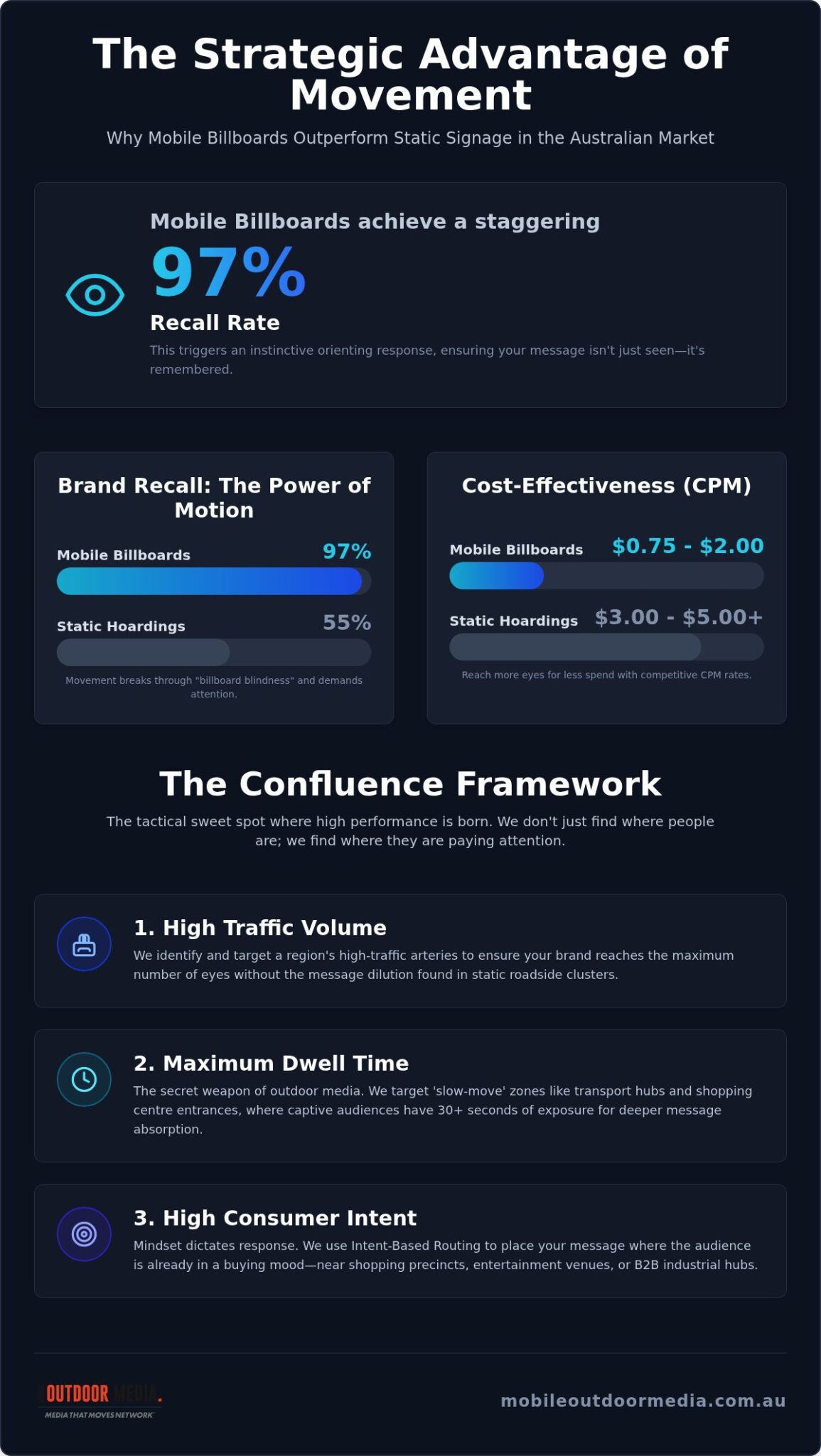
The psychology is simple. Human brains prioritise movement. When a mobile billboard enters a driver’s peripheral vision, it triggers an instinctive orienting response. This isn’t just theory. Research shows that mobile truck advertising achieves a 97% recall rate. Compare that to the 55% recall typically found with static formats, and the winner is clear. Strategic movement ensures your message isn’t just seen, it’s remembered.
The Evolution of Out-of-Home (OOH) in Australia
Outdoor media has moved far beyond static paper posters. High-definition Digital Mobile Billboards now dominate the landscape. In 2026, we don’t just hope people see your ad. We use data to ensure your message is exactly where the crowd is. This shift from mass reach to strategic presence is the core of modern mobile billboard placement strategies. We don’t settle for being somewhere; we aim to be everywhere that matters.
Breaking Down the ROI of Mobility
Efficiency is about more than just a low price tag. It’s about impact per dollar. Fixed billboards in major Australian metro centres can cost thousands per month, often with long-term lock-in contracts. Mobile assets offer a far more competitive cost-per-thousand (CPM). While static boards often see a CPM of $3 to $5, mobile billboards typically sit between $0.75 and $2. You’re getting more eyes for less spend.
You also gain the advantage of being the only ad in sight. In a cluttered shopping precinct or at a major stadium exit, your mobile asset stands alone. It isn’t fighting ten other signs for a fraction of a second. It’s unmissable. This flexibility allows you to reach multiple high-value precincts in a single day, pivoting your route based on real-time traffic or event schedules. You isn’t stuck in one spot while the target audience moves elsewhere.
The Confluence Framework: Mapping Traffic, Dwell Time, and Intent
Driving a truck around aimlessly isn’t a strategy; it’s a waste of your marketing budget. To achieve real-world impact, we use the Confluence Framework. This is the tactical sweet spot where high traffic volume, long dwell times, and a specific consumer mindset intersect. It’s the foundation of all high-performance mobile billboard placement strategies. We don’t just look for where people are; we look for where they’re paying attention.
Volume is the first pillar. We identify high-traffic arteries that serve as the lifeblood of a region. However, sheer numbers aren’t enough. You don’t want your message lost in a cluttered environment. We target routes where your asset is the dominant visual force. By mapping these arteries, we ensure your brand reaches the maximum number of eyes without the dilution found in static roadside clusters.
Analysing Dwell Time for Maximum Impact
Dwell time is the secret weapon of outdoor media. In high-speed zones, you have seconds to make an impression. In “slow-move” zones, like transport hubs or shopping centre entrances, commuters often have 30 seconds or more of exposure. This captive window is perfect for high-impact assets like Event Screens. Longer dwell times allow you to communicate complex, multi-frame digital messages that tell a story rather than just showing a logo. It’s about moving from a glance to a deep impression.
Intent-Based Routing Strategies
Mindset dictates response. Targeting industrial precincts is essential for B2B campaigns, while lifestyle brands find more success along coastal strips or entertainment precincts. Intent-Based Routing is a method of placing ads where the next logical step for the consumer is a purchase. If you’re a retail brand, positioning your asset near a major shopping precinct captures people when “recency of purchase” is at its peak. They’re already in the buying mood, and your ad provides the final nudge toward a sale.
Every route we plan is designed to be both aggressive and compliant. We ensure all national campaigns strictly follow the Australian advertising self-regulatory system. This maintains your brand’s professional reputation while you’re out-manoeuvring the competition. If you’re ready to dominate your next precinct, discuss your tactical route with our team today.
Asset Selection: Matching Billboard Mobility to Your Campaign Environment
Selecting the right asset is as critical as the route itself. A “one size fits all” approach leads to wasted spend and missed opportunities. High-impact mobile billboard placement strategies require you to match the mobility of the unit to the specific demands of the environment. If you’re running a metropolitan “blitz” campaign, Digital Mobile Billboards provide the scale and brightness needed to dominate busy intersections. For closer engagement, street-level tools like Digital Bike Boards or Walking Boards bridge the gap between the road and the shop front, capturing “last-mile” attention where vehicles can’t go.
When to Choose Relocatable vs. Moving Billboards
Static roadside leases often come with eye-watering costs and rigid multi-year commitments. Relocatable Billboard Advertising offers a smarter, flexible alternative for semi-permanent site presence. These units are perfect for construction sites, long-term infrastructure projects, or new housing developments where you need to own a specific location for months, not days. Unlike fixed hoardings, you can adjust the placement of a relocatable unit to ensure perfect sight-lines as the site evolves. You get the authority of a permanent sign without the logistical or financial shackles of a traditional lease.
The Power of Solar-Powered Placement
Visibility shouldn’t stop when the sun goes down or when mains power isn’t available. Digital Solar Outdoor Signage represents the next step in sustainable, versatile OOH. These Solar Ad Trailers are completely silent; this makes them the superior choice for noise-sensitive event precincts or quiet regional areas. They provide 24/7 visibility, maintaining a bright, clear message through the night using stored renewable energy. This allows your brand to maintain a constant presence in locations where a running engine or external generator would be prohibited.
Data from the Australian Bureau of Statistics Survey of Motor Vehicle Use shows the sheer volume of travel across our road networks. This mobility is exactly what we exploit. Whether it’s a Digital Mobile Billboard moving through peak-hour traffic or a Solar Ad Trailer anchored in a high-growth regional hub, the goal remains the same: unmissable impact. By choosing the right asset, you ensure your message isn’t just present; it’s perfectly adapted to its surroundings.
5 High-Impact Mobile Billboard Placement Strategies for 2026
Successful campaigns aren’t accidental. They’re the result of aggressive, calculated moves. In 2026, the most effective mobile billboard placement strategies focus on high-impact interception. You don’t wait for your audience to find you; you go where they’re already gathered. Whether you’re launching a new product or defending your market share, these five tactical approaches ensure your brand remains unmissable.
- Event Domination: Circling major stadiums and festival precincts during peak attendance.
- Commuter Shadow: Following the flow of traffic during morning and afternoon bottlenecks.
- Retail Intercept: Positioning near major shopping centre entrances to influence immediate purchase decisions.
- Competitor Conquest: Placing your message directly outside a rival’s flagship location to steal their thunder.
- Hyper-Local Activation: Using walking boards and bike boards for direct engagement in pedestrian-only zones.
Tactical Execution of the Event Domination Strategy
Timing is everything. Arriving early for “bump-in” catches the staff and early arrivals; staying late for “bump-out” captures the entire departing crowd when their attention is high. We often use Event Screen 8 units for real-time promotional updates or crowd management. This turns a mobile asset into a dynamic part of the event experience. We handle the logistical heavy lifting of navigating local council regulations. This ensures your mobile asset stays compliant while remaining front and centre in the most valuable precincts.
Last-Mile Engagement with Bike and Walking Boards
Sometimes the best placement isn’t on the road at all. Pedestrian malls and high-density urban centres are often restricted for trucks. This is where human-centric media excels. Digital Bike Board Advertising allows for urban guerrilla marketing that weaves through the crowd. These assets reach areas that traditional vehicles simply cannot enter. Walking boards provide a face-to-face brand experience that digital screens alone cannot match. These tools are perfect for grand openings or hyper-local activations where you need to be within arm’s reach of your customer.
Execution is about precision. By matching these strategies to your specific campaign goals, you transform outdoor media from a passive display into a proactive business tool. You isn’t just buying space; you’re owning the environment.
Executing Your National Campaign with Mobile Outdoor Media
Planning is only half the battle. Execution is where your ROI is won or lost. At Mobile Outdoor Media, we take a “Straight Talk” approach to national Australian campaigns. We don’t hide behind jargon or vague promises. Instead, we provide a turnkey solution that handles every moving part of your strategy. From sophisticated mobile billboard placement strategies to the final reporting, we ensure your brand dominates the precinct without you having to lift a finger.
Our fleet is built for versatility and scale. Whether you need high-definition Digital Mobile Billboards for a city blitz or Solar Ad Trailers for silent, 24/7 regional visibility, we have the assets ready to deploy. We manage the logistics, the professional drivers, and the on-board technology. This allows you to focus on your business while we ensure your message reaches up to 80,000 potential customers per day, per truck.
Data drives our decisions. We don’t just drive; we track. Our reporting proves the impact of your placement strategy, giving you clear visibility on how your campaign performed across different routes and time slots. This transparency is why the biggest brands in the country trust us with their outdoor media spend. We provide the proof you need to justify every dollar of your marketing budget.
Nationwide Reach and Local Precision
Consistency is vital for a national brand. We maintain the same high standards of quality and execution across all Australian states and territories. Working with a single partner for multi-region campaigns eliminates the headache of managing multiple contractors. You get one point of contact and a unified strategy that works just as effectively in a regional hub as it does in a major metropolitan centre. For a deeper look at the market, see our Mobile Outdoor Advertising Australia: 2026 Trend Analysis.
Getting Started: From Brief to Deployment
Our process begins with a direct consultation. We match your specific business goals to the most effective mobile billboard placement strategies, ensuring your creative is optimised for a mobile environment. We don’t just take an order; we provide a tactical roadmap for success. Once the brief is locked, we move fast. Our team handles the routing and deployment with the speed and precision that modern Australian campaigns demand.
Contact Mobile Outdoor Media for a strategic placement quote today
Own the Precinct with Tactical Precision
Winning the battle for attention requires more than just showing up; it requires a tactical hunt for your audience. By moving beyond fixed roadside boards and embracing the Confluence Framework, you ensure your brand isn’t just seen but remembered. Success lies in matching high-impact assets to the right environments, whether that’s a digital truck in peak traffic or a solar trailer in a quiet regional hub. You’ve seen how movement triggers recall, and now it’s time to put that psychology to work.
Mastering these mobile billboard placement strategies turns your outdoor media into a high-performance engine for growth. With over 25 years of industry-leading experience, Mobile Outdoor Media provides the national coverage and turnkey management needed to execute flawless campaigns across all major Australian metropolitan areas. We handle the logistics, the tech, and the routing, ensuring your message lands with maximum impact and measurable results.
It’s time to stop waiting for customers to notice your static signs. Take your message directly to the crowd and dominate your market with absolute confidence.
Frequently Asked Questions
How do you track the location of the mobile billboards?
We use real-time GPS tracking systems to monitor every asset in our national fleet. This ensures your mobile billboard placement strategies are executed exactly as planned. Clients receive detailed reports showing the precise routes taken and the time spent in specific high-traffic precincts. This transparency allows for data-driven adjustments and verifies that your message reached the intended audience throughout the entire campaign duration.
Can mobile billboards be parked in one spot for an entire day?
Parking a mobile billboard in a single spot for an extended period is subject to local council regulations and road safety restrictions. While relocatable billboards are specifically designed for semi-permanent placement, traditional mobile trucks often need to remain in motion to comply with parking laws. We manage these logistics by planning routes that maximise visibility while ensuring all deployments remain fully compliant with Australian advertising standards and local laws.
What are the best times of day for mobile billboard placement?
The most effective times for placement coincide with peak traffic windows and major event schedules. Target the morning and afternoon commuter peaks to capture high volumes of slow-moving vehicles during bottlenecks. For event-based campaigns, timing the deployment to match “bump-in” and “bump-out” periods at stadiums or festival precincts ensures you reach the maximum audience when their attention is most focused on the surrounding environment.
Do mobile billboards require special council permits in Australia?
Yes, permits are often required, but the specific requirements vary significantly across different Australian states and local councils. For example, placing portable boards in high-pedestrian areas in certain metro centres may require specific permits and public liability insurance. We navigate these complex regulatory landscapes for you, ensuring that every asset in your campaign meets the necessary legal standards and council approvals before deployment.
How many hours a day does a mobile billboard typically operate?
Standard mobile billboard trucks typically operate for eight hours per day to align with peak traffic and pedestrian periods. However, our Solar Ad Trailers offer 24/7 visibility, maintaining a bright presence through the night without the need for external power or running engines. This flexibility allows us to tailor the operating window to your specific mobile billboard placement strategies, whether you need a high-impact daytime blitz or round-the-clock exposure.
What happens if there is heavy rain or extreme weather during the campaign?
Our digital fleet is built to withstand standard Australian weather conditions, including heavy rain. The high-brightness LED screens remain clearly visible even in poor light or wet conditions, ensuring your campaign continues without interruption. In the event of extreme weather warnings that pose a safety risk to our drivers or the public, we prioritise safety and may temporarily pause operations, resuming as soon as conditions are deemed safe.
Can we change the digital creative while the truck is on its route?
Yes, one of the primary advantages of our digital fleet is the ability to update creative content remotely and in real-time. We can change your message while the truck is on its route to reflect time-sensitive offers, countdowns, or different creative for morning versus afternoon audiences. This agility ensures your campaign remains relevant and allows for rapid pivots if you identify new opportunities during the deployment.
Are solar ad trailers as bright as traditional digital billboards?
Solar Ad Trailers utilise advanced, high-efficiency LED technology designed to deliver brightness levels comparable to traditional digital billboards. They feature automatic dimming sensors that adjust the screen’s output based on ambient light conditions, ensuring the message is vibrant during the day and clear at night. This ensures your brand maintains a premium, high-impact appearance while benefiting from the silent, sustainable operation of a renewable power source.