Click to Call
How to Master Walking Board Marketing Solutions for Your 2026 Brand Activations
Traditional billboards are stationary, expensive, and often miles away from where your actual customers are walking. In the competitive 2026 market, waiting for people to drive past your ad isn’t a strategy; it’s a gamble. You need to meet your audience where they live, work, and shop. Professional walking board marketing solutions turn your brand message into a mobile, breathing interaction that cuts through the digital noise. These aren’t just signs. They are high-impact tools designed to dominate crowded footpaths and event perimeters where static media simply cannot reach.
You probably agree that eye-level engagement is the most effective way to spark a conversation, yet tracking the ROI of street-level activations often feels like guesswork. It’s time to change that. We’ll show you exactly how to plan, execute, and measure a high-impact walking board campaign that puts your brand directly in front of your target audience. From selecting backlit hardware for night-time visibility to coordinating a seamless national rollout, this guide provides the blueprint for flexible, high-visibility marketing that actually converts.
Key Takeaways
- Learn how walking boards penetrate pedestrian zones where traditional billboards are restricted, putting your brand at eye-level with your target audience.
- Master the logistics of walking board marketing solutions by defining high-traffic zones based on audience data and street-level design principles.
- Discover how to integrate product sampling and flyer distribution to turn passive views into active, memorable brand interactions.
- Shift from estimated footfall to hard data by implementing unique promo codes and dedicated QR landing pages to measure your campaign’s true conversion rate.
- Leverage national logistics and premium backlit hardware to ensure your brand maintains a consistent, high-intensity presence across every major Australian market.
What are Walking Board Marketing Solutions?
Walking board marketing solutions represent the strategic intersection of traditional out-of-home (OOH) media and direct brand activation. While the history of human billboards dates back over a century, the 2026 iteration is a high-tech, lightweight system designed for maximum impact in crowded urban centres. These displays are worn by professional brand ambassadors, allowing your message to penetrate pedestrian malls, transit hubs, and event perimeters where vehicles or fixed billboards are legally prohibited. It is a mobile, breathing advertisement that moves exactly where your audience goes.
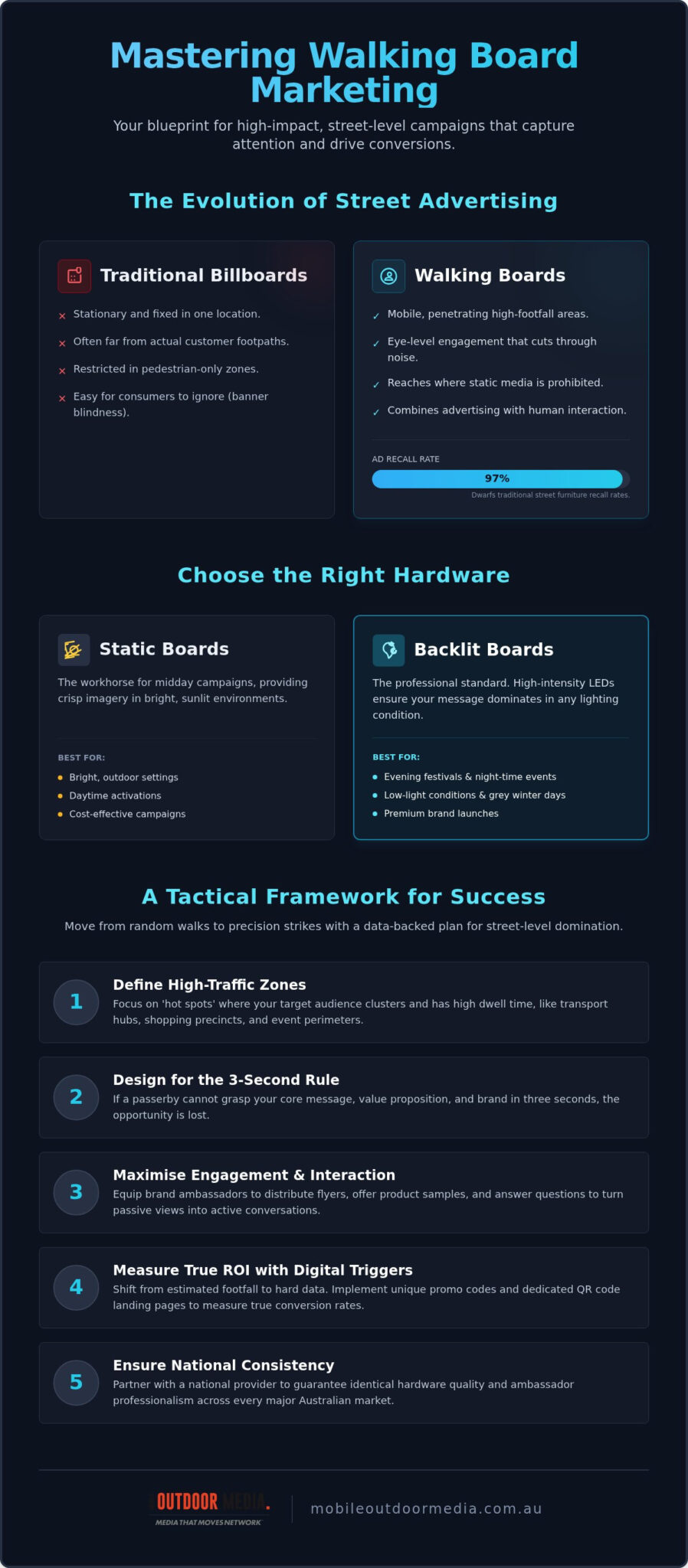
Across Australia, local council regulations often restrict static signage in high-footfall areas such as bustling pedestrian malls or vibrant commercial precincts. Modern walking board advertising bypasses these hurdles. These boards don’t just sit there. They move with the crowd. Research indicates that mobile billboard ads achieve a recall rate of up to 97%, a figure that dwarfs traditional street furniture. This high recall stems from the eye-level positioning and the novelty of the medium, which forces engagement in a way a static poster cannot.
Static vs. Backlit Walking Boards
Choosing the right hardware depends on your specific activation environment. Static boards are the workhorse of midday campaigns in bright, outdoor settings. They are cost-effective and provide crisp imagery under direct Australian sunlight. However, for 2026 brand launches, backlit boards have become the professional standard. These units feature high-intensity LED panels that ensure your creative pops in low-light conditions, evening festivals, or grey winter days. We prioritise ergonomic, lightweight frames to ensure ambassadors remain energetic and approachable. Comfort isn’t just about the staff; it’s about maintaining a professional brand image throughout a full shift.
The Role of the ‘Human Billboard’ in 2026
A sign can’t answer a question. An ambassador can. In a world saturated by digital noise, street-level engagement builds trust faster than any social media ad. The ambassador isn’t just a carrier; they are a point of interaction. They can distribute samples, explain a service, or guide a user through a QR code scan on the spot. This human element transforms a passive viewing experience into an active brand interaction. By combining high-visibility hardware with trained personnel, you create a touchpoint that is both authoritative and personal. Walking board marketing is the intersection of OOH and direct brand activation. It’s about owning the street, not just being on it.
How to Plan a Successful Walking Board Campaign
Mastering walking board marketing solutions requires more than just hiring staff and printing signs. It demands a tactical framework that aligns with the specific habits of Australian urban commuters. Planning is the difference between a random walk and a precision strike. To dominate the street level, you must move from broad visibility to data-backed targeting that ensures your brand message lands exactly where your audience is most receptive.
The first step is defining your high-traffic zones based on audience data, not just raw footfall. Total pedestrian numbers are a vanity metric if those individuals don’t match your buyer persona. Align your creative design with the 3-second rule; if a passerby cannot grasp your core message in three seconds, the window of opportunity closes. Organise your ambassador routes to coincide with peak commute times at major transport hubs or specific event schedules. This synchronisation ensures your message is present when the crowd density is at its highest.
Integrate digital triggers like QR codes to bridge the gap between physical visibility and immediate lead capture. Finally, partner with a national provider to ensure consistent quality across all locations. Whether your campaign is running in the Sydney CBD or the streets of Perth, the hardware and ambassador professionalism must be identical. According to the Out of Home Advertising Association of America (OAAA), the integration of physical OOH with mobile triggers significantly boosts consumer engagement and online search activity following an encounter.
Audience Profiling and Route Mapping
Success depends on identifying ‘hot spots’ where your specific demographic clusters. Focus on transport hubs like Flinders Street in Melbourne or Central Station in Sydney, as well as shopping precincts and stadium surrounds during major sporting events. Don’t just look for movement; look for dwell time. People waiting at tram stops or traffic lights are your highest-value targets because they have the mental bandwidth to engage. Always ensure your routes are compliant with local council regulations across Australia to prevent campaign interruptions. If you are ready to map out your next urban takeover, you can discuss your route strategy with our team.
Creative Specifications for Maximum Impact
Street-level creative requires a different approach to digital or magazine ads. Use bold, high-contrast colours and minimal text to ensure readability from 10 metres away. A singular, clear Call to Action (CTA) is essential for driving immediate results. Avoid cluttering the board with secondary messages or fine print that pedestrians won’t read. You can see our walking board advertising specs for design inspiration before you start your creative build. Keeping the design punchy and professional ensures your brand maintains its authority on the street.
Maximising Engagement: Content and Interaction
Engagement is the true currency of street-level marketing. While planning and creative design establish the foundation, the interaction between your brand ambassador and the public determines the campaign’s final ROI. Professional walking board marketing solutions excel because they bridge the gap between a visual impression and a physical action. When an ambassador carries a high-intensity backlit board, they aren’t just a sign. They are an active point of sale capable of distributing product samples, vouchers, or flyers directly into the hands of your target demographic.
To achieve a “surround sound” street effect, many brands now combine walking boards with digital bike boards. This creates a multi-layered presence where your message occupies the road and the footpath simultaneously. During twilight activations, the backlighting on the walking boards ensures your team dominates the visual landscape, making it impossible for pedestrians to miss the interaction opportunity. This layered approach forces the crowd to acknowledge your brand from multiple angles, increasing the likelihood of a direct engagement. If you’re considering adding this format to your campaign mix, our digital bike board hire 2026 Australian buying guide covers everything you need to know about costs, hardware, and deployment strategies.
Staff Training and Engagement Protocols
The success of your activation rests on the quality of your staff. Ambassadors must be trained to be proactive without being intrusive. We focus on developing punchy elevator pitches that convey the brand’s core value in under ten seconds. Safety and professionalism are non-negotiable. Every team member must represent your brand’s values, maintaining high energy even at the end of a shift. For campaign transparency, we utilise real-time check-ins and photo reporting. This allows you to see exactly where and how your brand is being represented at any given moment. High-performance walking board marketing solutions depend as much on the person as they do on the hardware.
Integrating Digital Elements
In 2026, street marketing must be digitally integrated to capture leads instantly. QR codes remain a staple, linking physical movement to dedicated landing pages or app downloads. However, the next step is creating “Instagrammable” moments. Boards designed with striking visuals or witty copy encourage passersby to take photos and share them online, providing organic reach at no extra cost. For tech-savvy Australian audiences, NFC (Near Field Communication) offers an even faster way to engage. A simple tap of a smartphone against the board can trigger a website launch or a digital coupon, removing all friction from the customer journey. This digital-physical hybrid ensures your street presence has a measurable online tail. For brands looking to push this further, exploring guerrilla marketing equipment hire options can unlock a broader arsenal of mobile assets to amplify your street-level impact across Australia.
Measuring Success and ROI in Street Marketing
Vanity metrics like “estimated impressions” are no longer sufficient for high-stakes brand activations. You need to know if your spend is actually moving the needle. Modern walking board marketing solutions allow you to shift from guesswork to verified engagements. By tracking how many people actually took a flyer, scanned a code, or spoke to an ambassador, you gain a clear picture of campaign performance. This transparency is vital when comparing the cost-per-acquisition (CPA) of street marketing against rising digital social spend. Industry data shows physical OOH achieves a 40% ROI, which remains competitive against digital advertising’s 38% despite the saturated online landscape. While a social media ad might get a half-second scroll, a physical interaction on a Sydney street corner creates a lasting memory.
Data-Driven Campaign Refinement
Post-campaign reports provide the intelligence needed to optimise future phases. We analyse foot traffic data to identify which specific time slots and locations delivered the highest engagement rates. If a morning commute at Melbourne’s Flinders Street outperformed an afternoon session, we pivot the resource accordingly. 2026 tracking technology has revolutionised OOH transparency by providing real-time interaction logs that were once impossible to capture. This allows you to test different creative variations in the field and double down on the messaging that resonates most with the Australian public. We don’t just report numbers; we provide actionable insights to refine your national rollout.
Long-Term Brand Sentiment
The true value of walking board marketing solutions often extends beyond the immediate conversion. This face-to-face interaction creates a ‘halo effect’ that strengthens long-term brand loyalty. When a person has a positive conversation with a brand ambassador, their sentiment toward that company improves. We gather qualitative feedback from our teams to understand exactly how the public is reacting to your message. This “boots on the ground” intelligence is essential for understanding the broader context of street level advertising Australia and how it fits into your wider marketing mix. It turns a simple ad into a genuine brand connection.
Why Mobile Outdoor Media for Your National Rollout?
Selecting the right partner for your 2026 activations isn’t just about finding a vendor. It’s about securing a logistics expert who understands the nuances of the Australian urban landscape. We provide national walking board marketing solutions that ensure your brand message remains consistent from the Melbourne CBD to the streets of Perth. Managing multiple agencies across different states is a recipe for fragmented messaging and logistical headaches. By choosing a single partner, you guarantee that every ambassador is trained to the same standard and every piece of hardware is in peak condition.
Our premium hardware is a core differentiator. We don’t use clunky, outdated signs. Our walking boards are lightweight, ergonomic, and equipped with high-intensity backlighting for maximum visibility during evening activations. This focus on quality ensures your team stays energetic and professional throughout the campaign. With decades of experience in high-impact mobile billboard advertising, we’ve refined the process of street-level deployment. We take a no-nonsense approach to marketing. You provide the brand vision; we handle the permits, the personnel, and the precision routing.
A Complete Suite of Mobile Solutions
A successful brand launch often requires a multi-layered approach. While walking boards are perfect for eye-level engagement in pedestrian malls, you may need to scale your presence as the campaign grows. Our infrastructure allows you to seamlessly integrate other assets, such as digital mobile billboards, to capture attention on major arterial roads. This single-partner solution simplifies your reporting and ensures a unified brand voice across all media types. Whether you’re running a boutique local activation or a massive multi-state rollout, we have the scale and the expertise to execute without friction.
Consistency is the key to brand authority. When you partner with us, you gain access to a national network that treats your campaign with the same level of precision, regardless of location. We understand that your time is valuable. That’s why we’ve built our business around efficiency and results rather than empty promises. Ready to get your brand moving? Book your 2026 walking board campaign now.
Dominate the Urban Landscape in 2026
Dominating the street level requires more than just high-level visibility; it requires a physical presence that pedestrians simply can’t ignore. Mastering walking board marketing solutions involves a tactical blend of data-backed route mapping and high-impact hardware. You’ve learnt how eye-level engagement bridges the gap between out-of-home advertising and direct customer interaction, bypassing the limitations of fixed signage. By prioritising trained ambassadors and modern tracking technology, you transform the street into a high-converting sales floor.
Our team provides the logistical backbone for Australia-wide deployment. We offer high-intensity LED backlit technology for 24/7 visibility and a seamless integration with digital bike boards and solar ad trailers to ensure a “surround sound” brand effect. Don’t settle for stationary ads that hope for a glance. Choose a flexible, national solution that puts your brand message directly into the hands of your target audience with professional precision.
It’s time to stop fighting for attention online and start owning the physical space where your customers live and work. Let’s make your next activation impossible to miss.
Frequently Asked Questions
What is the battery life of a backlit walking board?
Our high-intensity backlit boards typically offer a battery life of six to eight hours on a single charge. This ensures your creative remains illuminated throughout a full peak-hour shift or an entire evening festival activation. We use premium lithium-ion technology to maintain consistent brightness levels, ensuring your brand doesn’t fade as the sun goes down or the shift progresses.
Can walking boards be used in rainy weather?
Walking boards are built to be water-resistant and can operate effectively in light to moderate rain. The hardware is designed to protect the internal LED components and the printed creative from moisture. However, for the safety and comfort of our brand ambassadors, we may pause activations during extreme weather events or heavy storms to maintain a professional brand image.
How many walking boards do I need for an effective campaign?
The ideal number of boards depends on the density of your target zone and the scale of your goals. For a single transport hub or street corner, a team of two to four ambassadors is usually sufficient to create impact. For a city-wide takeover or large-scale walking board marketing solutions, we recommend a fleet of ten or more boards to ensure consistent frequency and reach across multiple CBD locations.
Do I need a permit for walking board marketing in Australia?
Permit requirements vary significantly between local councils across Australia. While walking boards are generally less restricted than stationary billboards or vehicle-based media, specific pedestrian malls and high-traffic precincts often require prior approval. We manage the permit application process and local council liaisons as part of our logistics service to ensure your campaign remains fully compliant and uninterrupted.
Can ambassadors distribute samples while wearing the boards?
Direct interaction is one of the primary advantages of this medium. Ambassadors are encouraged to distribute product samples, flyers, or vouchers while wearing the boards to turn a passive view into a tangible lead. This dual-action approach maximises the ROI of your walking board marketing solutions by combining high-impact out-of-home visibility with the personal touch of experiential marketing.
What is the lead time for a national walking board rollout?
A comprehensive national rollout typically requires a lead time of two to four weeks. This window allows for high-quality creative production, the coordination of logistics across different states, and the specific training of brand ambassadors. If you have a shorter timeframe for a single-city activation, we can often expedite the process depending on hardware availability and the complexity of your route mapping.
How do I track the location of the brand ambassadors?
We provide full transparency through real-time GPS tracking and detailed photo reporting. You’ll receive verified data showing exactly where your ambassadors are positioned and how they are moving through your designated high-traffic zones. This post-campaign data is essential for measuring engagement and refining your strategy for future phases of your brand activation.
Are walking boards effective for B2B marketing?
Walking boards are exceptionally effective for B2B brands when deployed strategically near industry conferences, trade shows, or business districts. They allow you to bypass the digital clutter of LinkedIn or email and reach decision-makers at eye level as they move between venues. By positioning your message directly outside a competitor’s event, you can capture a highly targeted professional audience with precision. Brands seeking maximum agility across these environments should also review the latest guerrilla marketing equipment hire options for high-impact Aussie campaigns to build a complete mobile activation toolkit.