Click to Call

Street Level Advertising Australia: The 2026 Reference Guide to High-Impact OOH
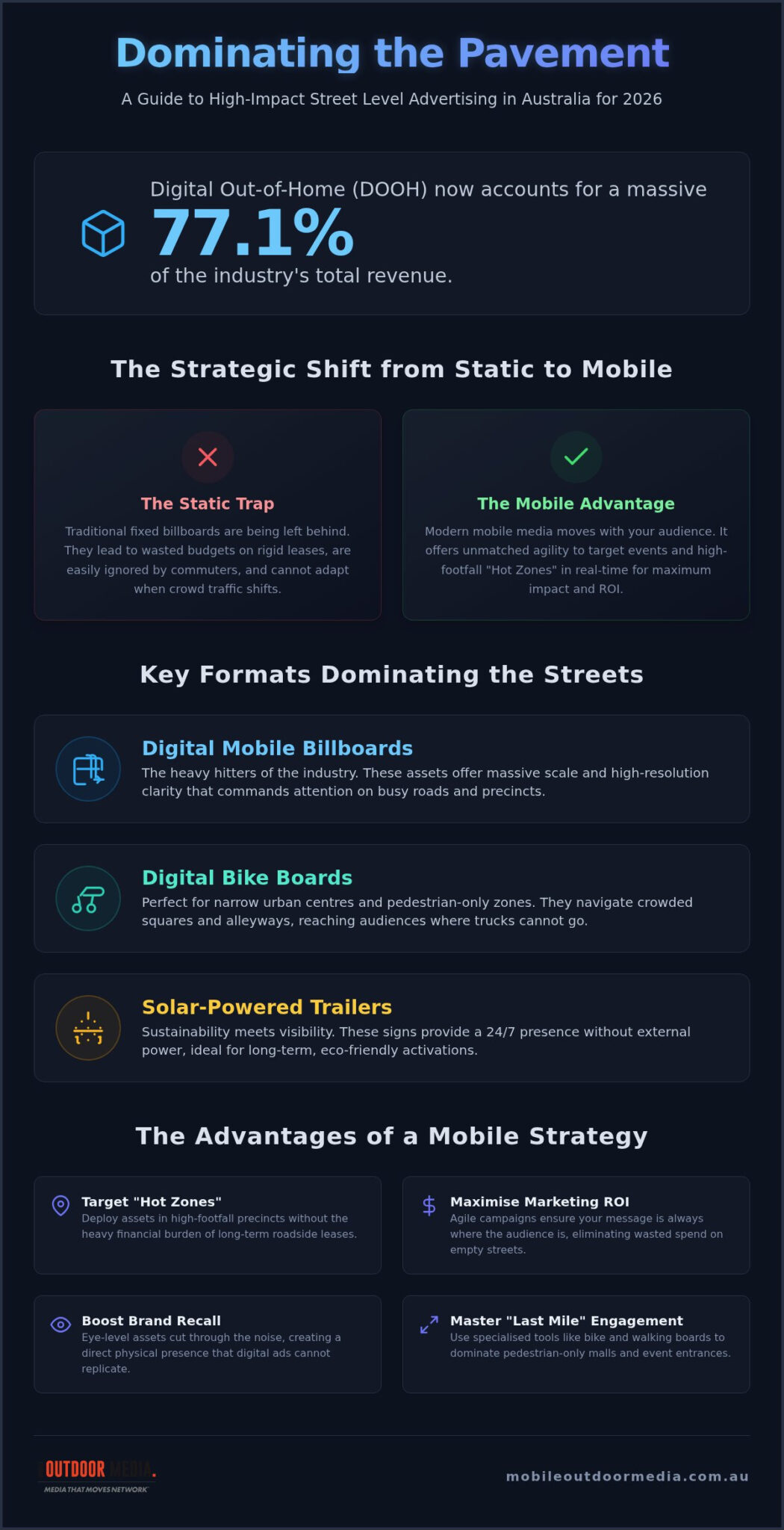
Digital Out-of-Home advertising now accounts for a massive 77.1% of the industry’s revenue, yet many brands are still wasting budget on static displays that commuters simply ignore. You’ve likely noticed that as CPC costs climb and digital ad fatigue sets in, winning at street level advertising australia requires more than just a fixed position. It’s frustrating to watch your marketing spend vanish into rigid leases that can’t pivot when the crowd moves. We know that traditional outdoor media often feels like a gamble rather than a calculated strike.
This reference guide will teach you how to master the art of engagement by prioritising mobility and precision. You’ll learn how to leverage digital mobile billboards, solar ad trailers, and digital bike boards to put your brand exactly where the action is. We’re breaking down the tactics for hyper-local engagement and showing you how to achieve massive brand recall with flexible, cost-effective campaigns. From understanding local council regulations to deploying walking boards in high-footfall precincts across the nation, this is your roadmap to dominating the Australian pavement in 2026.
Key Takeaways
- Move with the crowd by swapping static, ignored placements for mobile billboards that adapt to real-time event shifts and precinct traffic.
- Maximise your marketing ROI with street level advertising australia by targeting specific “Hot Zones” without the heavy financial burden of long-term roadside leases.
- Master “Last Mile” engagement in pedestrian-only malls and high-footfall precincts using specialised assets like walking boards and digital bike boards.
- Capitalise on the 2026 DOOH boom by deploying high-impact digital screens that capture attention at eye level where traditional media fails.
- Ensure national campaign consistency by partnering with experts who offer a versatile fleet and proven logistical precision across every Australian state.
What is Street Level Advertising in the Australian Context?
Street level advertising isn’t just a poster on a bus shelter. It’s any media that meets the consumer at eye level; right in their direct line of sight. This proximity creates a massive advantage for brand recall. While drivers might glance at a high-rise billboard for a split second, pedestrians and commuters engage with street-level assets for significantly longer. It’s about being present in their physical world during their daily routine. To understand the broader industry, you can look at What is Out-of-Home (OOH) Advertising; it’s the bridge between your brand’s message and the consumer’s physical environment. In 2026, street level advertising australia has evolved into a high-tech, data-driven field that prioritises mobility and agility over static, fixed placements.
Reaching consumers at the “point of purchase” or intent is the ultimate goal. When an ad is positioned at eye level near a retail precinct or event entrance, the path to conversion is shortened. It’s an aggressive, tactical approach that ensures your brand isn’t just a background detail in a skyline but a dominant force on the pavement.
The Evolution of Australian Out-of-Home Media
We’ve moved past the days of hand-painted signs and static paper posters. Today, the market demands high-definition LED screens that move with the crowd. Australian consumers in 2026 are increasingly cynical toward digital banner ads but remain receptive to physical brand presence. Urban development in cities like Sydney and Melbourne has made fixed assets harder to secure and more expensive. Relocatable media has emerged as the logical response. It’s a strategy designed for a world where “prime locations” shift based on time of day, weekend footfall, and major event schedules. Brands now value the ability to pivot their location within hours rather than being locked into a three-month lease for a static board.
Key Formats Dominating the Streets
Selecting the right asset is the difference between being seen and being ignored. Every campaign has different logistical requirements.
- Digital Mobile Billboards: These are the heavy hitters of the industry. They offer massive scale and high-resolution clarity that commands attention on any busy road or precinct. You can view the specifications for digital mobile billboards to see how they fit your strategy.
- Digital Bike Boards: These are perfect for narrow urban centres and pedestrian-heavy zones. They go where trucks cannot; navigating alleyways and crowded squares with ease. Explore digital bike board advertising for your next agile campaign.
- Solar-Powered Trailers: Sustainability meets visibility. These digital solar outdoor signage options provide 24/7 presence without the need for external power sources, making them ideal for long-term activations.
The Strategic Advantages of Mobile and Relocatable Media
Agility is the defining factor of modern outdoor marketing. While fixed billboards remain anchored to a single spot regardless of traffic changes, mobile media thrives on movement. If a major sporting event shifts the crowd from the CBD to a stadium precinct, your message follows them. This flexibility ensures you aren’t wasting budget on empty streets. It’s a calculated strike. By avoiding the long-term, high-cost leases associated with fixed roadside assets, you maintain control over your campaign duration and location. You don’t have to be locked into a six-month contract for a board that might be obstructed by new construction next week.
Street level advertising australia allows you to cut through the visual noise. Traditional high-rise boards are often part of a cluttered skyline, but eye-level assets occupy a space that’s still relatively open. This proximity creates a physical presence that a digital banner on a smartphone simply cannot replicate. You’re not just a pixel on a screen; you’re a tangible part of the consumer’s environment. This direct engagement builds a level of trust and authority that digital-only brands often struggle to achieve.
Targeting High-Footfall Precincts Nationally
Maximising impact requires a deep understanding of local “Hot Zones”. Whether it’s the bustling shopping strips of Chapel Street in Melbourne or the transit hubs of Sydney’s George Street, your asset needs to be where the feet are. Using relocatable billboard advertising allows for a semi-permanent presence at these high-value sites without the permanence of a fixed lease. It’s about being unmissable. When planning these deployments, staying compliant with Australian advertising self-regulation is critical for maintaining brand reputation and ensuring long-term site access. We handle the logistics so you can focus on the message.
Complementing Digital Marketing Campaigns
Physical media acts as a powerful retargeting tool. When a consumer sees your brand on a high-definition mobile screen during their morning commute, your social media ads later that day feel more familiar. This is the “Halo Effect”. Physical presence validates your digital claims. Unmissable physical stunts or bold mobile displays also drive social sharing. People take photos of impressive street-level ads and post them online, giving your campaign organic reach that money can’t buy. It’s a seamless loop between the pavement and the palm of their hand. If you’re ready to bridge that gap, you can enquire about our fleet availability for your next campaign.
Planning a Street Level Campaign for Maximum ROI
Executing a successful street level advertising australia campaign requires more than just a vehicle and a route. It’s a surgical operation. To ensure your marketing spend delivers a measurable return, you must follow a methodical planning process. The first step is defining your “Hot Zones”. Don’t just guess where people are; use demographic data to identify where your specific audience works, shops, and socialises. A campaign for a luxury car brand belongs in a different precinct than one for a fast-food launch. Once you’ve mapped these zones, you need to select the right asset. For high-impact visibility on arterial roads and busy intersections, digital mobile billboards are the gold standard. If your goal is granular engagement in pedestrian-only malls, walking boards are the superior choice.
Optimising your creative is the third critical step. Street-level media demands a different design philosophy than print or digital banners. Finally, you must schedule your deployment for peak times. There is no point in having a mobile screen active in a business district at midnight. You strike during commute hours, lunch breaks, and the lead-up to major event starts to ensure every minute of airtime is seen by a maximum number of eyes. Professionalism also means compliance. Following the industry standards set by the Outdoor Media Association (OMA) ensures your campaign maintains high quality and stays within the bounds of Australian advertising regulations.
Creative Best Practices for Eye-Level Impact
You have three seconds. That’s the “3-Second Rule”. If a passerby cannot understand your core message, brand name, and call to action in three seconds, your creative has failed. Craft messages that land instantly. Use bold, high-contrast colours that can cut through the harsh Australian sunlight. Legibility is non-negotiable; choose sans-serif fonts that remain clear from a distance. To bridge the gap between the street and the smartphone, always include a large QR code or a short, memorable URL. This allows interested consumers to transition from physical awareness to digital conversion in seconds.
Timing and Frequency: When to Strike
Success in street-level media is about being in the right place at the right time. Morning pedestrian peaks in transit centres require a different route than afternoon shopping rushes. You need to adjust your assets’ movements to mirror the natural flow of the city. National event calendars provide perfect opportunities for high-impact short-term bursts. Whether it’s a grand final weekend or a major music festival, being present when the crowd is most concentrated yields the highest ROI. Consistency is also vital for local area marketing (LAM). Seeing a brand repeatedly in a specific precinct builds a level of local trust and authority that one-off ads cannot match.
Specialised Tools: Bike Boards and Walking Boards
Mobile billboards dominate the roads, but they can’t enter every urban space. The “Last Mile” represents the final hurdle in reaching a consumer right before they enter a store or event. Pedestrian-only malls, narrow city laneways, and crowded festival grounds are often off-limits to vehicles but remain prime real estate for engagement. This is where street level advertising australia becomes truly personal. By deploying specialised tools like bike boards and walking boards, you remove the physical barriers between your brand and your audience. These assets possess a high novelty factor that traditional media lacks. People don’t just glance at them; they stop, photograph, and share them on social media. It’s guerrilla marketing that generates organic reach without extra cost.
Human-centric marketing is the secret weapon here. When a brand ambassador carries your message, it’s no longer just an advertisement; it’s a recommendation. This physical presence creates a level of trust that a digital banner on a smartphone can’t match. You’re not just screaming into the void. You’re participating in the consumer’s world. This proximity ensures your brand is the last thing a customer sees before they make a purchasing decision.
Digital Bike Boards: The Urban Guerrilla Choice
Combining the mobility of a bicycle with the visual impact of high-bright LED screens is a tactical masterstroke. These units navigate narrow urban centres effortlessly, slipping through traffic where trucks would be stuck. Dominating the street level advertising australia market requires this kind of agility. They’re the perfect choice for accessing crowded event spaces where traditional OOH is strictly restricted or prohibitively expensive. You aren’t just placing an ad; you’re inserting your message into the literal flow of the city. Before committing to a campaign, reviewing a comprehensive digital bike board hire guide for 2026 will help you understand costs, formats, and deployment options across Australian cities. For a comprehensive breakdown of this strategy, see The Ultimate Guide to Launching a Bike Board Advertising Campaign in 2026.
Walking Boards: Interactive Street Presence
Walking board advertising introduces an interactive element that static screens simply cannot provide. These boards are perfect for store openings, product samples, or providing directional signage in complex precincts. They create a two-way conversation between the brand and the consumer. To achieve a true “takeover” effect, we recommend organising a team of walking boards to move through a high-footfall zone in a coordinated formation. It’s an unmissable sight that commands the entire pavement. This approach turns a simple campaign into a full-scale brand activation that drives immediate, measurable action. For a deeper dive into planning and executing these activations, explore our guide on walking board marketing solutions for your 2026 brand activations.
Request a quote for your street-level activation
Choosing Your National Street Level Media Partner
Executing a campaign across multiple states requires more than just a few vehicles. It demands a partner with a national footprint. When your brand message needs to resonate from the streets of Perth to the CBD of Brisbane, consistency is your greatest asset. If your street level advertising australia campaign lacks a unified look and feel, your brand authority suffers. We provide a single point of contact for national rollouts; simplifying what would otherwise be a logistical nightmare of varying permits and local regulations. This scale ensures that your high-impact message remains professional and potent regardless of the postcode.
Equipment quality is the next non-negotiable factor. The harsh Australian sun is a notorious killer of low-grade LED screens. You need high-bright, professional-grade technology that remains legible even in the glare of a Sydney summer midday. Reliability matters. A dead screen or a malfunctioning trailer isn’t just a technical glitch; it’s a hole in your ROI. We maintain our fleet to the highest standards, ensuring every asset is a credit to your brand. Transparency is equally vital. We provide live GPS tracking and comprehensive reporting for all mobile assets. You’ll never have to guess if your ad was in the right place at the right time. We prove it.
Mobile Outdoor Media’s National Fleet
Our inventory is designed for versatility and maximum impact. For brands looking to align their physical presence with sustainability goals, our digital solar outdoor signage offers an eco-friendly solution without sacrificing visibility. These units provide 24/7 engagement using clean energy. When the scale of the activation increases, our Event Screens (available in 8 and 16-square-metre options) become the focal point of the precinct. We don’t just offer trailers; we offer a professional-grade fleet that commands attention on any Australian street. Every asset we deploy is built to dominate its environment.
Ready to Own the Street?
We’ve stripped away the complexity of launching a street-level campaign. The process is fast. It starts with a simple enquiry, followed by a strategic consultation to define your Hot Zones and asset mix. We don’t believe in one-size-fits-all routes. Your deployment is bespoke; customised to match the specific timing and footfall patterns of your target audience. Whether you’re planning a short-term guerrilla strike or a long-term site presence, we have the infrastructure to make it happen. Our team handles the logistics, the permits, and the precision timing so you can focus on the results. It’s time to stop being invisible and start being unmissable.
Dominate the Pavement with Precision OOH
Street level advertising australia in 2026 demands a shift from passive placement to active engagement. You’ve learned that success lies in mobility; moving your message exactly where the crowd flows. By leveraging high-impact digital mobile billboards and agile walking boards, you ensure your brand is unmissable at the point of intent. Precision timing and “Hot Zone” targeting are the tools that turn a simple advertisement into a high-ROI brand activation that cuts through digital fatigue.
We provide the national Australian coverage you need to scale your message across every state with absolute consistency. Our fleet features state-of-the-art digital LED technology for maximum clarity in harsh sunlight and eco-friendly solar-powered options for sustainable visibility. You don’t have to settle for invisible billboards or rising digital costs. It’s time to take control of the street and put your brand exactly where it belongs: right in front of your customers.
Your audience is already out there on the move. We have the infrastructure and the expertise to help you reach them with absolute confidence and professional precision.
Frequently Asked Questions
Is street level advertising legal in all Australian states?
Street level advertising is legal across all Australian states. However, specific permit requirements and parking restrictions vary significantly between local councils. We manage the complex regulatory landscape for you to ensure every deployment is fully compliant with state laws and industry standards. Whether you’re targeting the Sydney CBD or a regional hub in Queensland, we navigate the red tape so your campaign stays on the move without legal interruptions.
How much does it cost to hire a mobile billboard in Australia?
Pricing for mobile billboards depends on several variables including the campaign duration, the number of units deployed, and the specific geographic “Hot Zones” you’re targeting. Factors like digital versus static formats and event-based scheduling also influence the final investment. We provide bespoke quotes tailored to your specific logistical needs and marketing objectives. Contact our team for a detailed breakdown based on your 2026 campaign requirements.
Can I track the location of my mobile billboard during the campaign?
Absolute transparency is a core part of our service. Every mobile asset in our fleet is equipped with live GPS tracking technology, allowing you to verify exactly where your brand is at any given moment. This data provides the proof of presence required for modern ROI reporting. You’ll receive comprehensive reports that confirm your message reached the intended high-footfall precincts as planned.
What is the lead time for launching a digital bike board campaign?
A standard digital bike board activation can typically be launched within 7 to 14 days, provided your creative assets are ready for deployment. This timeframe allows for route planning, brand ambassador scheduling, and system testing. If you need a faster turnaround for a reactive guerrilla marketing strike, our team can often expedite the process depending on fleet availability in your specific Australian city. For a full breakdown of what to expect when planning your investment, our 2026 Australian digital bike board hire buying guide covers pricing, formats, and lead times in detail.
Are solar ad trailers effective during cloudy weather or at night?
Our solar ad trailers are designed for 24/7 reliability regardless of the weather conditions. They utilise high-efficiency solar panels to charge internal battery systems, ensuring the high-bright LED screens remain fully operational throughout the night and during extended periods of overcast weather. This makes them a dependable choice for long-term activations in high-traffic areas where external power sources are unavailable.
What happens if it rains during a walking board activation?
Our walking boards are built with weather-resistant technology to handle light rain and typical urban conditions. However, the safety and presentation of our brand ambassadors are our top priorities. In the event of severe weather or heavy downpours, we pause the activation and resume once conditions improve. This ensures your brand is always represented professionally and your message remains clearly visible to passersby.
Can I change the digital creative on my billboard mid-campaign?
One of the primary advantages of digital street level advertising australia is the ability to update your creative instantly. You can swap messages to reflect time-of-day offers, react to live event results, or refresh your call to action to maintain high engagement levels. This flexibility allows for dynamic A/B testing and ensures your campaign remains relevant throughout its entire duration without the costs of re-printing.
How do I choose between a bike board and a traditional mobile billboard?
The choice depends on your target environment and campaign scale. Traditional mobile billboards offer massive reach and visibility on arterial roads and busy intersections. Digital bike boards are the superior choice for navigating narrow city laneways, pedestrian malls, and crowded event spaces where larger vehicles cannot go. If your goal is “Last Mile” engagement in high-density urban centres, the agility of a bike board is unmatchable.