Click to Call
Solar Powered Advertising Trailer Campaigns That Move
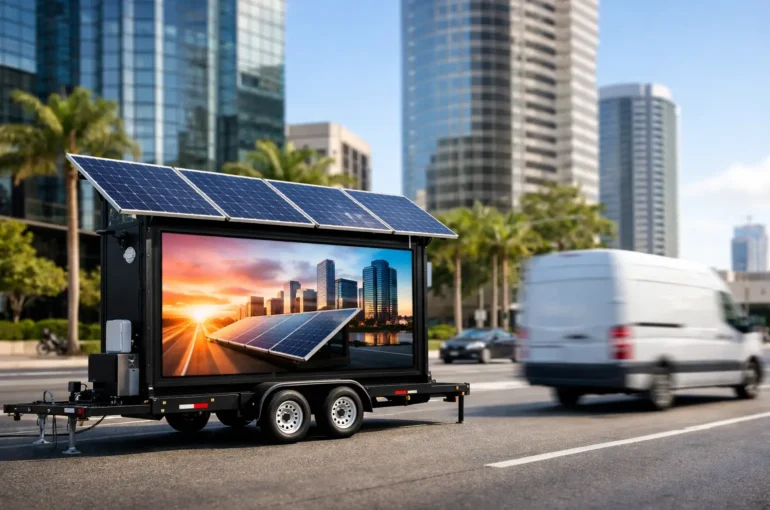
A crowded event precinct, a packed retail car park or a high-traffic roadside can deliver thousands of opportunities to be seen. The challenge is getting your message into that space without being locked into a fixed billboard site. A solar powered advertising trailer gives your campaign a large-format digital presence that can be positioned where the audience already is – then moved when the opportunity shifts.
For brands that need visibility, flexibility and practical campaign control, this is outdoor advertising built to work harder. Put a bright screen beside a venue entrance, near a busy shopping strip, at a community event or in a strategic regional location. Change the message when the day, crowd or campaign phase changes.
What Is a Solar Powered Advertising Trailer?
A solar powered advertising trailer is a relocatable digital display unit mounted on a purpose-built trailer. Solar panels help power the screen and onboard systems, allowing the unit to operate independently in suitable locations without relying on a permanent mains connection.
It combines the visual impact of a digital billboard with the placement flexibility of an event asset. Rather than buying a single fixed site for weeks or months, advertisers can deploy the screen where it has the best chance of being noticed. That may be outside a sporting venue before kick-off, adjacent to a retail centre during a sales period, or at a regional festival where traditional digital inventory is limited.
The solar component is not just a good talking point. It supports practical deployment in spaces where power access is limited, costly or inconvenient. This can make a meaningful difference for event organisers, property teams and campaign managers working across outdoor sites.
Why Solar Advertising Trailers Get Seen
Static advertising relies on the audience passing one location. A solar advertising trailer lets you take the display to the audience. That shift matters when foot traffic, vehicle traffic and event crowds are concentrated in places that do not have the right permanent billboard nearby.
A digital screen also creates more reasons to look. Motion, timed creative, short video and rotating messages can hold attention more effectively than a single printed panel. For a promotion with a deadline, such as a weekend sale, new store opening, ticketed event or property release, a clear call to action can be scheduled to run at the right time.
Repetition is another advantage. People rarely act after one glance. Positioning a trailer in a high-exposure location over multiple days gives commuters, shoppers and local visitors repeated contact with the same brand message. That is how a campaign moves from recognition to recall.
The format works especially well when your audience is geographically defined. A restaurant group can promote a new venue in the surrounding suburbs. A developer can build awareness around a display village or land release. An agency can support a national campaign with localised creative in each market. The screen can be placed close to the action, not just somewhere that happened to have availability.
Where a Solar Powered Advertising Trailer Works Best
The right location is not necessarily the busiest road in town. It is the location where the right people have time and reason to notice your message. For event activity, that could be an arrival zone, transport interchange, car park or pedestrian approach. For retail, it may be a nearby arterial road, centre entry or retail precinct with reliable dwell time.
Solar ad trailers are particularly useful for temporary campaigns and locations with changing audience patterns. Think seasonal activations, school holiday events, election periods, live entertainment, sporting fixtures, market days, product demonstrations and grand openings. They are also a strong option for regional campaigns, where fixed digital outdoor sites may be limited or not positioned near the target community.
That said, placement needs planning. Local council rules, landowner permission, road safety requirements, sightlines and event-site conditions all matter. A trailer should never be treated as something that can simply be dropped anywhere. The best campaign partners assess the site, manage approvals where required and make sure the display is positioned for visibility without creating avoidable operational issues.
Build the Campaign Around the Location
A screen is only as effective as the message it carries. Outdoor creative must be understood quickly, often by people walking past or travelling in a vehicle. Keep the core message direct, the branding unmistakable and the call to action easy to absorb in seconds.
For most campaigns, one clear idea beats a crowded design. Use large type, high-contrast colours and strong imagery. If you are promoting an offer, show the offer. If you are launching an event, show the date, location and ticket prompt. If the goal is brand awareness, lead with the brand and the visual asset people will remember.
Digital capability gives you room to make the creative work harder. A café can promote breakfast in the morning and dinner later in the day. A retailer can switch from a launch message to a limited-time offer. An event organiser can run sponsor content, site directions and programme reminders on the same screen. This does not mean filling every second with information. It means matching the message to the moment.
Creative should also suit the viewing environment. A message aimed at slow-moving pedestrian traffic can include slightly more detail than one aimed at drivers on a busy corridor. At an event, the screen can carry event-specific creative that feels relevant to the crowd. Near a major road, keep the message bold and immediate.
Solar Power Brings Practical Advantages
Independent power helps make a trailer more deployable, but it does not remove every operational consideration. Screen brightness, hours of operation, weather conditions, location and campaign duration can all influence the best setup. For longer deployments or demanding screen schedules, the campaign team should confirm how power needs will be managed before the trailer arrives on site.
The value is flexibility. Solar-supported operation can reduce the need for external power infrastructure and help keep the site cleaner, faster to set up and easier to manage. This is useful at events, open spaces, vacant sites, car parks and temporary activations where access to power may be restricted.
It also supports a more resource-conscious approach to outdoor media. For businesses with sustainability commitments, solar-powered display infrastructure can complement the campaign story. It should not replace genuine environmental action, but it is a practical choice where the format and site are suited to it.
Choosing Between a Trailer, Mobile Billboard or Event Screen
The best format depends on how the audience behaves. If the campaign needs to circulate across multiple suburbs, retail zones or commuter routes, a digital mobile billboard may be the stronger choice. It keeps the message moving and can build exposure across a wider catchment in one day.
If the audience is gathered in one place, a solar advertising trailer offers sustained visibility at that location. It gives the campaign a fixed focal point for the hours or days that matter, while retaining the ability to relocate for the next phase.
For larger event environments, a dedicated event screen may be more suitable, particularly where programming, live content, sponsor visibility or large crowd viewing is required. The key is to match the screen format to the campaign job instead of forcing one product to do everything.
Mobile Outdoor Media can help plan the right mix across digital mobile billboards, solar ad trailers and event screens, including campaigns that need consistent delivery in multiple Australian markets. One coordinated approach can save time, reduce supplier complexity and keep creative aligned from Brisbane to Perth and beyond.
Make Every Day of the Booking Count
A solar powered advertising trailer should be treated as a campaign asset, not a screen hired and forgotten. Confirm the audience, site, operating hours and creative schedule before launch. Consider what is happening nearby: event start times, peak shopping periods, local traffic patterns, school holidays, competing activity and weather contingencies.
Measure the outcome against the objective. If the goal is awareness, look at the quality of the location, visibility period and estimated audience exposure. If the goal is attendance or sales, use a campaign-specific offer, landing page wording or promotional code so activity can be tracked alongside other media.
Most importantly, give the trailer a job. Put it where it can build anticipation, direct people, reinforce a local presence or keep your brand in front of a crowd that matters. When the audience moves, your outdoor advertising can move with them.
Related reading: Solar Powered Advertising Trailers: The 2026 Guide
Need power-free visibility on site? Book a solar trailer.