Click to Call
Mobile Outdoor Advertising Australia: 2026 Trend Analysis & Buying Guide
Static billboards aren’t just expensive; in 2026, they’re becoming invisible. It’s a frustrating reality for brands watching their ROI stagnate as commuters develop “billboard blindness” and fixed signage costs continue to climb. You want your message to be unmissable, yet reaching high-traffic precincts where permanent boards are banned often feels like a losing battle. You want the flexibility to move where the crowd goes and the visual impact that forces people to look up from their phones.
This is exactly where the industry is shifting. Discover how the latest innovations in mobile outdoor advertising australia are revolutionising brand reach and ROI across the country this year. We’ll explore the rise of data-integrated assets, the dominance of digital mobile billboards, and how tools like solar ad trailers are providing the tactical edge you need. From high brand recall to measurable foot traffic, this guide covers the strategies required to dominate the streets and ensure your message is never ignored again.
Key Takeaways
- Discover why dynamic mobile media is replacing static billboards to overcome audience desensitisation and increase brand cut-through in 2026.
- Learn how Solar Ad Trailers and high-definition LED screens provide 24/7 visibility while meeting modern sustainability standards for Australian brands.
- Explore how Digital Bike Boards and street-level activations allow your message to penetrate high-pedestrian zones where fixed signage is restricted.
- Implement a data-driven approach to mobile outdoor advertising australia to ensure your campaign hits peak traffic times across every state simultaneously.
- Use our professional buying checklist to evaluate equipment reliability, screen brightness, and national deployment capabilities before selecting a media partner.
The Evolution of Mobile Outdoor Advertising in Australia for 2026
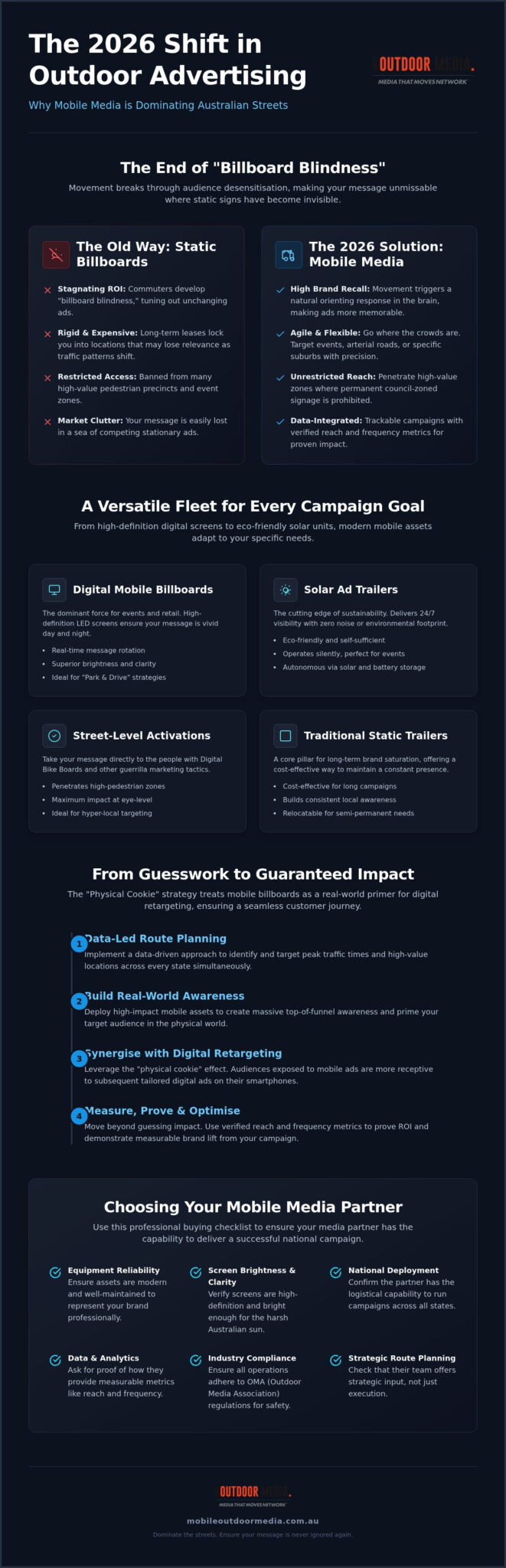
The 2026 marketing landscape has shifted. Traditional Outdoor advertising (OOH) is no longer about just being seen; it’s about being impossible to ignore. Mobile outdoor advertising australia has transitioned from a niche tactic into a primary strategy for brands that refuse to be background noise. Unlike static roadside billboards that commuters have learned to tune out, mobile assets leverage movement to break through the psychological filters of a busy audience. Movement acts as a catalyst for attention. When an ad moves through a high-traffic precinct, it triggers a natural orienting response in the human brain. This makes the message significantly more memorable than a stationary sign that hasn’t changed in months.
Why National Brands are Moving Away from Fixed Signage
Fixed signage is increasingly viewed as a rigid liability rather than a strategic asset. Long-term leases often lock brands into locations that may lose relevance as foot traffic patterns shift. Major Australian intersections are now so cluttered with competing messages that “billboard blindness” is at an all-time high. Brands are tired of paying premium rates for ads that people literally look past. Mobile billboards bypass the limitations of permanent council-zoned signage by taking the message directly into high-value zones where fixed billboards are often prohibited. This agility allows for hyper-local targeting that static boards simply cannot match.
The 2026 Tech Integration: Mobile OOH Meets Digital
The most significant evolution in 2026 is the convergence of physical assets and digital intelligence. We now treat a digital mobile billboard as a “physical cookie” that builds massive top-of-funnel awareness. This real-world presence primes the audience for digital retargeting. There is a powerful synergy between seeing a high-impact screen on the street and subsequently receiving a tailored ad on a smartphone. This layered approach ensures the brand remains top-of-mind throughout the customer journey. Data now plays a central role, providing verified reach and frequency metrics that were previously impossible to track with traditional outdoor media. It’s no longer about guessing impact; it’s about proving it through measurable brand lift.
High-Impact Formats: From Digital Trucks to Solar Trailers
The 2026 market demands more than just visibility; it requires high-definition impact. High-definition LED screens have become the dominant force for event and retail promotions across the country. These screens offer a level of brightness and clarity that ensures your message remains vivid, even under the harsh Australian sun. Choosing the right asset involves balancing “Park & Drive” strategies, which target stationary crowds at major events, with continuous movement routes that maximise reach across arterial roads. For brands requiring a semi-permanent footprint, relocatable billboards provide a heavy-duty solution for construction sites or new retail developments without the permanence of traditional foundations. The landscape of mobile outdoor advertising australia has evolved to include these versatile, high-tech options that adapt to your specific campaign goals.
Digital Mobile Billboards vs. Traditional Static Trailers
Digital assets offer unparalleled flexibility. They allow for message rotation, real-time updates, and superior night visibility that static formats simply can’t match. However, traditional static trailers remain a core pillar of Mobile Billboard Advertising for long-term brand saturation. While digital captures immediate attention through movement and light, static trailers offer a cost-effective way to maintain a constant presence in a specific area. All assets must comply with OMA Industry Regulations to ensure safety and community standards are met. This balance of tech and traditional media allows for a layered approach to market dominance, ensuring your brand is seen by the right people at the right time.
Solar Powered Signage: The Eco-Friendly Trend
Sustainability is no longer optional for Australian brands. Solar Ad Trailers represent the cutting edge of 24/7 visibility without the environmental footprint. These units use advanced battery storage and high-efficiency solar panels to operate autonomously, even during prolonged overcast periods. They are particularly effective for event-based signage because they produce zero noise pollution, making them ideal for quiet residential zones or sensitive festival environments. Prioritising carbon-neutral advertising options reflects a brand’s commitment to modern values while maintaining a high-impact physical presence. Using clean energy assets ensures your campaign remains effective without disturbing the local community. If you’re ready to see how these assets can transform your next campaign, you can request a tailored quote to find the perfect fit for your budget.
Street-Level Activations: The Rise of Guerrilla Marketing
While large-scale assets dominate arterial roads, the real battle for consumer attention often happens on the pavement. In 2026, mobile outdoor advertising australia has embraced “human-centric” media to penetrate high-pedestrian zones. These are the areas where motor vehicles are strictly restricted, such as busy shopping malls and urban plazas. By moving at the same pace as the crowd, these street-level assets achieve a level of intimacy that high-speed roadside boards simply cannot replicate. It’s about being where the people are, not just where the cars are. This approach transforms a passive message into an active part of the urban landscape.
Digital Bike Boards: Navigating the Urban Centre
Digital Bike Boards are the ultimate tool for urban cut-through. They effortlessly navigate shopping precincts and pedestrian malls that are completely inaccessible to traditional trucks. By combining high-definition screens with GPS tracking, brands can now execute hyper-local targeting with surgical precision. You can sync bike routes with specific times of day to hit commuters during the morning peak or weekend shoppers. This agility ensures your message is active exactly when and where your audience is most receptive. For a deeper dive into strategy, see The Ultimate Guide to Launching a Bike Board Advertising Campaign in 2026.
Walking Boards and Human Billboards
There’s a specific power in eye-level engagement. Walking Board Advertising removes the barrier between the brand and the consumer. It isn’t just a sign; it’s a live brand activation. These assets are perfect for product launches or grand openings where direct interaction is the primary goal. Coordinating “swarms” of walking boards creates a massive visual saturation effect in a concentrated area. This “swarm” tactic forces pedestrians to acknowledge the message through sheer repetition and physical presence. It’s unmissable because it’s part of the physical environment people are moving through. When you combine this human element with the digital reach of larger assets, you create a comprehensive brand experience that blankets an entire precinct. This layered strategy ensures your message is seen from the highway all the way to the shop front.
Strategic Route Planning and National Deployment
Planning a national campaign requires more than just a fleet; it requires a methodology. Successful mobile outdoor advertising australia in 2026 relies on data-driven route planning to hit peak traffic times with surgical accuracy. We don’t just drive. We deploy assets based on real-time traffic flow and audience density data. Coordinating a national campaign across multiple Australian states demands a partner with the infrastructure to maintain brand consistency while adapting to local regulations. National brand consistency shouldn’t come at the expense of local relevance. We bridge that gap by combining national scale with local area marketing insights. This ensures your message resonates in a coastal retail hub just as effectively as it does in a metropolitan business district.
Maximising Reach in High-Traffic Precincts
Identifying “choke points” is the secret to high brand recall. These are the specific areas where traffic naturally slows and dwell time increases. This gives your mobile screen more time to deliver its message. For large-scale activations, the Event Screen 16 has become the industry standard for festival and sports marketing. It provides a massive, high-definition presence that dominates the visual field in crowded environments. For a full breakdown of how to integrate these assets into a broader strategy, consult our Mobile Display Advertising Australia: The 2026 Reference Guide. It covers everything from technical specs to deployment logistics.
Semi-Permanent Solutions: Relocatable Billboard Hire
Relocatable Billboard Advertising is a major trend for 2026, particularly for real estate and infrastructure projects. Unlike permanent signage, these boards don’t require fixed foundations or long-term council commitments. This flexibility is vital as project sites evolve. You can move the signage to follow the progress of a construction site or shift it to a more visible corner as new roads open. When you compare the costs, relocatable boards offer a significantly higher ROI than permanent fixed signage. You aren’t paying for “dead time” on a board that’s no longer in the optimal position. You’re paying for a dynamic asset that moves with your project’s needs. This adaptability ensures your message is always positioned for maximum impact without the overhead of traditional outdoor leases.
Enquire about national deployment options today
Navigating the Buy: Choosing the Right Mobile Partner
Selecting a media partner is the most critical decision in your campaign lifecycle. In the competitive space of mobile outdoor advertising australia, not all providers are equal. A professional partner must offer more than just a truck; they should provide a robust infrastructure that ensures your brand is protected and promoted with precision. When evaluating potential agencies, your checklist should prioritise fleet diversity, technical reliability, and a proven track record of national execution. You need a partner who understands the logistical complexities of moving high-value assets across state lines while maintaining total uptime. Reliability isn’t a luxury; it’s the foundation of your ROI.
Evaluating Equipment Quality and Uptime
Technical specifications directly dictate the “cut-through” of your message. For Digital Mobile Billboards, resolution and pixel pitch are non-negotiable. A low-quality screen with visible pixels will cheapen your brand. High-definition displays ensure your creative looks as sharp on the street as it did on the designer’s monitor. Beyond the screen, 24/7 technical support is essential, especially for event-based screens where there is no room for error. Your provider must also strictly comply with Australian advertising standards and local council safety regulations. Asking for maintenance logs and proof of recent successful deployments is a standard part of a professional buy.
The Mobile Outdoor Media Advantage
Mobile Outdoor Media offers a level of scalability that few in the industry can match. Our fleet is designed for every possible activation, from the compact Event Screen 8 for local community gatherings to solar-powered trailers for long-term retail presence. We act as a one-stop-shop for brands that need to coordinate complex, national guerrilla marketing alongside large-scale digital truck routes. This centralised approach eliminates the headache of managing multiple vendors and ensures total brand consistency across the country. We don’t just provide the assets; we provide the expertise to ensure they are deployed for maximum impact. If you’re looking for a partner who treats your campaign with the same level of precision as a logistics operation, contact Mobile Outdoor Media for a bespoke national strategy.
Dominate the Australian Market in 2026
The landscape of mobile outdoor advertising australia has reached a definitive turning point. Brands can no longer rely on the passive, background visibility of fixed roadside boards. Success in 2026 requires the agility to move with the crowd and the visual power of high-definition digital assets that demand attention. By integrating sustainable solar-powered trailers and data-driven route planning, you ensure your message is both unmissable and environmentally responsible. Movement is the new standard for engagement; if your ad isn’t where the people are, it doesn’t exist.
With over 20 years of industry expertise, Mobile Outdoor Media provides the national infrastructure and diverse fleet needed for professional, large-scale impact. We offer total Australia-wide coverage, ensuring your brand maintains consistency from metropolitan centres to regional hubs. Whether you need the surgical precision of bike boards or the massive presence of an Event Screen 16, we have the tools to deliver measurable results. It’s time to stop blending into the background and start leading the market with a campaign that moves.
Frequently Asked Questions
How much does mobile outdoor advertising cost in Australia?
Pricing for mobile outdoor advertising australia is determined by several variables. These include the type of asset selected, the duration of the campaign, and the specific geographic coverage required. Digital formats generally command a higher rate than static trailers due to their increased impact and visibility. To get an accurate figure, businesses should request a tailored quote that reflects their specific route planning and frequency needs.
Do I need a permit for mobile billboard advertising?
Permit requirements depend entirely on the specific local council and state regulations. While mobile billboards with a driver are legal across the country, parking or operating in certain high-traffic precincts often requires local approval. Some local government areas mandate specific permits for portable boards, which involves an application and licence fee. It’s vital to consult with your provider to ensure all relevant local by-laws are met before your campaign commences.
Can mobile billboards be used for grand openings and sales events?
Mobile billboards are exceptionally effective for grand openings because they provide immediate local saturation. Unlike fixed signs, these assets can follow the crowd during peak trading hours or target specific residential suburbs to drive traffic to a new location. This tactical flexibility creates a sense of urgency. It ensures your event message is seen by the right local audience exactly when you need to drive foot traffic.
What is the difference between a mobile billboard and a relocatable billboard?
The primary difference lies in mobility and duration. A mobile billboard is an active, vehicle-based asset designed for continuous movement or short-term parking at events. A relocatable billboard is a heavy-duty, semi-permanent structure that stays in one place for longer periods, such as construction or retail sites. While it doesn’t move daily, it can be relocated as the project site evolves, providing a more stable footprint than a trailer.
How do you track the effectiveness of a mobile billboard campaign?
Effectiveness is tracked using a combination of GPS data and brand-lift metrics. By monitoring the exact route and dwell times, we can estimate the reach and frequency of the campaign. Many brands also measure success through increased foot traffic or spikes in digital engagement within the target area. Integrating mobile outdoor advertising australia with mobile retargeting strategies provides a clearer picture of how physical exposure translates into digital conversions.
Are digital mobile billboards visible during the day in bright sunlight?
High-definition digital screens are engineered to remain perfectly visible in bright Australian sunlight. These professional-grade LED displays use high-nit brightness settings that automatically adjust based on the ambient light conditions. This ensures that your creative content doesn’t look washed out or dull during the day. Whether it’s midday glare or twilight, the screen maintains the high-contrast levels needed for your message to be clearly legible from a distance.
Can I change the creative content on a digital mobile billboard during the campaign?
Yes, one of the greatest benefits of digital mobile assets is the ability to update creative content instantly. Because the screens are managed remotely, you can change your message to reflect different times of day, local weather, or specific sales offers. This allows for a more dynamic campaign where you can test multiple creatives or run time-sensitive promotions without the cost or delay of re-printing physical posters.
How long does it take to deploy a national mobile advertising campaign?
Deployment times vary based on the scale of your campaign. A local activation can often be organised within a week, but a comprehensive national rollout across multiple states usually requires two to four weeks of lead time. This period allows for asset allocation, detailed route optimisation, and ensuring all local regulatory requirements are satisfied. Proper planning is essential to ensure that a large-scale deployment runs smoothly and achieves maximum impact.