Click to Call

Event Displays Versus Print Banners: What Works?
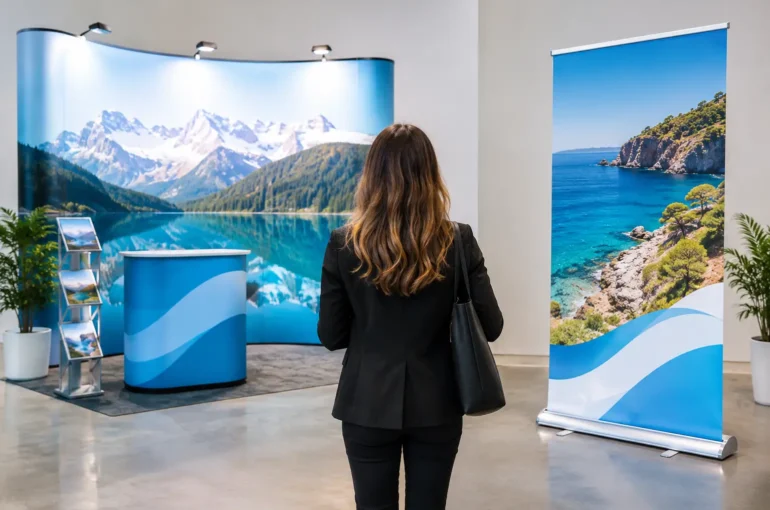
A busy event does not give your brand a second chance to be noticed. When comparing event displays versus print banners, the real question is not which format is better in theory. It is which one will put your message in front of the right people, at the right moment, with enough impact to be remembered.
Print banners remain a reliable event essential. They are portable, familiar and effective when audiences are already moving through a defined space. Event displays, particularly digital screens and mobile formats, bring more movement, scale and flexibility to the job. The strongest choice depends on your location, campaign objective, creative and how much control you have over the audience environment.
Event displays versus print banners: the key difference
A print banner delivers one fixed message. Once it is installed, its strength comes from clear design, strong placement and repeated visibility over the course of an event. Pull-up banners, mesh banners, fence banners, media walls and large-format signage all work well when your brand needs a physical presence at an entry point, activation site, exhibition stand or sporting venue.
An event display is designed to do more. Digital Event Screen units can run motion graphics, video, multiple messages, sponsor rotations, countdowns and live information. Mobile display formats can also be positioned where crowds gather, then moved as foot traffic shifts. Rather than asking attendees to find your signage, you can take the screen to the busiest part of the event precinct.
That distinction matters. Print is static visibility. Event displays are active visibility. Neither is automatically the right answer, but they solve different campaign problems.
When print banners are the smart call
Print banners work best when the message is simple, the location is fixed and the display needs to stay in place for an extended period. A property development open day, local sports club sponsorship, trade stand or community festival often benefits from banner signage that creates a consistent branded backdrop.
They are also a practical option where a venue has allocated branding positions. If your business has a designated fence line, stage backdrop, registration desk or exhibition shell scheme, a well-produced banner can own that space without adding complexity to the event setup.
The creative needs to do the heavy lifting. A banner is often viewed while people are walking, chatting or looking for their next destination. Use a short headline, high-contrast colours, a recognisable logo and one clear action. Trying to explain every product feature in small type will not improve results. It will simply disappear into the background.
Print can offer excellent value for campaigns with a long lifespan. A quality banner can be reused across multiple appearances, provided the offer, brand look and contact details will remain current. For organisations running regular markets, expos, school events or local activations, that reusability can make print a sensible base layer.
There are limits, though. A static banner cannot change its message at different times of day. It cannot promote one sponsor before a match, another at half-time and a final offer as crowds leave. It also depends heavily on placement. Put it behind queues, parked vehicles or competing signage and even great artwork loses its value.
Where event displays take the lead
Event displays are built for moments when attention is contested. Think major public events, product launches, race days, concerts, sporting fixtures, retail precinct promotions and city-centre activations. These are environments packed with visual noise. A bright, moving screen has a stronger chance of cutting through than another printed panel on a crowded fence.
Digital event screens give campaign managers control after the artwork has gone live. You can schedule different creative for arrival, peak trade and departure periods. You can feature event information alongside sponsor messages. You can run a call to action for a limited-time offer, then switch to brand-building content when the crowd changes.
That flexibility is especially useful for multi-sponsor events. Instead of producing and installing several banners, a screen can rotate approved partner creative in a controlled schedule. Each advertiser receives visible screen time, while organisers avoid filling the site with competing static signage.
Scale changes the outcome too. A large event screen can be seen across an open area where a standard banner may only reach people standing nearby. For a public-facing activation, that means exposure can extend beyond ticket holders to pedestrians, passing traffic and nearby businesses. The audience is not confined to one exhibition aisle or one entrance gate.
Mobile Outdoor Media provides event screen formats that can be deployed where the audience is concentrated, helping brands create a visible presence without relying solely on fixed venue inventory. That is valuable when crowd flow changes quickly or when the best viewing position is outside the formal event footprint.
Choose based on the campaign objective
Start with what the campaign needs to achieve. If your goal is brand consistency at a fixed point, print banners are often enough. A sharp media wall behind interviews, a branded finish-line fence or a pull-up banner beside a registration desk can deliver exactly what is needed.
If the goal is broad awareness, repeated exposure or a high-energy presence, event displays deserve serious consideration. Motion attracts the eye, while screen scheduling lets you refresh the message instead of asking one static creative concept to do every job.
For lead generation, the answer can depend on how the interaction happens. A banner beside a staffed stand can support conversations and make the space easy to find. A digital screen can build awareness further from the stand, directing people towards a location, QR code, offer or demonstration time. Used together, they can create a stronger path from first impression to action.
For sponsors, screens provide clear advantages where proof of delivery matters. A defined playback schedule, high-visibility placement and rotating creative give organisers a more flexible sponsorship product. Print still has a role for permanent, highly photographed or close-up branding positions, such as podiums, media backdrops and field-side signage.
Consider the venue before choosing the format
Indoor exhibition halls, narrow foyers and controlled entry areas often favour print because space is limited and visitors are close to the message. In these environments, polished banners can create structure without overwhelming the site.
Outdoor events introduce more variables. Sunlight, wind, rain, crowd density, sightlines and vehicle access all affect display performance. Printed materials need suitable hardware, secure installation and finishes that can handle Australian conditions. A banner that looks good in a proof can look flat or unreadable under harsh midday light.
Outdoor screens need planning as well. Positioning, viewing distance, power arrangements, access and council or venue requirements should all be confirmed early. The benefit is that a properly placed screen can remain visible over crowds and across open spaces, where print may struggle to command attention.
Do not overlook sound restrictions. Video content can work without audio when designed properly. Use bold captions, product visuals, short message sequences and strong branding. At many events, silent motion content is more practical than a video that relies on a voiceover no one can hear.
Creative changes with the format
The biggest mistake in event advertising is treating a screen like a printed banner, or a printed banner like a web page. Each needs creative built for its viewing conditions.
For print, prioritise instant recognition. A person should understand the main message in a few seconds from a distance. Keep copy short, use large type and leave breathing room around the logo and offer. If your campaign has a complex story, use the banner to create curiosity and let staff, a landing page or a product demonstration provide the detail.
For event displays, design in short sequences. Lead with branding, show the offer, then repeat the core message. Avoid fast transitions and dense information. Viewers may only see part of the loop, so every frame should make sense on its own. A strong screen creative should still work if someone glances at it while crossing a footpath or waiting in a queue.
The strongest campaigns often use both
This is not always an either-or decision. Print banners can establish the branded zone, while event displays create reach beyond it. The banner tells attendees they have arrived at your activation. The screen gives the wider crowd a reason to walk over.
A festival sponsor might use fence banners around a key area, a media wall for social photos and a digital screen near the main pedestrian approach. A retailer opening a new location might use printed point-of-sale signage on site while a mobile event screen builds awareness through the surrounding precinct. Each format has a defined job, rather than duplicating the same message in the same place.
Budget should be allocated according to exposure, not just production cost. The cheapest display is not necessarily the best value if it is hidden, static in a fast-moving crowd or unable to carry the campaign through peak periods. Invest where the audience will genuinely see it.
Before approving artwork, stand in the shoes of the attendee. Ask where they enter, where they pause, what competes for their attention and what message will make them look up. Put your strongest format in that moment, and make every square metre of event advertising earn its place.