Click to Call
Walking Billboard Advertising That Gets Seen Daily
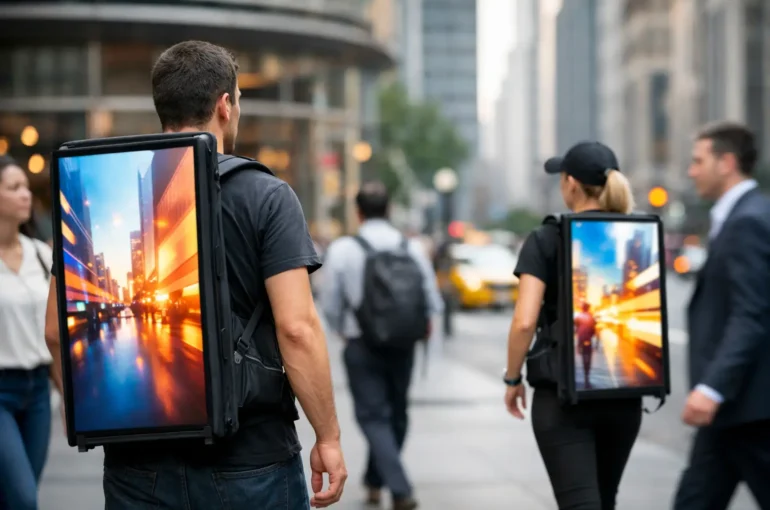
A crowded footpath gives brands only seconds to earn attention. Walking billboard advertising puts your message at eye level, in the flow of the crowd and close to the places where people shop, eat, queue, commute and attend events. Rather than waiting for an audience to pass a fixed sign, take the sign directly to the audience.
For businesses and campaign managers, that mobility is the point. A walking board can work a retail precinct at lunch, target a stadium crowd before kick-off and build visibility around an entertainment venue after dark. It is physical, visible and difficult to scroll past.
What Is Walking Billboard Advertising?
Walking billboard advertising uses trained promotional staff carrying purpose-built display boards through high-footfall public areas. The boards feature large-format printed creative on one or both sides, turning a brand message into a moving street-level media placement.
The format is often called a walking board, human billboard or mobile pedestrian billboard. Whatever name is used, its advantage is the same: the campaign route can be planned around people, not locked into a single site.
This is not a substitute for every outdoor format. A large digital mobile billboard delivers greater screen scale and can carry motion content, while bike boards can cover more distance in a session. Walking boards do something different. They slow the message down in dense spaces where vehicles may be restricted, traffic moves slowly or the audience is already on foot.
Where Walking Boards Work Hardest
The best campaigns start with an audience location, not just a suburb name. “Sydney CBD” is broad. A route connecting a station exit, office towers, a food court and a retail strip during the lunch rush is actionable.
Walking boards are particularly effective around locations where people naturally pause, gather or move at walking pace. Think busy retail centres and precincts, transport interchanges, university areas, hospitality strips, markets, exhibitions, sporting fixtures, concerts and community events. They can also support local area campaigns for property launches, gyms, clinics, restaurants and new-store openings.
Timing matters just as much as route selection. A weekday morning commuter route suits a different message from a Friday-night entertainment precinct. Families heading into a daytime event need a different creative approach from office workers on a 30-minute lunch break. Match the deployment to the behaviour you want to influence.
For national activity, local knowledge matters. What works around Melbourne’s inner-city laneways will not automatically suit a Gold Coast retail strip or a Perth event site. Build a consistent campaign platform, then adjust the route, timing and call to action to the local environment.
Why This Format Earns Attention
Static advertising can be powerful, but it is tied to its position. Walking boards bring an extra level of control. If foot traffic shifts, weather changes or an event entrance moves, the campaign can respond. That flexibility helps brands make better use of limited campaign days and concentrated promotional windows.
The format also creates repetition. A well-planned route passes the same high-value zones more than once, helping the message land with people who see it on their commute, lunch break or walk to a venue. Repeated exposure is especially useful for simple offers, memorable branding, event dates and location-based calls to action.
There is a practical visibility benefit too. A person carrying a bright, well-produced board is part of the streetscape but clearly promotional. In busy pedestrian environments, that can cut through the visual clutter of shopfronts, screens, parked cars and street furniture.
The trade-off is dwell time. A walking billboard is mobile, so people may only see it briefly. That means it rewards disciplined creative. Do not try to turn the board into a brochure.
Make the Creative Read in Three Seconds
Walking billboard advertising succeeds when the message is understood at a glance. Lead with one idea: a brand name, offer, event, product benefit or directional prompt. If the audience has to stop and decode the artwork, the opportunity has already passed.
Use bold colour contrast, a large logo and a headline that remains legible from several metres away. Keep supporting copy minimal. A QR code can be useful when the audience has time to engage, such as at a queue, market or event entry, but it should not carry the whole campaign. People still need to understand the message without scanning anything.
For retail and hospitality, a clear offer and nearby location work well. For property, the campaign might focus on a development name, key benefit and inspection date. For an event, make the date, venue and act or attraction instantly clear. For established brands, the goal may simply be reach and salience through striking visual branding.
Before production, view the design at reduced size on a mobile screen. If the core message disappears, it will be even harder to read in the street. Confirm artwork dimensions, print requirements and production lead times early so the campaign does not lose momentum at the final step.
Plan the Route Like Media, Not Leafleting
A walking board is not just a person on a footpath. It is a mobile media unit, and it needs a clear operating plan. Start by defining the campaign outcome. Are you launching a store, driving event attendance, building local awareness or supporting a larger outdoor and digital campaign?
Then decide who needs to see it, where they are most concentrated and when they are receptive. A strong plan identifies primary routes, backup routes, operating hours, rest points and event or retail landmarks. It also considers practical constraints such as pedestrian congestion, permitted access, weather and staff safety.
For a multi-day campaign, vary the route with purpose. Cover priority zones repeatedly, but do not spend every hour circling the same block unless that block is the audience centre. Add nearby feeder locations such as stations, car parks, university entrances and hospitality areas to widen reach while keeping the campaign geographically relevant.
Track execution too. A campaign partner should be able to confirm where the boards operated, when they were active and whether conditions required an approved route adjustment. That operational visibility gives media buyers confidence that the planned exposure actually occurred.
Combine Walking Boards With Other Mobile Media
Walking boards can stand alone for focused local activity, but they become even more effective when they are part of a coordinated street campaign. Use them where pedestrian density is highest, then extend the message through mobile billboards on arterial roads, bike boards in active precincts or event screens at the venue itself.
This approach gives the campaign different kinds of exposure. A motorist may see the large-format mobile billboard on the way in, then encounter walking boards near the entrance. Attendees see the same colours, headline and offer more than once, in more than one setting. That consistency makes the campaign feel larger and more established.
It depends on budget, campaign area and the job the advertising needs to do. A one-day launch in a compact precinct may need only walking boards. A multi-city promotion may justify a mixed mobile format that combines local precision with broader road-based reach.
Measure What Matters
Not every outdoor campaign should be judged by an immediate online sale. Walking boards are often designed to build familiarity, prompt store visits, support an event or make a brand feel present in a specific location. Set measurements that reflect that objective.
For direct-response activity, use a short, distinct landing-page address, campaign code or offer that staff can recognise. For retail, compare foot traffic, enquiries or redemptions across the activation period. For events, track ticket movement alongside the deployment schedule. For awareness campaigns, use route records, operating hours and estimated audience exposure as execution indicators, then consider brand-lift or survey work if the budget supports it.
Do not judge the format on a generic impression number alone. A smaller, highly relevant audience outside the right venue can be more valuable than a larger, untargeted crowd elsewhere.
Put Your Message Where the Crowd Is
Walking billboard advertising is built for campaigns that need to be seen in the real world, right where decisions are being made. Keep the message simple, choose locations with a reason and run the boards when your audience is actually there. Mobile Outdoor Media can help turn that street-level opportunity into a campaign plan that moves with the crowd.
Related reading: How to Master Walking Board Marketing Solutions
Want feet on the street for your next activation? Book walking boards.