Click to Call
Mobile Advertising for Political Campaigns: The 2026 Australian Strategy
In the 2026 election, the candidate with the biggest social media budget might still lose to the one who simply shows up where the voters actually stand. Digital ad fatigue is reaching a breaking point. Most Australians are already tuning out the endless stream of sponsored posts and static roadside signs that stay stuck in the wrong suburb while the campaign moves on. You need a strategy that stays as agile as the news cycle. Success requires dominating the physical space in high-foot-traffic zones, from local community markets to the very front gates of polling booths.
We know the pressure of making every campaign dollar count. This guide shows you how to leverage mobile advertising for political campaigns to cut through the noise and win votes across Australia. You’ll learn how to use high-impact tools like digital mobile billboards and relocatable billboards to ensure your message stays front and centre. We’ll preview how to deploy solar ad trailers and street-level bike boards to maintain a dominant presence that evolves as election day approaches.
Key Takeaways
- Learn why voters are tuning out digital noise and how to build trust through a physical presence in key marginal electorates.
- Discover how to use mobile advertising for political campaigns to dominate community hubs and polling booths where fixed billboards simply cannot reach.
- Master the flexibility of digital mobile billboards to update your messaging in real-time as the 2026 election news cycle shifts.
- Ensure full compliance with AEC guidelines by correctly integrating mandatory “Authorised by” tags into your digital and physical creative.
- Understand how to scale your visibility nationally, using a versatile fleet of solar ad trailers and street-level boards for maximum voter engagement.
The Evolution of Australian Political Campaigning in 2026
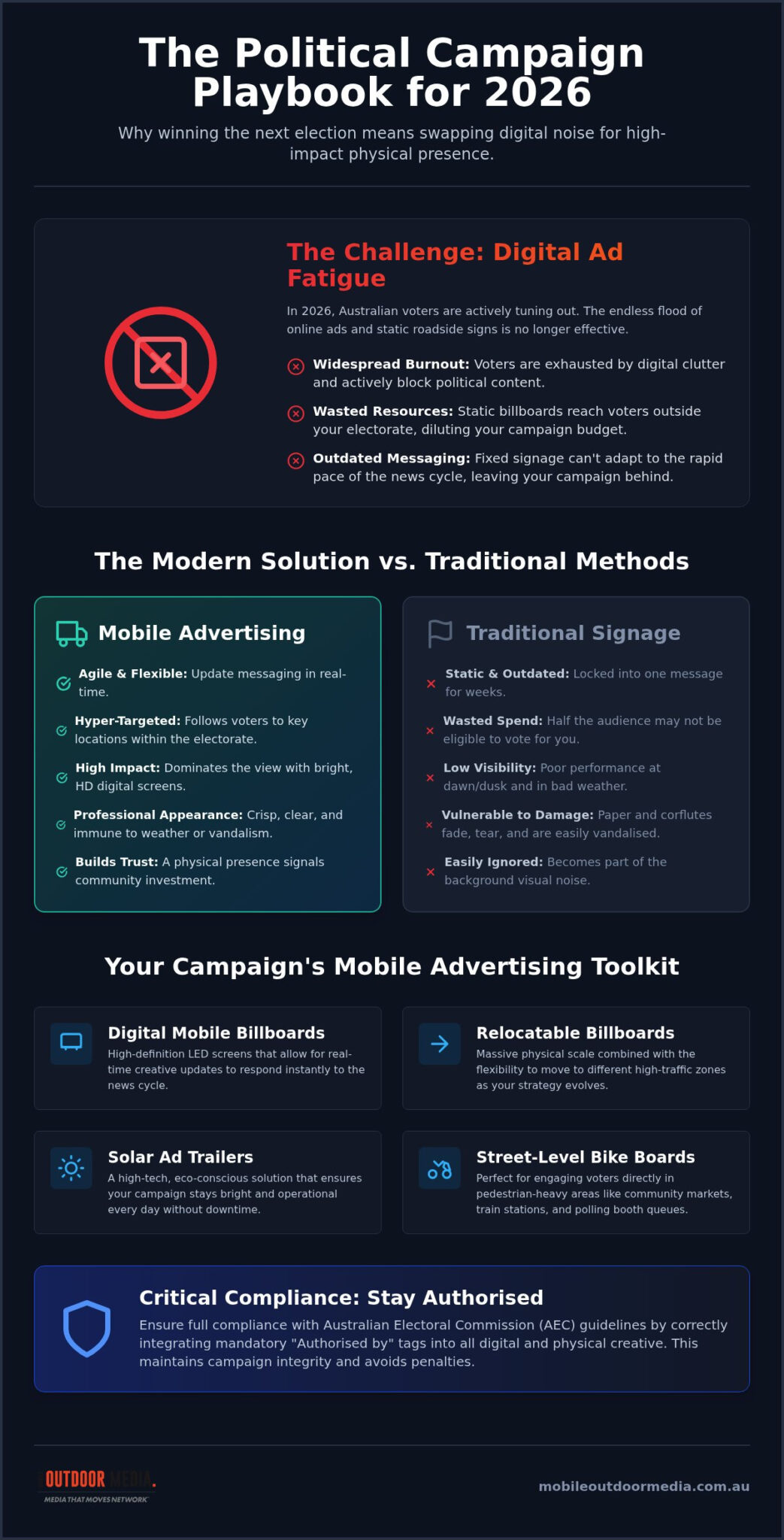
Australian voters are hitting a wall. In 2026, the sheer volume of social media ads has led to widespread digital fatigue. People don’t just scroll past political posts; they actively block them. This shift has triggered a resurgence of physical presence, especially in marginal electorates where trust is the ultimate currency. Winning an election now requires more than just a clever algorithm. It demands a boots-on-the-ground approach that combines high-impact visuals with strategic movement. Using mobile advertising for political campaigns allows candidates to break out of the digital bubble and claim a stake in the real world.
The evolution of mobile campaigning has moved beyond simple leaflets and door-knocking. Modern strategy focuses on dominating the view. Fixed roadside billboards are becoming a liability because they’re static. If a candidate’s message needs to pivot on a Tuesday, a fixed sign is still stuck in Monday’s talking points. Mobile media solves this fixed location problem by allowing billboards to follow the crowd, whether that’s a morning commute or a weekend community market.
Breaking Through the Digital Ad Fatigue
Physical visibility creates immediate legitimacy. When a voter sees a high-impact mobile billboard in their local street, it feels more real than a sponsored video on a phone. It signals that the candidate is invested in the community. Out-of-Home (OOH) media works because it can’t be skipped or muted. Successful campaigns in 2026 are blending the agility of digital creative with the massive physical scale of outdoor assets to ensure they aren’t just seen, but remembered.
The Need for Campaign Agility
Political narratives in Australia move at a breakneck pace. A single headline can change the focus of an entire electorate in hours. Your signage must keep up. Relocatable billboards offer a massive advantage over permanent placements. You can move your message to respond to an opponent’s claim or shift your focus to a different suburb as polling data comes in. It’s about being in the right place at the right time, every time. Using mobile advertising for political campaigns ensures your messaging stays relevant while others are left behind with outdated signage.
High-impact mobile visuals aren’t just for the people on the street. They’re designed for social sharing. A massive, well-placed billboard at a rally or a busy hub creates a viral physical moment. Voters take photos; they share them on their own feeds. This turns a physical asset into a digital amplifier, bridging the gap between the real world and the online space without the high cost of paid social placements. The same principles that drive successful outdoor advertising for grand opening events — dominating the local landscape and forcing the community to take notice — apply directly to high-stakes political launches and campaign kickoffs.
Comparing Mobile Billboards to Traditional Political Signage
Fixed roadside billboards were once the gold standard. In 2026, they’re often a liability. When you buy a static site, you’re paying for a location that doesn’t move, even if the voters do. Half the traffic passing a highway sign might live three electorates away. That’s a massive waste of campaign funds. Effective mobile advertising for political campaigns flips the script. Instead of waiting for voters to find you, you take the message to them. By targeting specific high-traffic hubs and community centres within your exact boundary, you ensure every dollar spent is working for your candidate.
Flexibility is the second major advantage. With digital mobile billboards, you aren’t locked into one creative for weeks. You can use day-parting to switch your message. Run a cost-of-living angle for the morning commute and a local infrastructure promise for the school run. It’s about staying relevant in a fast-moving news cycle. This professional appearance matters. Unlike traditional paper posters or corflutes that fade, tear, or get vandalised, digital displays maintain a crisp, authoritative look until the polls close.
Static vs. Digital: Which Wins the Vote?
Visual impact is non-negotiable. High-definition LED screens dominate the landscape during dawn and dusk commutes when visibility for traditional signage drops. For candidates prioritising sustainability, solar ad trailers offer a high-tech solution that aligns with eco-conscious branding. There’s no maintenance downtime. You don’t have to worry about weather-beaten paper peeling off a frame. Your campaign stays bright, bold, and fully operational every single day.
Targeting Electorate Boundaries with Precision
One of the biggest headaches in Australian elections is the “dead zone”. Fixed billboards often sit just outside target lines, reaching people who can’t actually vote for you. Mobile assets allow you to hug the electorate boundary with surgical precision. You can park at community hubs, shopping centres, and transport interchanges where your target demographic gathers. Compliance is also simplified. You must follow Australian political advertising rules regarding authorisation. Digital formats allow you to update these legal tags instantly if campaign details change. To get your strategy moving, you can view our available fleet today.
High-Impact Examples of Mobile Media in Political Strategy
Success in 2026 isn’t just about presence; it’s about tactical placement. The “Community Hub” strategy involves deploying Solar Ad Trailers to local markets and sporting events. These hubs are where voters are relaxed and receptive. By positioning assets here, a candidate becomes part of the local fabric. This is mobile advertising for political campaigns at its most organic. It bypasses the hostility of social media comments and places your message in the real world where it belongs. You aren’t just a face on a screen; you’re a visible part of the neighbourhood.
Election day requires a “Polling Booth Takeover”. You can’t rely on a few corflutes tied to a fence. Positioning high-impact mobile assets near key voting centres ensures your face is the last one a voter sees before they head inside. For the final days of the campaign, a “Rapid Response” unit using digital trucks is essential. If an opponent makes a false claim during a leadership debate, you can have a counter-message live on the streets within an hour. This agility is governed by Australian political communication laws, which require clear authorisation tags even for rapid-turnaround digital creative.
Street-Level Engagement: Walking and Bike Boards
Direct voter conversation is the most powerful tool in any campaign. Walking Boards humanise the candidate by putting a person behind the message. They can enter pedestrian-only zones, shopping strips, and train station platforms where trucks simply cannot go. Voters can ask questions directly to the person carrying the board, breaking down the barrier between the politician and the public. This guerrilla approach creates a high-energy “Rally Booster” effect. For urban centres, Bike Boards and digital bike boards allow for high-frequency loops through busy city blocks, ensuring your brand stays top-of-mind during the peak morning and afternoon rush.
Large-Scale Visual Dominance: Event Screens
Public squares and parklands are the new town halls. Hosting large-scale events requires massive visual support. The Event Screen 16 is designed for this specific purpose. It allows you to broadcast live policy announcements or speeches to thousands of people simultaneously. You don’t need permanent infrastructure to create a professional broadcast environment. These trailer-mounted screens offer a massive logistical advantage. They’re quick to set up and pack down, meaning you can hit three different public rallies in a single day. This level of scale ensures your campaign doesn’t just participate in the conversation; it dominates it.
Strategic Planning and Compliance for Candidate Exposure
Compliance isn’t just a box-ticking exercise; it’s a critical component of campaign security. In the high-stakes environment of 2026, a single administrative error can lead to a headline you don’t want. Navigating the Australian Electoral Commission (AEC) guidelines for mobile advertising for political campaigns requires precision. Every piece of creative must feature a clear “Authorised by” tag. While this sounds simple, integrating these tags into digital creative requires careful planning to ensure they remain legible on a moving vehicle without distracting from the primary message.
Timing is everything. Campaigns shouldn’t just dump their budget in the final week. You need a phased deployment that ramps up during the pre-polling surge and peaks on “Super Saturday”. This strategy ensures your candidate is present when early voters are making up their minds and dominant when the undecided masses head to the booths on election day. Combining demographic data with traffic flow patterns allows you to position your assets exactly where the most influential voters are located at any given hour.
Route Planning for Maximum Voter Reach
Identifying “hot spots” within an electorate is the difference between a successful campaign and a wasted budget. You need to look for targeted loops that hit community hubs, transport interchanges, and shopping strips during peak periods. For a deeper look at this process, see our guide on mobile billboard route planning. Avoiding over-exposure is also vital. If voters see the same truck on the same corner for ten days straight, they’ll start to tune it out. Rotating routes keeps the message fresh and gives the impression of a massive, widespread campaign presence.
AEC Compliance and Creative Best Practices
Legibility rules for political authorisations are strict. The AEC requires that authorisation details be easy to read for a person of average eyesight. On an LED screen, this means using high-contrast colours and ensuring the text is large enough to be caught by a passing motorist. Content restrictions also apply. You can’t use strobe effects or distracting animations that might violate local council bylaws or road safety regulations. Staying on the right side of these rules ensures your campaign remains focused on winning votes rather than fighting legal fires.
Securing Your Seat: Deploying Mobile Outdoor Media Nationally
Scaling a campaign from a single local seat to a nationwide federal rollout requires a partner with national reach. You can’t manage a multi-state strategy if you’re dealing with different suppliers in every postcode. A unified approach ensures your brand identity stays consistent and your logistics remain airtight. Professional management handles the heavy lifting, from asset maintenance to route coordination, letting your team focus on the policy. High-impact mobile advertising for political campaigns is most effective when it’s part of a broader, coordinated movement. For a deeper dive into these tactics, explore the Ultimate Guide to Mobile Display Advertising Australia.
Integrated Campaign Support
Mobile assets shouldn’t exist in a vacuum. In 2026, the most successful candidates coordinate their mobile billboards with their social media and TV buys. When a voter sees your face on their morning commute and then again in a targeted social post, the brand recall is significantly higher. Reliability is non-negotiable. You need high-quality hardware that offers 24/7 uptime to maintain an “always-on” presence. This constant visibility builds a sense of momentum that static ads simply cannot match.
Booking Your Campaign Window
The “Election Rush” is a real logistical challenge. As the 2026 polling dates approach, demand for high-impact assets like digital mobile billboards and solar ad trailers will skyrocket. Early booking is critical to secure your preferred dates and locations. Waiting until the writ is issued is often too late. You need to lock in your strategy months in advance to ensure your fleet is ready for the first day of pre-polling.
Every electorate is different. A dense urban seat might benefit from walking boards and digital bike boards, while a regional seat requires the long-term presence of relocatable billboards at campaign offices. Customising your fleet mix allows you to meet voters where they live and work. Don’t leave your physical presence to chance. Request a tailored quote today to secure your campaign’s visibility and dominate the 2026 landscape.
Dominate the 2026 Election Landscape
Success in the upcoming election requires a physical presence that a social media algorithm simply can’t replicate. Voters are tired of digital noise; they respond to candidates who show up in their local community hubs and shopping strips. Using mobile advertising for political campaigns offers the agility to pivot your message instantly and the scale to be seen by thousands of commuters every single day. It’s about being seen in the real world where the votes are actually cast.
You need a partner that understands the high stakes of a national rollout. We offer full Australian coverage with a fleet that includes AEC-compliant digital displays and eco-friendly solar trailer options. From relocatable billboards at your campaign office to walking boards at the local markets, we handle the logistics so you can focus on the policy. The margin for error is zero when every vote counts.
Claim the physical space around polling booths and ensure your candidate is the one voters remember. Get your message on the move and let’s get to work.
Frequently Asked Questions
Are mobile billboards legal for political advertising in Australia?
Yes, mobile billboards are a fully legal and widely used method for political communication across Australia. They must comply with the Commonwealth Electoral Act 1918, specifically regarding the authorisation of electoral matter. While the Australian Electoral Commission (AEC) governs the content and tags, local councils manage the physical placement and parking. It’s essential to partner with a provider who understands these overlapping regulations to ensure your campaign stays on the right side of the law.
How much does mobile advertising for a political campaign cost?
Pricing for mobile advertising for political campaigns depends on several factors, including the type of asset used, the duration of the hire, and the geographic scope of the deployment. A single digital truck for a one-day rally will have a different investment profile than a fleet of solar ad trailers deployed across a month-long pre-polling period. We provide tailored quotes based on your specific electorate needs and campaign scale to ensure maximum value for your budget.
Can I change the digital content on the billboard during the campaign?
Yes, the primary benefit of digital assets is the ability to update messaging in real-time. If a new policy announcement is made or an opponent makes a claim that needs an immediate response, your creative can be swapped out within hours. This agility allows you to keep your campaign fresh and relevant as the election news cycle shifts. Static billboards simply cannot offer this level of strategic flexibility during a fast-moving campaign.
Do mobile billboards need AEC authorisation tags?
Yes, every mobile billboard used for a political campaign must feature a clear “Authorised by” tag. This is a mandatory requirement under AEC rules to ensure transparency and accountability in electoral communication. The tag must include the name and physical address of the person authorising the advertisement. For digital displays, these tags must be integrated into the creative in a way that remains legible to the public as the vehicle moves.
Where can mobile advertising trailers be parked during a campaign?
Mobile advertising trailers can be parked on most public roads, provided they follow local council parking restrictions and don’t create a traffic hazard. They’re also highly effective when placed on private property with the owner’s permission, such as a high-visibility shopfront or a campaign office. Strategic placement near community markets, sporting events, and transport interchanges allows you to maximise exposure while staying within the legal boundaries of each specific local government area.
How many hours a day can a digital mobile billboard operate?
Digital mobile billboard trucks typically operate for up to eight to ten hours per day, aligning with peak traffic periods like the morning and afternoon commutes. However, our solar ad trailers can operate for significantly longer periods, often around the clock, depending on the available battery storage and sun exposure. This makes solar options perfect for long-term presence at campaign headquarters where you want your candidate’s face visible to voters at all hours.
Is there a minimum hire period for political campaign billboards?
Minimum hire periods vary depending on the specific equipment you require. Digital mobile billboard trucks are often available for single-day events or rallies, while relocatable billboards and solar ad trailers usually have a minimum hire period of one week. For federal or state-level campaigns, we recommend booking multi-week blocks to secure your equipment during the high-demand pre-polling and election day windows when assets are in short supply.
Can mobile billboards reach voters in pedestrian-only areas?
Yes, we use specialised street-level equipment to reach voters in zones where trucks and trailers are prohibited. Walking boards and bike boards are designed specifically for pedestrian-only malls, busy shopping strips, and train station platforms. These assets allow your campaign to maintain a high-impact presence in the heart of the electorate, facilitating direct engagement and conversation with voters in high-foot-traffic areas that traditional vehicle-based billboards simply cannot access.