Click to Call
Mobile Billboard Route Planning: The 2026 Strategy for High-Impact Exposure
Driving a massive truck around for eight hours isn’t a marketing strategy; it’s just an expensive cruise. If you’ve ever worried that your campaign is wasting budget on empty backstreets, you aren’t alone. Most brands struggle with the uncertainty of whether their message actually reached the right eyes. Effective mobile billboard route planning in 2026 is no longer about covering kilometres. It’s about “Intent Interception.” This means matching your vehicle’s movement to the specific daily rhythm of your target audience.
We agree that every minute your asset is on the road must count toward your bottom line. You deserve total confidence that your investment is hitting high-dwell zones and staying within Australian heavy vehicle regulations. This article promises to give you a repeatable framework for selecting routes that maximise brand recall. We’ll preview the latest strategies for ensuring campaign accountability and show you how to intercept customers at the perfect moment. Stop guessing where your audience is. Start meeting them there with professional precision.
Key Takeaways
- Learn how moving messages break visual monotony and significantly boost “Opportunity to See” in high-traffic Australian environments.
- Master the “Transit vs. Dwell Zone” strategy to target locations where audience density and visual clearance provide maximum brand exposure.
- Optimise your mobile billboard route planning by combining data-driven heat maps with local insights that standard GPS often misses.
- Follow a repeatable five-step guide to define your target audience’s epicentre and intercept their daily commute with professional precision.
- Gain the confidence to scale national campaigns across diverse regions by matching specific assets to the unique demands of each route.
Why Mobile Billboard Route Planning is the Engine of Campaign ROI
Strategic mobile billboard route planning is the difference between a high-impact campaign and a forgettable expense. It’s the calculated selection of specific paths designed to maximise your “Opportunity to See” (OTS). While fixed billboards wait for people to look up, a mobile asset actively seeks out the highest concentration of your target market. This isn’t about driving aimlessly. It’s about precision logistics that ensure your message is seen by the right people at the perfect moment.
The Australian streetscape is saturated with static signage. Over time, consumers develop “ad blindness” to fixed boards, essentially filtering them out as part of the background scenery. A moving message breaks this visual monotony. It commands attention because it’s a dynamic element in a static world. We focus on a concept called “Intent Interception.” This involves positioning your brand where your audience is already thinking about your category. If you’re promoting a fitness app, we don’t just drive down any road; we target routes near parks, gyms, and health-conscious hubs. You aren’t just showing an ad. You’re providing a solution exactly when the consumer is most receptive to it.
The Science of Motion and Brand Recall
The human eye is biologically hardwired to track movement. In a static environment like a suburban shopping centre or a CBD thoroughfare, a moving vehicle triggers an instinctive orienting response. Active routing leads to significantly higher brand recall than passive placement. This happens because the brain prioritises moving objects as “new” or “relevant” information compared to the stationary buildings around them. Visual disruption is the primary driver of mobile OOH effectiveness. It forces a mental reset, making the viewer engage with the creative rather than simply glancing past it.
Static vs. Mobile: The Strategic Advantage
Fixed roadside billboard leasing locks you into a single location for months, regardless of how the environment changes. If major roadworks start or a local event shifts the flow of traffic three blocks away, your ad is left shouting at an empty street. Mobile billboards offer the agility to pivot based on real-time shifts. We find the traffic when patterns change, ensuring your budget is never spent on vacant bitumen.
- Real-time adaptation: If a primary arterial road is blocked, we reroute to the official detour where the captive audience is.
- Event-based agility: We can follow the crowd from a major stadium directly to the local entertainment district as the sun goes down.
- Zero wasted spend: We avoid low-traffic periods and focus strictly on peak windows where the density is highest.
Success in 2026 requires this level of tactical flexibility. Learn more about the benefits of digital mobile billboards to see how high-definition movement and bright displays amplify this strategic advantage.
The Anatomy of a High-Impact Advertising Route
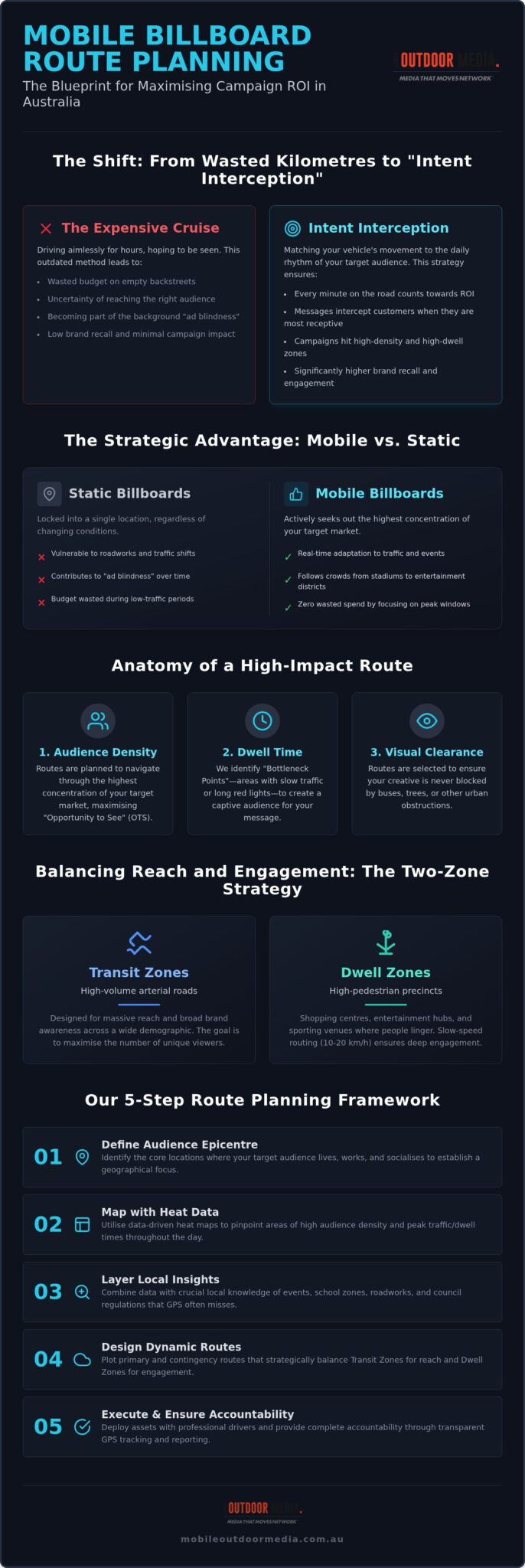
A successful route isn’t just a line on a map. It’s a calculated balance between three critical pillars: Audience Density, Dwell Time, and Visual Clearance. Without density, you’re invisible. Without dwell time, your message is a blur. Without visual clearance, your creative is blocked by buses or trees. Effective mobile billboard route planning identifies the “Bottleneck Points” where traffic naturally slows down. These are the areas where a long red light or a narrow bridge creates a captive audience for your message. Every second a vehicle is stationary or moving slowly increases the likelihood of a consumer engaging with your call to action.
We categorise routes into two primary types: Transit Zones and Dwell Zones. Transit Zones are high-volume arterial roads designed for massive reach. Dwell Zones are the high-pedestrian precincts where people linger. Balancing these two ensures your campaign achieves both broad awareness and deep engagement. By understanding the local geography of Australian metropolitan centres, we can predict exactly where these zones intersect to create maximum exposure.
Targeting High-Dwell Precincts
Shopping centres, entertainment hubs, and sporting precincts are the “Gold Zones” of outdoor media. In these areas, we prioritise slow-speed routing, typically between 10 and 20 km/h. This ensures pedestrians have ample time to read your copy and recognise your branding. For locations that require a constant presence, Solar Ad Trailers provide a semi-permanent solution. These assets offer 24/7 visibility in key hubs where traditional trucks might be restricted by overnight noise curfews. They act as a silent, glowing anchor for your campaign, maintaining exposure long after the commuters have gone home. This 24/7 visibility is essential for brands that want to dominate a specific precinct without the logistical overhead of a 24-hour driver rotation.
Arterial Road Strategy for Reach
While dwell zones provide engagement, arterial roads provide the sheer volume needed for a national brand launch. We select routes that connect major regional hubs, ensuring your message travels alongside the workforce. The key is balancing peak-hour congestion, where your board sits in a sea of slow-moving cars, with off-peak visibility for those running errands. Our digital mobile billboards use high-intensity illuminated screens that cut through the glare of dawn and dusk commutes. This ensures your creative looks as sharp at 6:00 am as it does at noon. If you’re ready to dominate the streets, you can get started with a custom route plan today and see how movement transforms your reach.
Data-Driven vs. Intuitive Routing: Choosing Your Strategy
Choosing between data-driven analytics and intuitive operational experience isn’t a binary decision; it’s a synthesis. Heat map routing uses aggregated mobile device data to visualise audience density over time, while event-based routing focuses on manual planning for specific occurrences like festivals or stadium matches. Effective mobile billboard route planning integrates both to ensure your message isn’t just in a busy area, but in the right busy area at the right time. GPS tracking provides the necessary accountability for national campaigns, giving you a verifiable digital trail that serves as proof of play. This transparency eliminates the common industry fear that a truck might not have reached its intended destination. Selecting the right asset for the terrain is equally critical. While a large truck dominates arterial roads, digital bike boards are the superior choice for narrow urban routes, laneways, and pedestrian malls where larger vehicles face legal or physical restrictions.
Leveraging Technology for Route Precision
Real-time traffic data allows operators to adjust routes on the fly, avoiding unexpected gridlock that could stall a campaign in a low-visibility area. Digital billboards enhance this agility by allowing for creative changes based on geographic triggers. Geofencing is the practice of using GPS technology to create a virtual geographic boundary, enabling specific advertisements to trigger automatically when the vehicle enters a predefined zone. This level of precision ensures your creative is always contextually relevant to the immediate surroundings, such as displaying a lunch offer only when the vehicle is within two kilometres of a specific precinct.
The Human Element: Operational Expertise
Technology provides the map, but professional drivers provide the execution. They understand the local quirks of Australian road networks, from sudden clearway changes to new infrastructure that might obscure a board. Avoiding “dead zones” where foliage or overpasses block the view requires a human eye and years of operational experience. We balance automated pathing with manual oversight to maintain maximum safety and visual impact, ensuring every kilometre driven is a kilometre seen. This hands-on approach catches the nuances that a standard GPS often misses, such as temporary construction hoardings that could compromise your brand’s visibility.
How to Build Your Mobile Billboard Route: A 5-Step Guide
Building a route that delivers high-impact exposure requires more than just a map and a driver. It’s a five-step process that turns a simple journey into a strategic interception. Professional mobile billboard route planning starts with data and ends with operational precision. If you don’t have a clear framework, you’re just burning fuel. Follow this methodical approach to ensure your asset is exactly where it needs to be.
- Step 1: Define the ‘Epicentre’. Identify the primary location where your target audience congregates. This could be a business district, a shopping hub, or a specific event venue.
- Step 2: Map the ‘Daily Commute’. Trace the arterial paths your audience takes to reach that epicentre. You want to meet them during their journey, not just at their destination.
- Step 3: Audit for ‘Visual Obstructions’. Conduct a physical or digital audit to ensure a clear line-of-sight. Check for low-hanging foliage, overpasses, or permanent infrastructure that could block the board.
- Step 4: Layer in ‘Timing’. Match the route to peak activity hours. If you’re targeting parents, align with the school run; if you’re targeting professionals, focus on the 7:00 am to 9:00 am window.
- Step 5: Finalise ‘Legal Clearance’. Verify local council and road authority restrictions. Australian heavy vehicle regulations are strict, and you must ensure your route is compliant with 2026 road rules.
Step 1 & 2: Audience Mapping
Effective mapping requires identifying where your specific demographic works, shops, and plays. We use ‘Competitor Conquesting’ as a primary tactic. This involves routing your vehicle directly past rival business locations to intercept their potential customers. It’s a bold move that ensures your brand is the last thing a consumer sees before they make a purchase decision. Property professionals, for example, can apply this same principle through mobile advertising for real estate to intercept buyers near competitor listings and open homes. For a deeper look at the broader landscape of outdoor campaigns, see our Pillar Guide to Mobile Display Advertising Australia.
Step 3: Visual Obstruction Audit
Before finalising your route, a crucial part of effective mobile billboard route planning is conducting a thorough visual obstruction audit. This involves physically driving the proposed route or utilising digital tools like satellite imaging and Google Street View to pinpoint anything that could block your billboard’s visibility. Look out for low-hanging tree branches, overpasses, large buildings, or even street furniture that might obscure the display from your target audience. A clear line of sight ensures your message cuts through, delivering the high-impact exposure you’re aiming for, rather than being hidden behind an obstacle.
Step 4 & 5: Operational Refinement
A robust plan includes a ‘Route Schedule’ that accounts for petrol stops and mandatory driver breaks. You can’t ignore the logistics of the vehicle itself. Understanding Australian ‘Signage on Vehicles’ regulations is vital to ensure your campaign isn’t sidelined by local authorities. We always recommend a ‘Dry Run’ before the official launch. This physical audit identifies unexpected roadworks, new detours, or temporary closures that a digital map might miss. It ensures your driver isn’t caught off guard on day one.
Executing National Campaigns with Mobile Outdoor Media
If you’ve ever managed a multi-state rollout, you know the logistical nightmare of coordinating different suppliers. Executing a national campaign requires more than just a fleet of trucks. It demands a partner who understands the distinct regulatory and geographic landscape of every Australian territory. We manage complex routing by synchronising national brand objectives with local regional dynamics. This ensures your message feels native to its environment while maintaining absolute brand consistency across the country. Whether you’re coordinating a grand opening or a multi-state product launch, we handle the logistics so your marketing team can focus on the results. A national partner provides a single point of accountability, ensuring that a campaign in one state mirrors the quality and timing of another.
Our national reach is backed by a diverse fleet designed for every possible environment. For high-density pedestrian zones where vehicles can’t go, walking boards provide the ultimate face-to-face engagement. For massive arterial reach, our digital mobile billboards dominate the skyline. This flexibility is the core of successful mobile billboard route planning. We don’t force a one-size-fits-all solution. We match the asset to the specific constraints and opportunities of the route, ensuring you never pay for more than you need. This tailored approach is why national brands trust us to handle their most critical launches. Industries with location-sensitive audiences, such as those using mobile advertising for real estate to promote new developments and auction campaigns, particularly benefit from this asset-matching approach across diverse metropolitan and suburban routes.
Scalability and Flexibility
Scaling a campaign is seamless with the right infrastructure. You can start with a single asset in a local precinct and expand to a national multi-vehicle blitz within weeks. This allows brands to test the waters in one region before committing to a full-scale national rollout. For longer-term site activations where you need a stationary but flexible presence, relocatable billboards offer the perfect middle ground. These allow for high-impact visibility at specific construction sites or retail developments without the permanence of a fixed lease. They are the ideal tool for maintaining a presence while your permanent location is being built or organised.
Booking Your 2026 Campaign
Success starts with early preparation. Professional route design and asset preparation typically require a lead time of four to six weeks, especially for national rollouts. This period allows us to audit every path and secure the necessary permits for your specific dates. Our team collaborates directly with your marketing department to refine every turn of the journey. We don’t just provide a driver. We provide a tactical extension of your brand that knows exactly how to navigate the Australian market with precision and confidence.
Dominating the Australian Streetscape in 2026
Successful outdoor advertising isn’t about hope; it’s about precision. You now have the framework to turn every kilometre into a high-impact connection. By mastering mobile billboard route planning, you ensure your brand intercepts your audience when they’re most receptive. We’ve shown you how to balance high-dwell precincts with arterial reach and how to leverage data for total campaign accountability. Movement is your greatest competitive advantage in a world of static noise.
Our expert strategic planning team is ready to help you navigate complex local regulations and high-traffic zones. We provide national Australian coverage and real-time GPS tracking on all routes. This gives you the transparency and reach required to dominate your market with total confidence. It’s time to stop letting your message sit still. Start moving it toward your customers with professional precision and calculated impact.
Your next campaign deserves the visibility of a moving message. Let’s get your brand on the road and in front of the people who matter most.
Frequently Asked Questions
What is the best speed for a mobile billboard route?
The ideal speed for a mobile billboard depends on the specific environment of the route. In high-pedestrian dwell zones, we maintain a slow pace of 10 to 20 km/h to maximise brand recall and engagement. On arterial roads, we match the flow of traffic to ensure your message remains a natural yet disruptive part of the commute. This careful speed management is a core component of effective mobile billboard route planning.
Are there legal restrictions on where a billboard truck can drive in Australia?
Legal restrictions vary across different Australian states and local councils. Billboard trucks must comply with heavy vehicle national laws, including height clearances and weight limits on specific suburban streets. Some councils also have strict by-laws regarding where mobile signage can be parked or driven. Our team handles all the necessary permits and ensures your campaign stays fully compliant with the latest 2026 road authority regulations.
How do I track the route of my mobile billboard in real-time?
Every vehicle in our fleet is equipped with real-time GPS tracking technology. You’ll receive a secure link or dashboard access that allows you to monitor the exact location and path of your billboard as it moves. This provides absolute accountability and serves as proof of play for your campaign. You can verify that your message is hitting the high-dwell zones we identified during the initial planning phase.
Can I change my mobile billboard route once the campaign has started?
You can certainly adjust your route after the campaign has launched. One of the primary benefits of mobile assets is their inherent flexibility compared to fixed signage. If traffic patterns shift or a local event creates a new high-density opportunity, we can pivot the vehicle to intercept that audience. For digital boards, this process is even faster, allowing for real-time tactical changes that keep your brand in the right spot.
How many hours a day should a mobile billboard be on the road?
Most high-impact campaigns run for eight hours per day to capture both the morning and afternoon peak periods. This window ensures you’re reaching commuters during their most active times while also covering the midday retail rush. We can organise longer shifts or specific timing blocks to align with unique events or late-night entertainment precinct activity. The goal is to match the driving schedule to your audience’s daily cycle.
What happens if a mobile billboard route is blocked by roadworks?
If roadworks or unexpected closures block a planned path, our drivers use real-time traffic data to reroute immediately. We don’t just sit in gridlock; we detour to the official alternative routes where the captive audience has been diverted. This agility ensures that your budget isn’t wasted on stagnant backstreets. We maintain the integrity of your campaign objectives by finding the new traffic flow as it happens on the ground.
Is route planning included in the cost of mobile billboard hire?
Expert mobile billboard route planning is a standard inclusion in our service. We don’t just hire out equipment; we provide a full strategic partnership to ensure your campaign delivers a high return on investment. Our team conducts the audience mapping, visual audits, and legal checks required to build a high-impact route. You get the benefit of our national experience and local knowledge as part of the total campaign package.
Can mobile billboards drive on motorways and highways?
Mobile billboards can drive on motorways and highways, though these routes are typically used for transit between major regional hubs. While high-speed roads offer massive volume, the “Opportunity to See” is shorter due to the speed of passing vehicles. We generally recommend focusing on arterial roads and metropolitan bottlenecks where traffic slows down. This increases dwell time and ensures your creative has the maximum possible impact on every viewer.