Click to Call
Outdoor Media Versus Social Ads: Choose Reach
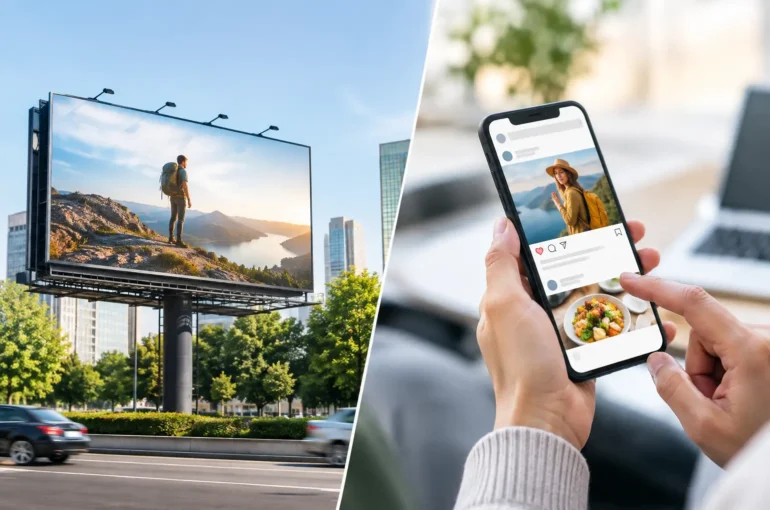
A thumb can dismiss a social ad in less than a second. A mobile billboard moving past a packed venue, busy retail strip or commuter route is much harder to ignore. That is the practical difference at the heart of outdoor media versus social ads: one competes for attention within a crowded feed, while the other places your message directly in the path of real people.
For Australian businesses and agencies, this is not a choice between old and new media. It is a question of campaign intent. Do you need to build broad local visibility, own a high-traffic area or create a visible event presence? Or do you need to reach a tightly defined audience and drive an immediate online action? The best answer is often both, but only when each channel has a clear job.
Outdoor Media Versus Social Ads: The Real Decision
Social advertising is built for audience selection. You can target by location, interests, behaviours, previous website visits and customer lists. It can be fast to launch, easy to adjust and effective for retargeting people who are already considering a purchase.
Outdoor media is built for public attention. A well-planned mobile billboard, digital screen, bike board or walking board takes a brand beyond the screen and into the places where customers shop, work, travel and gather. It creates repeated exposure in a defined physical area without asking anyone to follow an account, opt in or stop scrolling.
Neither format wins automatically. A local restaurant promoting a weekday offer may need social ads to serve menus and booking prompts to nearby diners. That same restaurant could use a mobile billboard around its precinct to make the venue feel familiar before people decide where to eat. A property launch, festival, sporting event or retail opening may gain more from dominating the streets around the action than from relying on a feed placement that disappears among hundreds of others.
Start with the outcome, not the channel. If your goal is visibility at a location, outdoor should be a serious part of the plan. If your goal is online conversions from a defined audience, social may take the lead. If you need both recognition and response, make them work together.
Attention Is Not the Same as an Impression
Social platforms report impressions, reach, video views, clicks and conversions. These metrics are valuable, but they do not always tell you how much attention an ad received. Autoplay video, rapid scrolling and ad fatigue can produce a reported impression without a memorable brand moment.
Outdoor works differently. A large-format message has to do its job quickly. People see it while driving, walking, waiting for public transport or arriving at an event. There is no tiny caption to read and no long explanation to absorb. That limitation is also its strength. Good outdoor creative is simple, bold and repeatable: a recognisable brand, one message, a clear offer or event date, and a visual that can be understood in seconds.
Mobile formats add another advantage: movement. Instead of waiting for the right people to pass a fixed site, a campaign can move through selected suburbs, retail areas, transport corridors and venue precincts. This helps brands concentrate visibility where the audience is likely to be, whether that is central Sydney during a product launch, the Gold Coast during school holidays, or regional centres supporting a statewide campaign.
The trade-off is clear. Social allows individual-level targeting, while outdoor creates shared public visibility. You cannot serve a mobile billboard only to people who abandoned a shopping cart. You can, however, make a whole area aware that your brand is active, present and worth noticing.
Target Geography, Not Just Demographics
Digital targeting is powerful when the customer profile is well defined. A business-to-business service can target job titles and industries. An ecommerce brand can retarget past visitors. A new app can test several audience groups before putting more budget behind the strongest result.
But many purchasing decisions are location-led. People choose a gym near home, a lunch spot near work, a display home in their growth corridor, or an event that is happening this weekend. In these cases, postcode-level targeting inside a social platform may not be enough to create local market presence.
Outdoor lets you own the moment and the place. A campaign can run around a shopping centre, near a stadium, through a nightlife precinct, along commuter routes or outside a trade show. Relocatable billboards and event screens can create an obvious physical focal point, while mobile digital billboards can follow a planned route through multiple high-value areas.
This is especially useful when campaigns need regional flexibility. Rather than coordinating separate suppliers in every market, brands can plan a consistent national rollout while adjusting routes and deployments for local conditions. Mobile Outdoor Media supports campaigns across Australian capital cities and regional areas, helping advertisers take the same core message into the streets where it matters.
Cost Should Be Measured Against the Job
Social ads can appear cheaper because they offer low entry costs and real-time budget controls. For a small test, a short promotion or a conversion-focused retargeting campaign, that flexibility is hard to beat. You can start small, assess results and change direction quickly.
Outdoor is not judged in the same way. Its value lies in conspicuous reach, frequency within a location and the authority that comes from being publicly visible. A bold mobile campaign outside an event or across key retail precincts can create a level of perceived scale that a small social budget may struggle to achieve.
The wrong comparison is cost per click versus the total cost of a billboard route. The better question is: what action are you asking each medium to deliver? If social is driving site visits and outdoor is building local awareness, each should be measured against its own role.
For outdoor, look at route quality, dwell areas, campaign hours, number of days, format size and proximity to the audience. For social, review reach quality, frequency, click-through rate, cost per lead and conversion outcomes. Keep the measurement honest. A campaign that generates clicks but no brand recall has a different problem from one that fills a precinct with visibility but has no simple way to respond.
Use Social to Amplify Outdoor
The strongest campaigns avoid treating outdoor and social as rivals. Outdoor gives social creative a real-world presence. Social gives outdoor a response path and an opportunity to continue the conversation.
Run the same visual campaign across both channels so customers recognise it immediately. Use outdoor to announce a launch, build anticipation near relevant locations and make the brand feel bigger than a single post. Then use social to retarget people in the campaign area, explain the offer in more detail and encourage booking, purchasing or enquiry.
Keep the message consistent, but do not force identical creative into every format. An outdoor message needs to be read at a glance. A social ad can carry product detail, testimonials, video or multiple frames. The shared elements should be the brand, campaign line, visual cue and call to action.
A QR code can work on outdoor when people are stationary, such as at an event, in a queue or near a pedestrian area. It is less useful on a fast-moving route. In those settings, choose a short web address, simple search prompt or memorable offer name instead. Make it easy for people to act later rather than expecting every exposure to create an immediate scan.
Choose the Format That Matches the Moment
Use social ads when you need precise audience selection, rapid testing, ecommerce conversion activity or retargeting. Use outdoor when you need high-impact local presence, repeated public exposure, event visibility or broad awareness around a specific area.
For a major launch, do not wait quietly in the feed and hope the right people stop scrolling. Put the message where the market can see it, then give that audience a relevant way to respond online. Plan the route, simplify the creative and make the campaign impossible to miss where it counts.