Click to Call

12 Event Display Ideas That Draw a Crowd
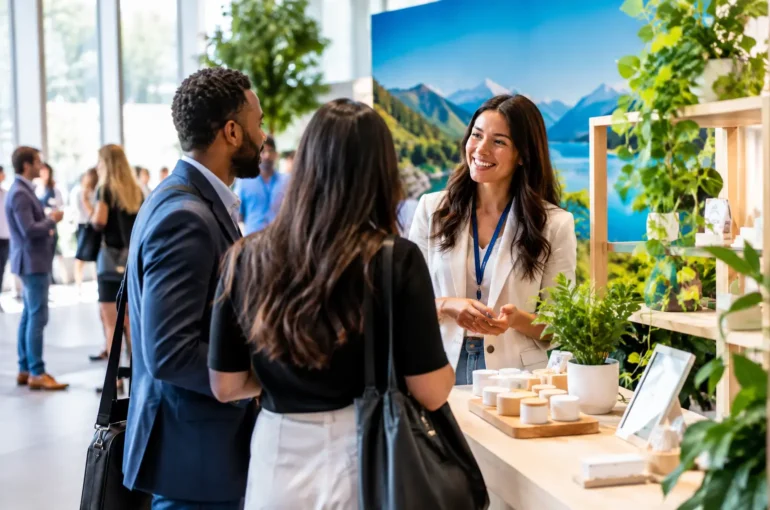
A busy event gives brands one hard-earned advantage: people are already gathered in the same place. The challenge is earning attention before they move on, check their mobile or join the next queue. The strongest event display ideas do not simply decorate a site. They put your message directly in the path of the crowd, repeat it often and give people a reason to look twice.
For a product launch, sporting fixture, festival, community day or multi-city promotion, start with the audience journey. Where do people arrive? Where do they wait? Which streets, entrances and gathering points carry the heaviest foot traffic? Build your display plan around those moments, then choose formats that can move with the action.
Event Display Ideas That Work Where Crowds Move
1. Put a digital screen at the entry point
The entrance is where anticipation is highest and signage is most useful. A large digital event screen can welcome attendees, run sponsor creative, promote session times and build anticipation before the main activity begins.
Keep the message simple. One brand, one offer or one clear call to action will land better than a screen crowded with small print. Rotate creative if the event runs all day, but ensure every frame can be understood in a few seconds.
2. Use mobile billboards to own the approach
Do not wait until people are inside the gates. Position mobile billboards on the main roads, near public transport hubs and around nearby retail precincts to catch attendees on their way in.
This approach also reaches people who are close to the event but have not bought a ticket. For public-facing campaigns, that wider street-level audience can be as valuable as the crowd inside. Routes, timing and approved stopping locations should be planned carefully, particularly around high-traffic venues.
3. Create a clear branded meeting point
Events can be confusing, especially when the site is large or the programme is packed. A branded meeting point gives people a useful reason to engage with your display. Think charging area, shade zone, information point or photo backdrop.
Make it visibly yours without making it hard to use. If the space solves a real attendee problem, people will stay longer and your branding earns more time in view. This is often a better investment than a static banner placed where nobody needs to stop.
4. Take the message into the crowd with bike boards
Bike boards are built for events with long walkways, multiple activity zones or crowds that spread beyond one central area. They turn a display into a moving piece of media, carrying your campaign through promenades, surrounding streets and high-footfall precincts.
They are particularly effective for time-sensitive messages. Promote a flash offer, direct people to a stand, announce a performance or keep a sponsor message circulating between programme changes. Movement creates repeat exposure without asking the audience to find you.
5. Make social content part of the display
A photo moment can work, but only if it is genuinely worth sharing. Avoid a generic branded wall with a logo repeated fifty times. Give the audience something visual, local or playful that connects to the event itself.
For example, a sports event might use a giant team-themed prop, while a food festival could create a bold colour-led installation around a tasting challenge. Keep the brand mark visible in the frame, then make the experience the hero. People share what makes them look good or gives them a story to tell.
6. Use walking boards for close-range promotion
Walking boards work best where the message needs a human presence and a specific location. Outside a venue, along a queue or beside a busy footpath, they can direct attendees towards an activation, retail offer or registration point.
Their value is precision. Unlike a fixed display, a walking board can respond to crowd flow throughout the day. If one entrance is quiet and another is busy, reposition the team. Brief them with a short, confident message and a clear understanding of where they can safely operate.
7. Turn waiting time into screen time
Queues are not ideal for attendees, but they are valuable media moments. People waiting for entry, food, merchandise or transport have time to absorb a message that would otherwise pass too quickly.
Deploy digital screens where permitted and run creative designed for the dwell time. Short video, countdowns, prize draws and event updates can all work. If your promotion includes a QR code, give people enough time to scan it and make sure the destination is mobile-friendly.
8. Build a display around a live moment
Static brand messaging can feel disconnected from a live event. Bring it into the programme with a screen takeover before a headline act, at half-time, during a prize draw or when a key speaker takes the stage.
The trade-off is that high-impact moments are often limited and can attract premium placement costs. Use them when the creative is strong enough to justify the attention. A simple brand line, launch reveal or competition mechanic usually outperforms a complicated corporate message.
9. Use relocatable billboards for longer campaigns
Some events run for several days, or return annually to the same precinct. Relocatable billboards can provide visible, sustained coverage around the site without locking your campaign into a permanent fixed location.
They suit event sponsors, property campaigns, ticket promotions and retail operators looking to capture event-driven traffic. Place them where people naturally slow down, such as approach roads, car park entries or pedestrian routes. Check sightlines from both directions and avoid artwork that relies on tiny detail.
10. Give sponsors a useful presence
If you are organising an event, sponsor displays need to feel like part of the experience rather than an interruption. A sponsor can support a hydration station, mobile-charging area, live score screen or family rest zone while receiving prominent exposure.
Set clear rules around logo size, screen rotation and exclusivity before selling packages. Sponsors want certainty about what they are buying. A defined display plan also protects the event from visual clutter, which can weaken every brand on site.
11. Plan creative for distance, speed and glare
The display format matters, but artwork can make or break its effectiveness. A design that looks sharp on a laptop may disappear from a moving vehicle or become unreadable in bright afternoon sun.
Use high-contrast colours, large type and a single focal point. Keep phone numbers, web addresses and lengthy copy to a minimum. For mobile formats, assume the audience has only a few seconds. For screens near a queue or activation, you can afford slightly more information, but not a wall of text.
12. Extend the event footprint beyond the venue
The best event displays do not stop at the fence line. Target nearby hospitality strips, transport connections, accommodation areas and major routes that carry people before and after the event.
This matters for brands that want more than on-site impressions. A mobile campaign can create familiarity before attendees arrive, reinforce the message during the event and keep it visible as crowds leave. Mobile Outdoor Media can coordinate this kind of street-level coverage across Australian cities and regional locations, helping campaigns stay consistent while responding to local conditions.
How to Choose the Right Event Display Mix
There is no single winning format for every event. A compact community activation may benefit from walking boards, bike boards and a small digital screen near the main activity. A major sporting event may need mobile billboards on approach routes, large event screens inside the precinct and sponsor displays placed around dwell areas.
Start with three decisions: where the audience will be, how long they will have to see the message and what action you want them to take. Brand awareness needs scale and repetition. A stand visit needs directional signage and proximity. Ticket sales, offers or registrations need a simple response path that works on a mobile.
Budget should shape the mix, not reduce the campaign to the cheapest available sign. One well-routed mobile billboard supported by targeted bike boards can outperform several poorly placed static displays. Equally, a large screen is a strong choice when the crowd gathers in one place and has time to watch.
Make the Display Earn Its Space
Event space is valuable, and audiences can spot empty branding from a distance. Give your display a job: direct people, entertain them, solve a practical problem, trigger a response or keep your name in sight as they move through the day.
Plan early, match the format to the crowd and put the message where people cannot miss it. When the event moves, your advertising should be ready to move with it.