Click to Call
Digital Bike Advertising That Owns Busy Streets
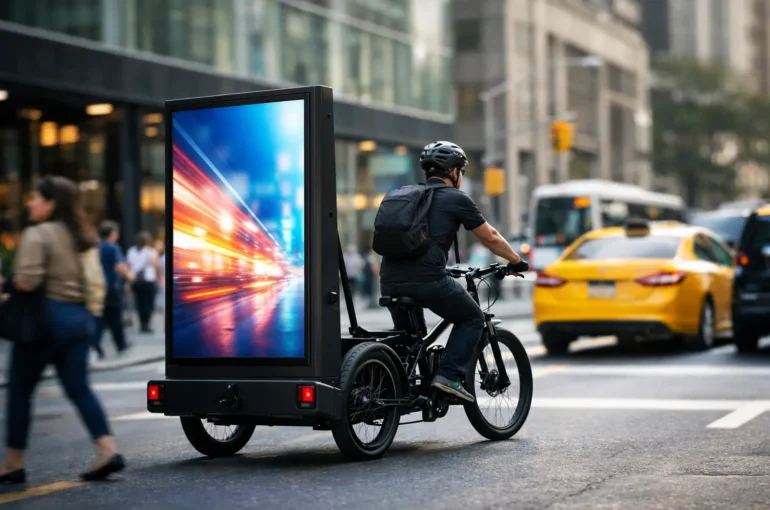
A shopper leaving the station, a lunch crowd moving through a CBD laneway, fans queuing outside a stadium – these are moments when digital bike advertising puts your message directly in the path of attention. Instead of waiting for people to notice a fixed sign, a mobile screen carries your campaign through the places where your customers are already walking, gathering and spending.
For Australian brands that need local visibility without being locked into one billboard site, digital bike boards offer a practical way to take over a precinct, support an event or build repeated exposure around a targeted route. They are highly visible, flexible and built for busy pedestrian environments.
What digital bike advertising does differently
Digital bike advertising combines a bright digital display with the movement and street-level presence of a branded bike. The result is an outdoor format that works at human scale. People see it while waiting for coffee, walking between shops, crossing a forecourt or joining an event crowd.
That proximity matters. Large roadside formats are designed for passing traffic and long viewing distances. Digital bike boards are designed for close-range engagement in high-footfall areas. A campaign can move through retail strips, dining precincts, university areas, transport hubs and event approaches, delivering the same creative repeatedly across the day.
The screen also gives advertisers more control than a printed-only board. Run multiple messages, rotate offers, promote time-sensitive information or update creative between campaign days. For a product launch, this can mean a sequence of brand, product and call-to-action messages rather than one static execution.
Put the format where it earns attention
The strongest digital bike advertising campaigns begin with a clear location objective. “We want exposure” is not enough. Decide who you need to reach, when they are most likely to be out and where the campaign can meet them.
A hospitality venue may want a bike board circulating nearby streets during lunch and after-work trade. A property developer may focus on village centres, commuter routes and weekend inspection corridors. An event promoter may deploy around transport interchanges, nearby retail zones and queues in the hours before gates open. A national retailer can adapt route plans city by city while keeping the same campaign look and offer.
This is where mobile outdoor media earns its place in a broader campaign. You can concentrate presence around a defined area rather than spreading budget across fixed locations that may only partly match your audience. It is location ownership with the ability to move when foot traffic moves.
Timing is equally important. A bike board travelling through a business district at 8 am, 12.30 pm and 5 pm reaches different crowd behaviours without leaving the same central area. Weekend activity shifts towards markets, sporting grounds, shopping centres and entertainment precincts. Match the route to the audience’s real-world routine, not just a suburb boundary on a map.
Build creative for a moving, close-up screen
A digital bike board is not the place for a crowded press ad. Pedestrians may be close to the screen, but attention is still brief. The best artwork is immediate: one key visual, a short headline, a recognisable brand and a clear next action.
Make the offer easy to absorb in a glance. “Grand Opening This Saturday”, “Scan for 20% Off”, “Now Leasing”, or “Tickets On Sale” can do more work than a paragraph of product claims. Use strong contrast, large type and imagery that still makes sense when someone sees it from a few metres away while walking past.
If the campaign uses several frames, give each one a job. The first frame should establish the brand. The next can show the offer or product benefit. A final frame can carry a QR code, website address or simple instruction. Keep codes large enough to scan safely from a sensible stopping distance, and never make the campaign depend on scanning alone. The core message must stand on its own.
There is a trade-off with rotating creative. More frames can tell a fuller story, but too many can dilute recall if people only catch one message. For a short campaign or a fast-moving route, fewer, stronger frames are usually the better choice.
Choose routes that create repetition, not just kilometres
A long route can sound impressive on paper, yet distance alone does not guarantee impact. The goal is to travel where the right people will actually see the display, then return often enough to be remembered.
A tighter circuit around a shopping precinct may outperform a broad trip across several suburbs if the campaign is trying to drive nearby store visits. Likewise, an event route should prioritise arrival points, food and beverage areas, queue zones and nearby gathering places rather than simply circling the wider neighbourhood.
Plan routes around practical street conditions too. Footpath access, pedestrian density, roadworks, weather, local permissions and event operations all affect how a deployment runs. A capable provider will shape the route around real conditions and make adjustments when the street environment changes.
For multi-city campaigns, consistency needs to sit alongside local knowledge. The message may be identical in Brisbane, Sydney, Melbourne and Perth, but the best precincts, peak trading periods and event movements will differ. Mobile Outdoor Media can coordinate this national execution while applying local route planning where it counts.
Use digital bike boards to support bigger campaign moments
Digital bike advertising works well as a standalone local activation, but it is particularly effective when it reinforces a larger campaign. Pair it with mobile billboards near major traffic corridors, event screens at a venue, social activity or in-store promotions, and the public sees the same message across multiple moments of their day.
For example, a fitness brand running a new-location launch could use mobile billboards to establish broad awareness, then send digital bike boards through surrounding retail and commuter areas with a limited-time joining offer. The large format creates reach; the bike boards deliver frequency close to the point of action.
It also gives campaign managers a useful tactical layer. If an event sells faster than expected, screen messaging can switch from general awareness to final-release tickets. If wet weather pushes foot traffic towards covered shopping areas, a route can be redirected to match. Fixed outdoor has clear strengths, particularly for long-term landmark presence, but it cannot make those same location adjustments.
Measure against the job the campaign was hired to do
Outdoor advertising is not judged by one number alone. A brand-building campaign may prioritise sustained visibility in a high-value precinct. A retail offer may look for QR scans, redemption codes, website visits or uplift in local store traffic. An event campaign may measure ticket sales by geography and time period.
Set the measurement plan before deployment. Use a campaign-specific code or landing page where appropriate, and make sure frontline teams know the offer is live. Compare trading patterns with relevant previous periods, while allowing for variables such as weather, public holidays, competing events and promotions.
Do not reduce the format to scans alone. A large share of outdoor value is repeated visual recognition: people noticing the name, remembering the promotion and seeing the brand again later when they are ready to act. Digital bike boards are especially useful for creating that familiarity around a place people visit often.
When digital bike advertising is the right fit
This format is a strong choice when pedestrian density is high, geographic targeting matters and the message can be understood quickly. Retail openings, food and beverage promotions, entertainment launches, exhibitions, property campaigns, local services, sports activations and community events are all natural fits.
It may be less suitable when the audience is primarily travelling at high speed on motorways, when the message requires detailed explanation, or when long-term presence at one exact location is the main goal. In those cases, a digital mobile billboard, static placement or a combined format may be a better investment.
The smart question is not whether a bike board can go everywhere. It is where a moving screen will create the most useful attention for your brand. Put a clear message in the right precinct, run it when the crowd is there and give people a reason to remember what they saw.